
Boquerones en Vinagre
Learn to prepare classic Boquerones en Vinagre, a refreshing Spanish tapa featuring marinated anchovies.
Contents (5 sections)▾
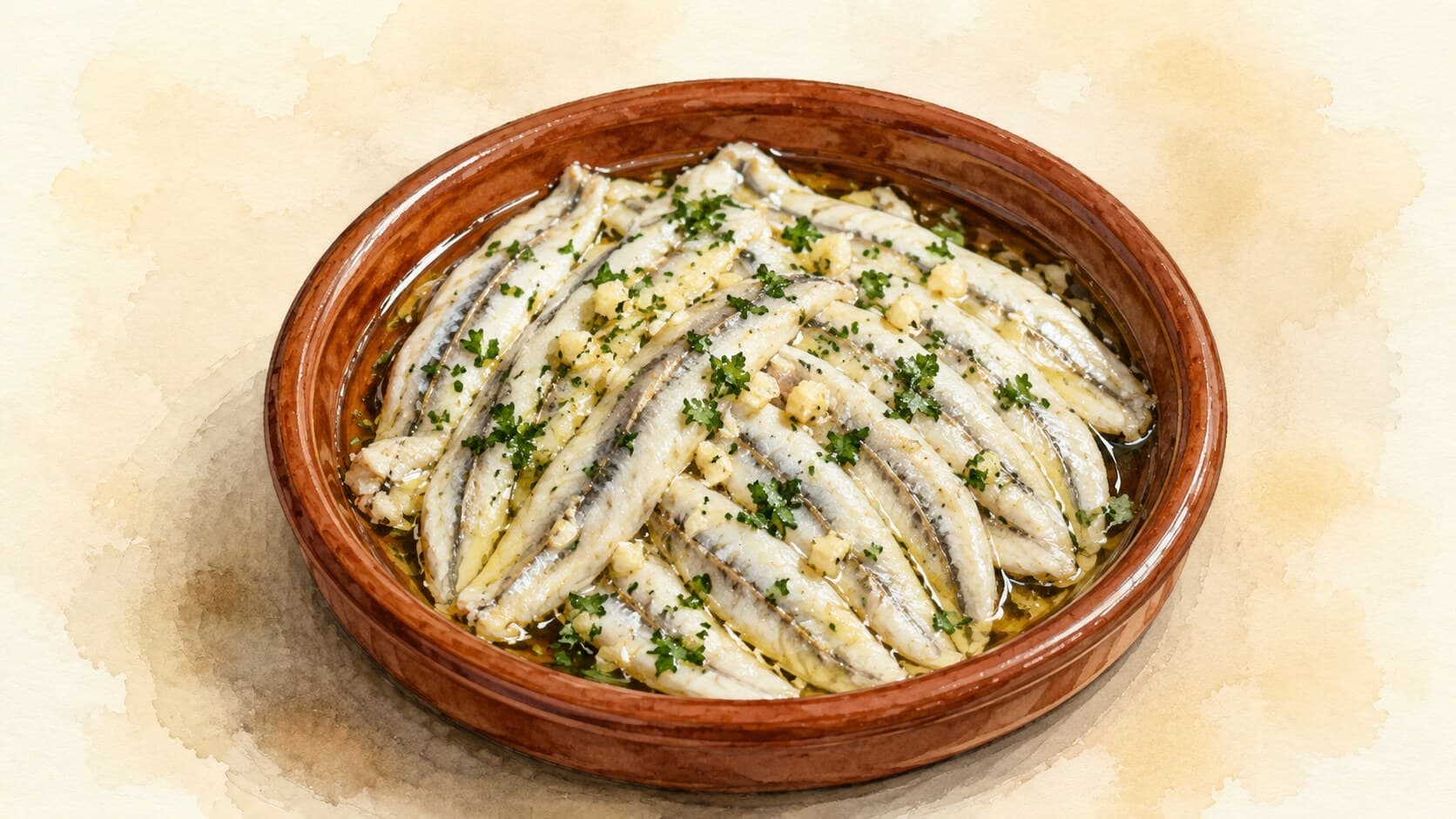
Ingredients
- 500 g fresh small anchovies
- 250 ml white wine vinegar
- 100 ml extra virgin olive oil
- 2 clove(s) garlic, thinly sliced
- 1 sprig(s) fresh parsley, chopped
- Salt to taste
Steps
Clean the anchovies by removing heads and guts, then rinse under cold water.
Butterfly the anchovies by gently opening them along the spine.
Place the butterflied anchovies in a shallow dish and cover them with 250 ml of white wine vinegar. Let them marinate for 2-3 hours in the refrigerator at 4°C until the flesh turns opaque-white.
After marinating for 2-3 hours, drain the anchovies and pat them dry with paper towels to remove excess vinegar.
In a serving dish, arrange the anchovies in a single layer, then drizzle with 60 ml of olive oil and sprinkle with 2 cloves of minced garlic and 2 tablespoons of chopped parsley.
Serve immediately or allow to chill for another hour at 4°C to enhance the flavors.
Why this works
The technique of marinating anchovies in white wine vinegar preserves the fish and transforms its flavor and texture. The acetic acid in the vinegar effectively 'cooks' the anchovies, turning the flesh opaque and firming it up without heat. This acid-curing process is crucial for achieving the characteristic taste of Boquerones en Vinagre. If the anchovies seem too salty after marinating for 2-3 hours, rinse them briefly in cold water for about 30 seconds to balance the flavor before dressing them. Additionally, the garlic and parsley not only add freshness but also complement the briny anchovies beautifully, enhancing the overall dish. Properly prepared, this tapa is a delightful addition to any Spanish meal and is best served chilled, ideally with a crusty bread or alongside olives. A well-executed boquerones will have a glossy appearance, indicating that the oil has successfully coated the fish. The precise timing and temperature ensure that the anchovies achieve the perfect texture, making them a standout appetizer.
Safety note. Boquerones en vinagre are not cooked with heat — the flesh is denatured by the acid in the vinegar. For parasite safety, the small fresh anchovies must be frozen at -20 °C for at least 7 days before the cure begins; this is the standard regulatory step that any Spanish fishmonger labels their fresh boquerones with. If you cannot buy commercially-frozen-to-spec boquerones, freeze them yourself to that spec, or skip the dish. Acid alone does not kill Anisakis parasites.
Common mistakes
Trusting the vinegar to make raw anchovies safe.
Target: Freeze the fresh anchovies first — at −20 °C for at least 7 days (or buy fish commercially frozen to that spec) — before any curing begins.
Why it matters: This is the non-negotiable one. The acid in vinegar firms and whitens the flesh, but it does not kill Anisakis, the parasite found in raw sea fish. Only a proper deep-freeze does. Vinegar alone is a texture step, never a safety step.
What to do: Freeze to spec first, thaw in the fridge, then cure. If you can't freeze the fish to that standard and can't buy it pre-frozen, don't make the dish.
Curing whole, thick, or uneven fillets.
Target: Butterfly the anchovies thin and lay them in an even single layer so every fillet is the same modest thickness.
Why it matters: The cure works by acid soaking inward from the surface (denaturing the protein — the same firming-and-whitening that heat would do, but cold). A thick or folded fillet stays raw and translucent in the middle while the outside turns over-cured, so the texture is uneven.
What to do: Open each fish flat along the backbone, keep the fillets a uniform thinness, and arrange them in one layer so the vinegar reaches all of them equally.
Leaving them in the vinegar too long.
Target: Cure just until the flesh turns opaque-white all the way through — for thin fillets, on the order of a couple of hours in the fridge, not all day.
Why it matters: Acid keeps "cooking" the fish the whole time it sits. Past the point of just-set, the proteins tighten too far: the anchovies go chalky and dry and the flavor turns harshly sour instead of bright.
What to do: Check the color, not just the clock. The moment the centers lose their raw translucency, drain them, pat dry, and dress with oil — the olive oil coating also slows any further acid action.
Curing at room temperature.
Target: Keep the fish cold (around 4 °C / fridge temperature) for the entire cure.
Why it matters: Acid firms the proteins but does not sterilize, so warm fish is an invitation for bacteria to grow during the hours-long soak. Cold keeps the fish safe and also makes the cure more even and gradual.
What to do: Cure in the refrigerator in a covered dish, and return the finished, oil-dressed anchovies to the fridge until you serve them.
What to look for
- Flesh that has turned from glassy and translucent to a solid opaque white, edge to edge. That even whiteness is how you read "done" — any grey, glassy, or still-translucent streak in the center means it needs a little longer.
- Fillets that are firm and hold their shape but still feel tender, not stiff. A gentle resistance is right; if they feel hard, dry, or chalky, the acid has gone too far.
- A clean, bright-sour smell — sharp but not harsh. Fresh, properly frozen-then-cured anchovies smell of the sea and clean vinegar; a strong "fishy" or off odor means the fish wasn't fresh enough to use raw, so discard it.
- A glossy sheen once the olive oil goes on. When the drained fillets are evenly coated and shining, the oil has sealed them; a dull, dry surface wants a little more oil to protect the flesh and round out the sharp acid.
A note on history
Boquerones en vinagre belongs to Andalusia, in southern Spain, and grows out of an ancient Mediterranean habit of preserving small fish in salt and vinegar — a practice tied to the fishing settlements of the region's Phoenician past around cities such as Cádiz (founded as Gádir roughly 1100 BC). Curing fish this way both extended its shelf life before refrigeration and made the most of the fresh anchovies that are abundant along the Andalusian coast (Wikipedia; Visit Southern Spain).
Get the essays in your inbox — free
Weekly notes on flavor, fermentation, and food history — the writing behind the Atlas of Flavor. No spam; unsubscribe anytime.