
Bánh Xèo (Sizzling Vietnamese Crêpes)
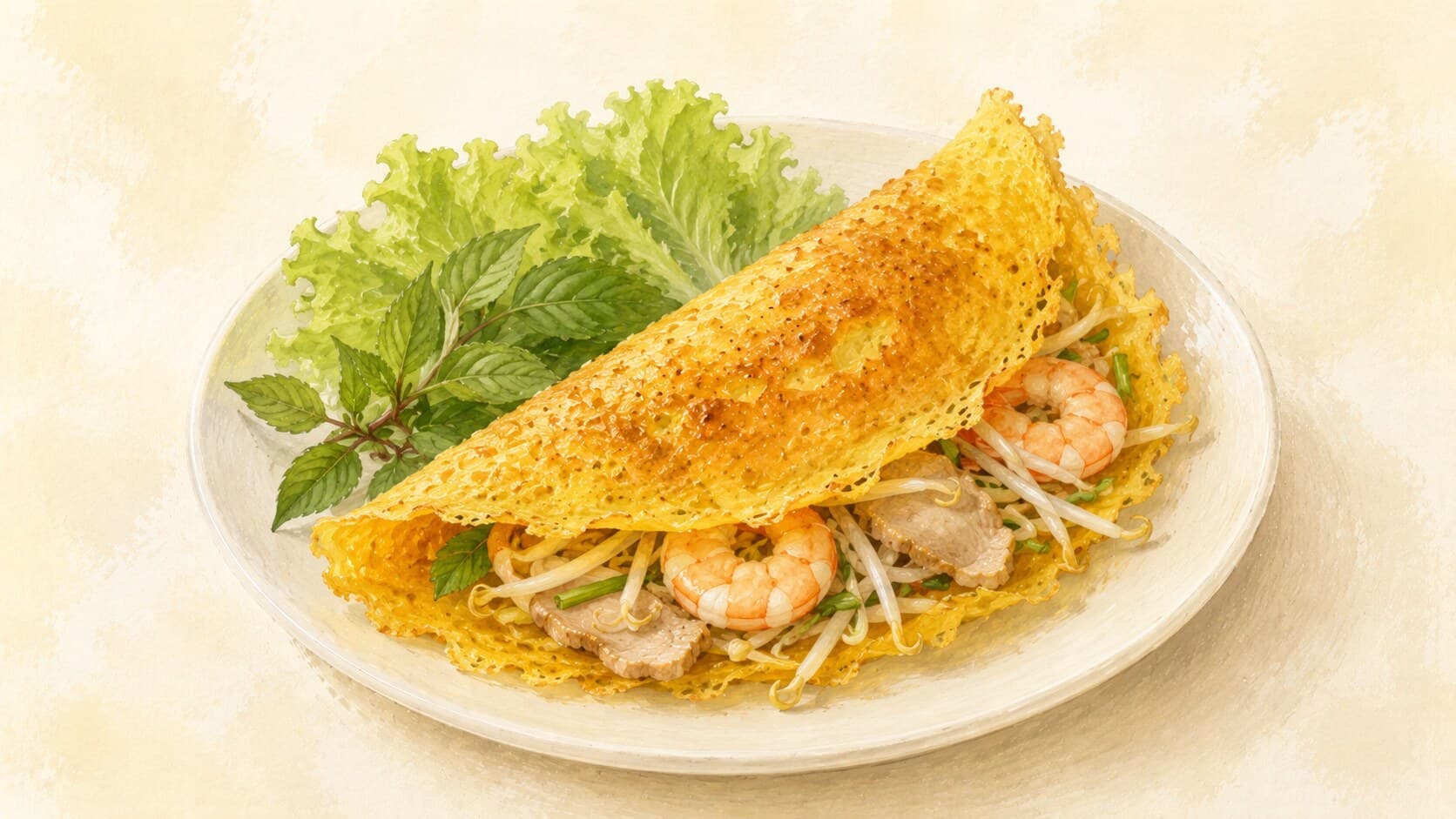
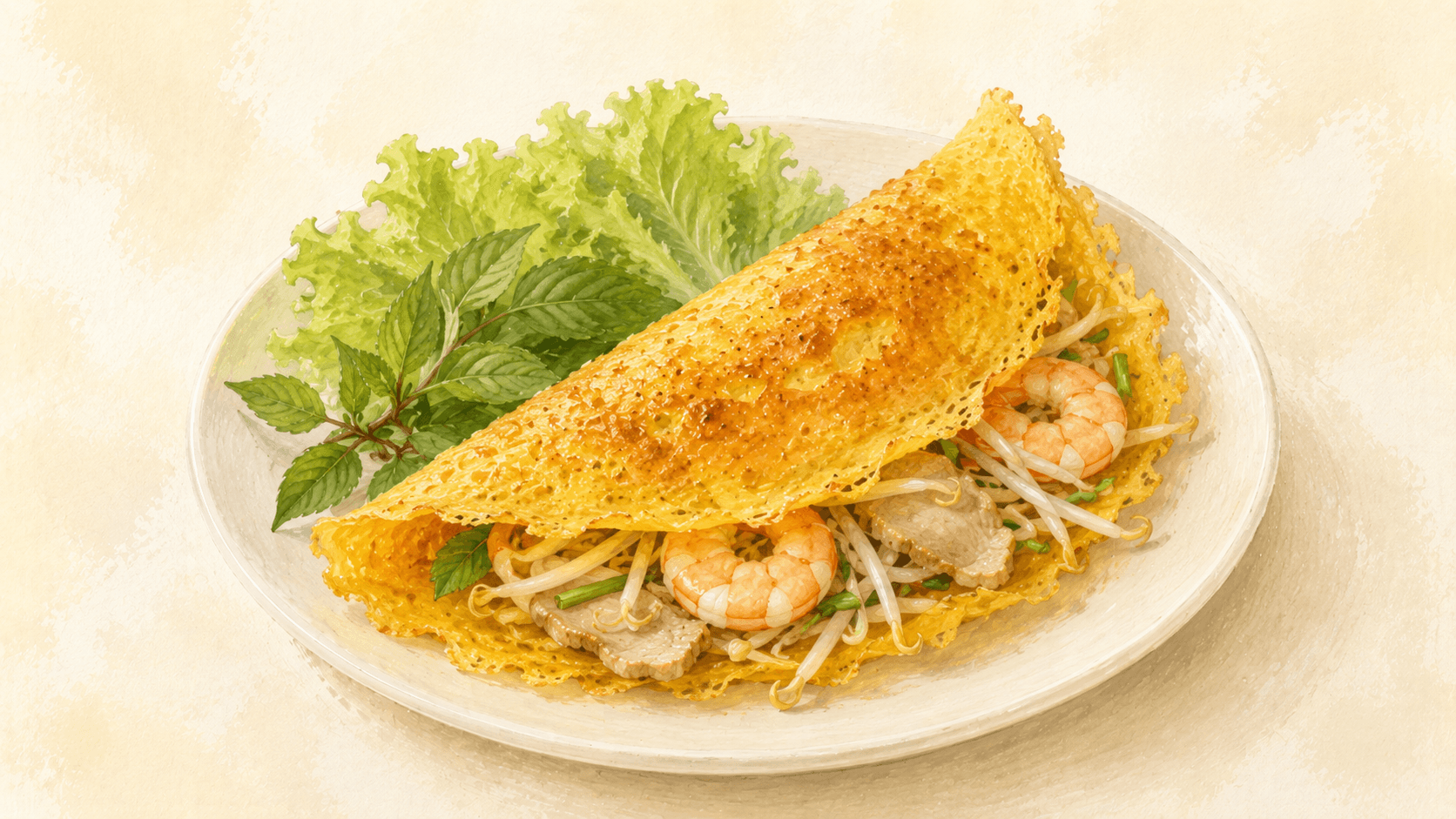
A rice flour batter with coconut milk, diluted and turmeric-yellow, cooked in very hot oil until it shatters. Bánh xèo is not a crêpe — it is a crisp shell of dried batter that happens to be thin.
Contents (8 sections)▾
Ingredients
- 200 g rice flour
- 1 tsp turmeric powder
- 400 ml coconut milk (thin, or thick diluted with water to thin consistency)
- 100 ml water
- 2 spring onions, thinly sliced
- 200 g pork belly, thinly sliced (filling)
- 200 g raw shrimp, peeled (filling)
- 200 g bean sprouts (filling)
- 2 tbsp neutral oil for frying
- Lettuce leaves, perilla/shiso, mint (for wrapping)
- Nước chấm for dipping: fish sauce, lime juice, sugar, warm water, garlic, chili
Steps
Mix batter: whisk rice flour, turmeric, coconut milk, and water until completely smooth. Stir in spring onions. Rest minimum 30 minutes (1 hour is better). The rest allows rice flour to fully hydrate and the batter to relax — a freshly mixed batter tears when spread.
Heat a 25–28 cm nonstick or carbon steel pan until very hot. Add 1 tbsp oil and swirl to coat the pan. The oil should shimmer and almost smoke immediately.
Pour in just enough batter to coat the pan thinly — tilt and rotate quickly to spread before it sets. The audible sizzle (the xèo) should be immediate and aggressive. If it is quiet, the pan is not hot enough.
Scatter pork belly slices and shrimp over one half of the crêpe. Add a handful of bean sprouts. Cover with a lid for 2–3 minutes — this steams the filling while the base continues to set.
Remove the lid. The edges should be pulling away from the pan and turning deep golden. Cook uncovered another 2–3 minutes until the base is crisp and the edges are thin and shatteringly brittle. Do not rush this step.
Fold the empty half over the filled half and slide onto a plate. The crêpe should feel light and dry, not oily or damp.
To eat: tear a piece of crêpe, wrap in a lettuce leaf with fresh herbs, dip in nước chấm.
Tools you'll want
Why this works
Bánh xèo is misnamed in most English-language recipes as a "crêpe." The word crêpe implies softness, delicacy, a pliable thin skin. The correct bánh xèo is none of these things. At its best, it is a rigid golden shell, shatteringly crisp at the edges, that happens to be thin. The difference comes down to how the batter behaves under extreme heat with fat.
The rice flour batter is significantly more dilute than a French crêpe batter — the high proportion of coconut milk and water relative to flour means there is very little protein or starch to form structure. When this batter hits an extremely hot, oiled pan, two things happen simultaneously: the water vaporizes rapidly (producing the explosive sizzle that names the dish), and the starch and coconut fat cook down into a thin, lacquered layer rather than a supple one. The high heat drives off moisture fast enough that the edges of the crêpe never have time to become pliable. They dry before they can bend. This is the mechanism behind the shatteringly brittle edge texture that defines a good bánh xèo.
The turmeric (a bright-yellow ground spice from a root, used here mostly for color) serves two functions. It is partly flavor — a mild earthiness and slight bitterness that works well with the coconut milk. But primarily it is visual: the bright yellow color is the indicator that you are eating a Vietnamese crêpe, not a French one. The color is also a heat indicator — a pale bánh xèo tells you the pan was not hot enough; a deep golden-amber tells you the batter was properly browned.
The lid goes on for the filling phase and comes off for the finishing phase. The logic: the pork belly and shrimp need steam heat to cook through without burning, since direct pan heat at that temperature would char the exposed surface. The lid creates a trapped-steam environment. But once the filling is cooked, the lid comes off so the remaining moisture can escape — this final open phase is where the base finishes drying and crisping. The crêpe should be completely dry, not steamed-wet, before you fold and slide it out.
Common mistakes
Insufficient pan heat.
Target: Pan hot enough that water droplets vaporize in 1 second. Almost smoking.
Why it matters: Cool pan produces soft, gummy bánh xèo that sticks, tears on folding, and never develops the brittle edge. The high heat is what creates the shatter — the dish's defining texture.
What to do: Pre-heat for at least 5 minutes on max heat. Sizzle-test before adding oil. Drops should vaporize instantly.
Workarounds:
- Weak burner? Cast-iron skillet pre-heated for 10 minutes in a 230 °C oven, then transferred to the burner.
Too much batter per crêpe.
Target: Just enough batter to coat the pan in a thin layer (about 1/3 cup for a 28 cm pan).
Why it matters: The goal is maximum thinness — extra batter means the center stays wet/undercooked while edges burn trying to crisp. A light, swift tilt right after pouring is the technique.
What to do: Pour less than you think. Tilt the pan immediately to spread.
Workarounds:
- If batter pools, scrape excess back into the bowl with a spatula and try again.
Skipping the batter rest.
Target: Rest mixed batter for 30 minutes minimum, 1 hour ideal.
Why it matters: Rice flour hydrates slowly — freshly mixed batter tears when spread because the starch hasn't fully swelled. Resting allows full hydration and produces a workable, stretchable batter.
What to do: Mix the batter first thing. Rest covered in the fridge while you prep other ingredients.
Workarounds:
- Short on time? At least 20 minutes makes a noticeable difference.
Removing the lid too early.
Target: Cover for 1.5–2 minutes to steam-cook the filling (shrimp pink, pork belly white throughout).
Why it matters: The filling — especially pork — needs steam to cook through. Pulling the lid early leaves raw pork under a cooked crêpe surface.
What to do: Lid on. Wait for visual cues: shrimp pink, pork edge white. THEN remove lid for the final crisping.
Workarounds:
- For pre-cooked fillings (cooked pork or shrimp), the steam phase can be shorter (45 seconds).
Rushing the final crisp.
Target: After removing lid, allow 2–3 minutes uncovered until edges are visibly dry and crisp.
Why it matters: This phase tests patience — the crêpe looks done but edges aren't yet "shatter crisp." The correct texture cracks when you break off a piece, not flexible.
What to do: Watch the edges. When they pull away from the pan and look dry, fold in half and serve.
Workarounds:
- For oven crisping, transfer the cooked crêpe to a 220 °C oven for 3 minutes after pan cooking.
What to look for
- The batter consistency: thin enough to pour and flow easily across the pan; roughly the texture of a light cream — not thick like pancake batter.
- The pan before pouring: a drop of water evaporates in under one second. This is the go signal.
- The crêpe 30 seconds after pouring: edges already beginning to turn opaque and pull slightly from the pan walls. If the whole surface is still liquid, heat too low.
- During the lid phase: steam visible when you lift the lid slightly; shrimp turned pink, pork belly white.
- The edges at the end: deep golden to amber, pulling visibly away from the pan, thin enough to be translucent. Run a spatula underneath — it should slide freely.
- After folding: the crêpe holds its shape and feels light and dry. If it deflates or feels heavy, it retained too much moisture.
Chef's view
The first time I made bánh xèo in my HCMC apartment, I used a nonstick pan that I had preheated for what I thought was long enough. The crêpe stuck, tore on folding, and was soft and slightly gummy in the center. The pan had not been hot enough. The second attempt, with the pan preheated until a visible haze formed above the oil, produced a crêpe that crackled when I folded it. That sound is the benchmark.
What bánh xèo demonstrates clearly is that technique — specifically pan temperature management — is the entire dish. The batter is simple. The filling is simple. The sauce is simple. The execution of getting maximum heat into the batter for maximum crispness is not. It took me three or four attempts before the edge texture was consistently right. The pan must be hotter than feels comfortable for a crêpe application.
Chef Test Notes
I tested batter-to-liquid ratios with the same rice flour base:
- Standard ratio (200 g flour : 500 ml liquid): The recipe above. Best balance — thin enough to crease and fold without shattering the whole crêpe, but with edges that genuinely crack.
- More dilute (200 g flour : 600 ml liquid): Edges were more dramatically lacy and the crêpe was more fragile. Harder to handle without breaking. Spectacular if you can manage it.
- Less dilute (200 g flour : 400 ml liquid): Edges stayed softer; the center was acceptable but the crêpe lacked the brittle quality. More like a thick rice pancake than a bánh xèo.
I also tested pan material:
- Nonstick pan: Reliable, requires less oil. The batter slides off easily. Lower maximum surface temperature — the pan cannot hold as much heat as carbon steel.
- Carbon steel pan: More difficult to use, more oil needed, but reaches higher temperatures and produces better crisping. The edge texture is noticeably more brittle compared to nonstick. Requires seasoning and careful temperature management to prevent sticking.
A note from HCMC
In the Mekong Delta version, specifically around Cần Thơ, the crêpes are larger than a dinner plate and cooked in wide, shallow clay pans over wood fire at outdoor tables at dusk. The name "bánh xèo" means "sizzling cake" — onomatopoeic, from the sound the batter makes when it hits the pan. When you hear it, the dish is explaining itself. In HCMC, the city version is slightly smaller and faster; but the sizzle is the same sound and the eating logic — wrap, dip, eat with hands — is unchanged from the delta version.
Related glossary terms
- Maillard reaction — the browning of the rice-coconut batter on an extremely hot surface is Maillard and caramelization; it produces the golden color and the characteristic crackled edge.
- Heat control — bánh xèo is a direct application of pan-temperature management; the crêpe is a real-time record of whether the heat was right.
- Emulsion — the coconut milk in the batter is already an oil-in-water emulsion; heating it rapidly drives off the water and leaves behind the coconut fat as a lacquering layer.
Get the essays in your inbox — free
Weekly notes on flavor, fermentation, and food history — the writing behind the Atlas of Flavor. No spam; unsubscribe anytime.