
Tom Yum Goong
This iconic Thai soup balances sour, spicy, and savory flavors with a harmonious blend of ingredients.
Contents (5 sections)▾
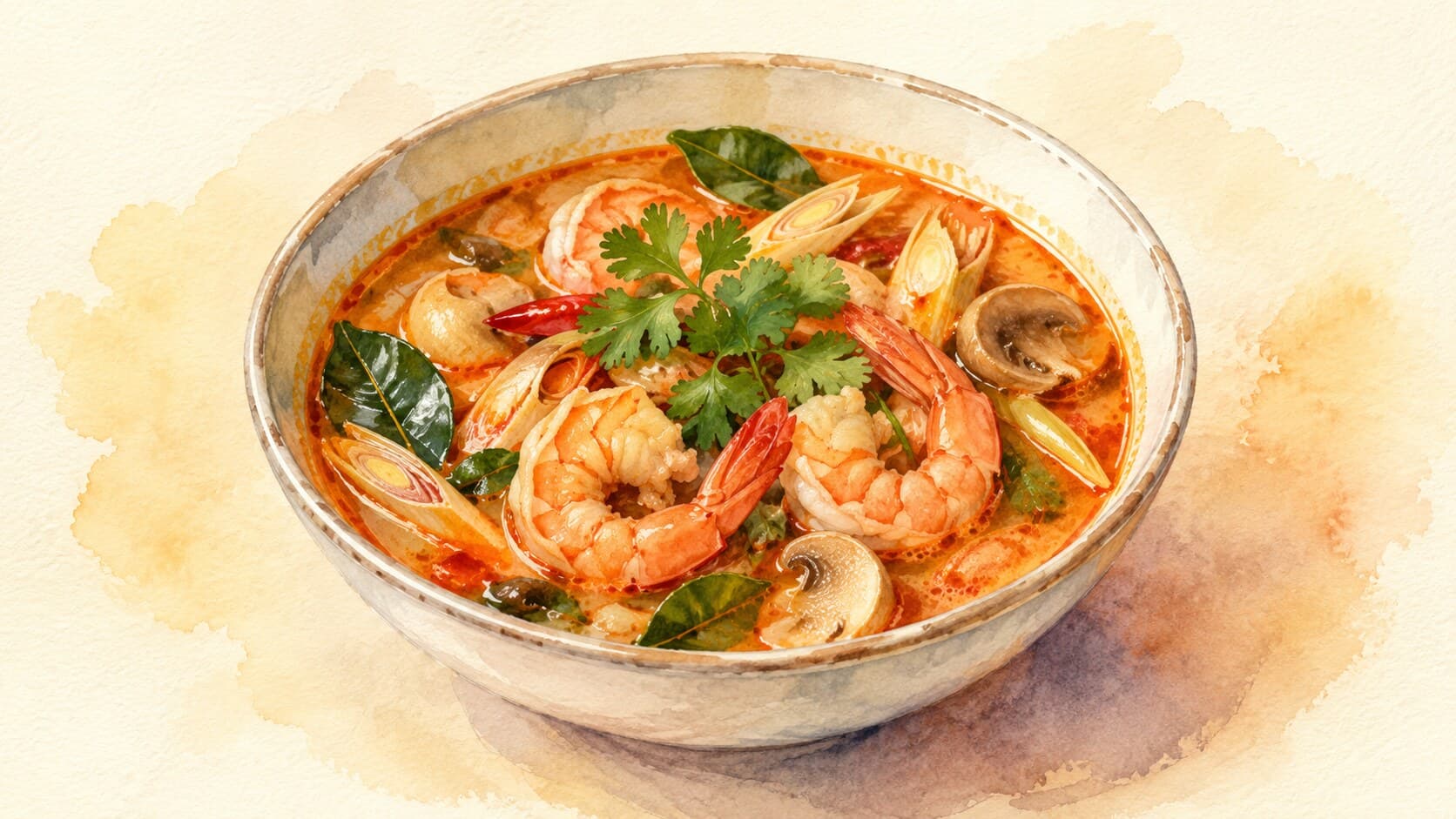
Ingredients
- 4 cups chicken or vegetable broth
- 200g shrimp, peeled and deveined
- 2 stalks lemongrass, cut and smashed
- 4-5 kaffir lime leaves, torn
- 3-4 slices galangal (or ginger)
- 2-3 Thai bird's eye chilies, smashed
- 200g mushrooms, sliced
- 2-3 tablespoons fish sauce
- 1 tablespoon lime juice
- 1 teaspoon sugar
- Fresh cilantro for garnish
Steps
In a pot, bring the broth to a boil.
Add lemongrass, kaffir lime leaves, galangal, and chilies; simmer for 5 minutes.
Stir in shrimp and mushrooms; cook until shrimp are pink.
Season with fish sauce, lime juice, and sugar; adjust to taste.
Serve hot, garnished with fresh cilantro.
Tools you'll want
Why this works
Tom Yum Goong achieves its signature flavor through a balance of ingredients. The broth's base is critical; using a good quality chicken or vegetable broth enhances umami. Lemongrass, kaffir lime leaves, and galangal contribute distinct aromatic notes. Simmering these ingredients releases essential oils, infusing the broth.
Cooking the shrimp just until pink ensures a tender texture. Overcooking can lead to rubbery shrimp. Adding lime juice and fish sauce toward the end preserves their fresh flavors. The sugar counterbalances the soup's acidity, creating a well-rounded taste.
The dish's heat comes from bird's eye chilies, which should be smashed to release their oils. Adjusting the chili quantity allows for customization of spice levels. The final garnishing with cilantro adds a fresh herbal note that brightens the soup.
Common mistakes
Substituting ginger for galangal (a Thai root, related to ginger but firmer and paler, with a pine-and-citrus aroma).
Target: Fresh galangal (Thai: kha) — recognizable by its smoother, paler, harder rhizome compared to ginger.
Why it matters: Galangal and ginger are NOT interchangeable. Galangal has a sharp, pine-citrus quality that defines Tom Yum's flavor. Substituting ginger produces a soup that's pleasant but distinctly Chinese rather than Thai.
What to do: Source from Asian grocery stores. Slice thinly across the grain — fibrous, so don't try to mince.
Workarounds:
- Frozen galangal works almost as well as fresh — keeps for months.
- No galangal at all? Use lemongrass alone in greater quantity. Will not equal galangal but produces a defensible variation.
Boiling the aromatics for too long.
Target: Lemongrass, galangal, kaffir lime leaves added at the start, simmered 5–7 minutes only before adding shrimp.
Why it matters: These aromatics yield their volatile oils quickly in the first few minutes. Beyond 10 minutes of simmering, you start extracting bitter compounds from the fibrous tissue, especially from lemongrass stalks.
What to do: Simmer aromatics briefly, then strain them out OR leave them in but eat around them (the traditional way).
Workarounds:
- For maximum aroma, bruise the lemongrass with a knife handle before adding — releases more oil.
- For a milder, clearer broth, strain the aromatics out before adding shrimp.
Adding fish sauce and lime juice too early.
Target: Fish sauce in the last 2 minutes; lime juice in the final 30 seconds, off-heat.
Why it matters: Both ingredients are volatile under heat. Fish sauce overheated becomes flat and aggressively salty without its umami depth. Lime juice boiled loses its fresh acidity and develops a metallic bitterness.
What to do: Add at the end. Taste, adjust, serve immediately.
Workarounds:
- For leftover Tom Yum (next day), refresh with a squeeze of fresh lime before reheating — the boiled-out acidity won't come back.
- If you over-added fish sauce, balance with extra lime + a pinch of sugar.
Skipping the chili paste (nam prik pao, a Thai roasted-chili jam with shallot, garlic, and tamarind — smoky, sweet-spicy, salty).
Target: 1–2 tbsp Thai chili paste added at the end (the "Tom Yum Naam Khon" creamy version uses this; the "Naam Sai" clear version omits it).
Why it matters: Nam prik pao is what gives traditional Tom Yum its red-orange color, smoky depth, and complex sweet-spicy roundness. The version without it (Naam Sai) is also legitimate, but distinctly thinner.
What to do: Buy a jar from an Asian market. Adjust the amount to taste — it's spicy, sweet, and salty all at once.
Workarounds:
- Quick approximation: 1 tbsp tomato paste + 1 tsp sambal oelek + 1 tsp sugar + 1 tsp fish sauce, briefly heated together.
- For a creamy version without nam prik pao, add 2 tbsp coconut milk at the end.
Overcooking the shrimp.
Target: Shrimp added in the final 90 seconds — pull from heat the moment they curl into "C" shape and turn pink.
Why it matters: Shrimp goes from "perfect" (tender, sweet, juicy) to "overcooked" (rubbery, dry) in 30 seconds. Tom Yum's hot broth continues cooking the shrimp after the pot is off the heat — pulling at "perfect" means over.
What to do: Add shrimp last. Watch the curl — pull when they form a "C," not a tight "O."
Workarounds:
- For peel-on shrimp (more flavorful), increase cook time by 30 seconds.
- For frozen pre-cooked shrimp, add at the very end and just warm through — they cannot be improved by more cooking.
Using button mushrooms.
Target: Straw mushrooms (canned is fine) or fresh oyster mushrooms.
Why it matters: Button mushrooms release water and become rubbery in soup. Straw and oyster mushrooms have the right texture profile — they stay tender and absorb flavor without diluting the broth.
What to do: Look for canned straw mushrooms at any Asian grocery; they keep indefinitely and produce more authentic results than fresh button mushrooms.
Workarounds:
- No Asian mushrooms? Use shiitake (fresh or dried-and-rehydrated). Still authentic, just different.
- Last resort: shimeji mushrooms hold their texture in soup better than button.
What to look for
- A clear, aromatic broth with visible herbs.
- Shrimp should be pink and slightly curled — opaque all the way through, fully cooked.
- Mushrooms should be tender but not mushy.
- A balanced taste of sour, spicy, and savory.
Chef's view
Tom Yum Goong is a quintessential representation of Thai cuisine, embodying the country's philosophy of balancing flavors. Its roots trace back to central Thailand, where local ingredients and cultural influences shaped its evolution.
The soup reflects communal dining traditions. It is often served at gatherings, encouraging sharing and connection. Techniques like simmering and balancing flavors speak to the meticulous nature of Thai culinary practices. Each bowl tells a story of place and tradition.
<!-- beginner-glossed v1 -->Get the essays in your inbox — free
Weekly notes on flavor, fermentation, and food history — the writing behind the Atlas of Flavor. No spam; unsubscribe anytime.