
Tom Kha Gai
This dish balances the richness of coconut milk with the tang of lime and the heat of galangal.
Contents (5 sections)▾
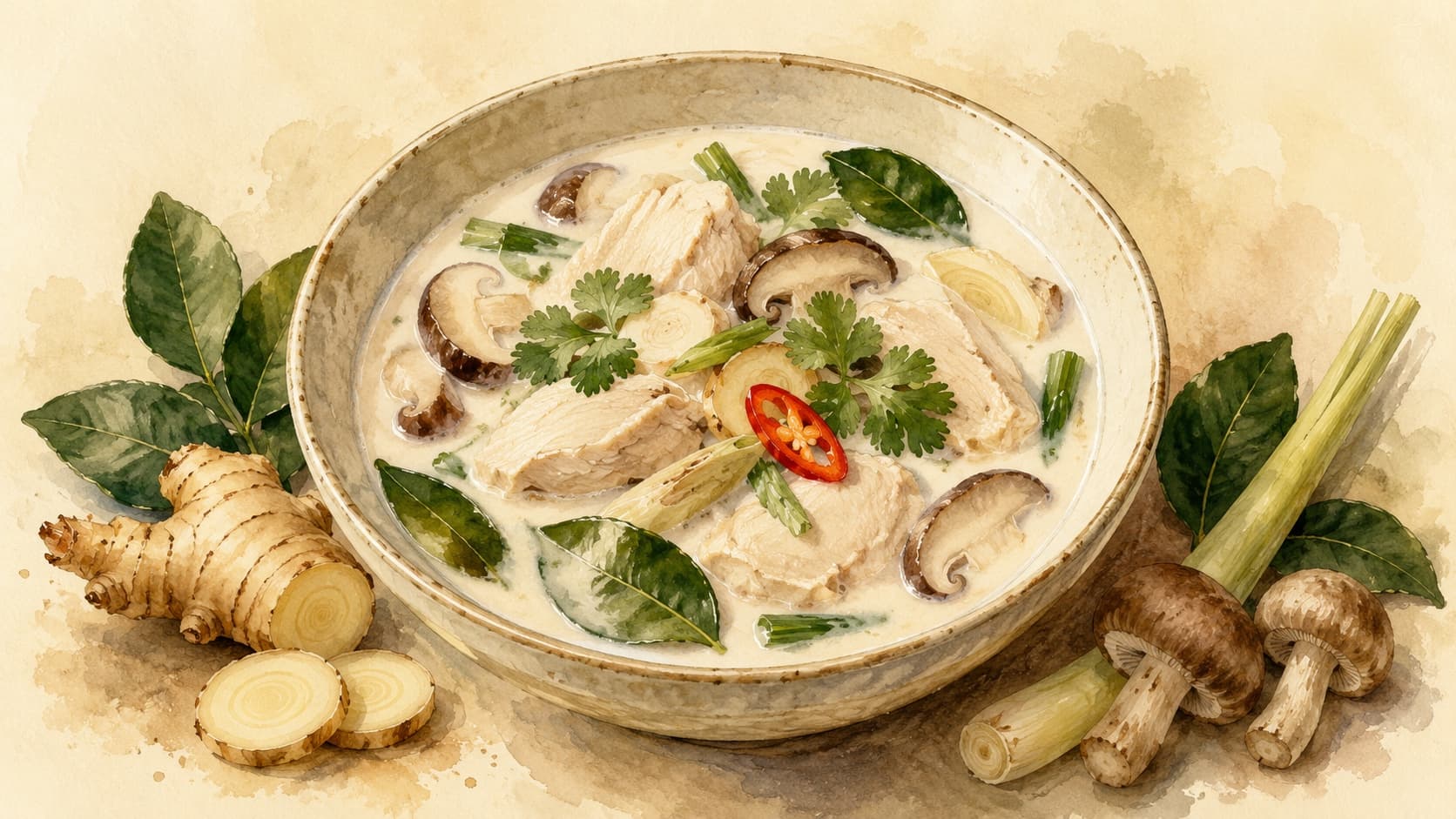
Ingredients
- 400 ml coconut milk
- 300 g chicken breast, sliced
- 2 stalks lemongrass, cut into 2-inch pieces
- 5 slices galangal
- 4 kaffir lime leaves
- 200 g mushrooms, sliced
- 2-3 Thai bird's eye chilies, smashed
- 2 tbsp fish sauce
- 1 tbsp lime juice
- Fresh cilantro for garnish
Steps
In a pot, combine coconut milk, chicken, lemongrass, galangal, and kaffir lime leaves.
Bring to a gentle simmer over medium heat.
Add mushrooms and chilies; simmer until the chicken is cooked through — the thickest slice reaches 74°C / 165°F on a food thermometer.
Stir in fish sauce and lime juice.
Serve hot, garnished with cilantro.
Tools you'll want
Why this works
Tom Kha Gai achieves harmony through the balance of flavors. Coconut milk provides creaminess, while lime juice adds acidity. Galangal offers a unique warmth, distinct from ginger. The combination of these elements creates a layered taste profile.
Cooking at a medium heat ensures the chicken remains tender. Simmering the ingredients allows the flavors to meld without overwhelming the coconut base. Maintaining gentle heat prevents the coconut milk from curdling, ensuring a smooth texture.
The fresh herbs and spices release essential oils, enhancing the aromatic quality. Each component contributes to the overall palate, creating a comforting, yet vibrant dish.
Common mistakes
Boiling the coconut milk.
Target: Coconut milk added in two stages — thick "head" first to cook the curry paste, then thin part with broth. Maintain bare simmer (under 85 °C) after combining.
Why it matters: Coconut milk's fat separates when boiled, producing greasy slicks on the surface and a curdled, "broken" appearance. Once broken, it can't be re-emulsified.
What to do: Use full-fat canned coconut milk (avoid "lite"). After combining everything, never let the soup go above a quiet simmer.
Workarounds:
- Already broken? Pull from heat, add 1 tbsp cornstarch slurry, blend smooth — partial rescue.
- For maximum stability, add a teaspoon of cornstarch to the cold coconut milk before heating — prevents breaking.
Using ginger instead of galangal (a Thai aromatic rhizome with a pine-and-citrus character — a cousin of ginger but firmer and sharper).
Target: Fresh galangal (Thai: kha), recognizable by its smoother, paler, harder rhizome.
Why it matters: Galangal and ginger are NOT interchangeable. Galangal's pine-citrus character is what makes Tom Kha "Tom Kha" (kha literally means galangal in Thai). Ginger produces a Chinese-flavored soup with the wrong character.
What to do: Source from an Asian grocery. Slice across the grain.
Workarounds:
- Frozen galangal works almost as well as fresh.
- No galangal at all? Use lemongrass alone in greater quantity — different but workable.
Overcooking the chicken.
Target: Chicken added in the final 8–10 minutes and simmered until the thickest slice reaches 74 °C / 165 °F on a thermometer — opacity is a doneness cue, not the safety test.
Why it matters: Thin slices reach a safe 74 °C fast in the simmering broth without going stringy and dry. Take the pot off the heat once the chicken has measured 74 °C — the residual broth heat keeps it hot and tender, but do not rely on it to finish cooking the chicken to a safe temperature.
What to do: Slice chicken thigh into 5 mm slices (cooks fast and stays tender). Add when the broth is fragrant from aromatics.
Workarounds:
- For tougher cuts, pre-poach in plain broth first, then add to the finished Tom Kha at the end.
Skipping the kaffir lime leaves (the glossy, double-lobed leaves of the makrut lime tree, used whole for fragrance and not eaten).
Target: 4–6 fresh or frozen kaffir lime leaves per pot. Torn or scored, not chopped.
Why it matters: Kaffir lime leaves contribute the distinctive aromatic top note of Tom Kha — citrusy but bitter-edged, with no equivalent in Western herbs. Without them, the soup smells "thin."
What to do: Tear each leaf to release essential oils, drop into the simmering soup, leave in (eat around them) or strain out at the end.
Workarounds:
- No kaffir lime leaves? Lime zest + a bay leaf is the next-closest approximation. Not equal but salvageable.
- Frozen kaffir lime leaves keep for months and work as well as fresh.
Wrong fish sauce balance.
Target: 2 tbsp fish sauce + 1.5 tbsp lime juice + 1 tsp palm sugar per 4 cups of broth.
Why it matters: Tom Kha is built on the salty-sour-sweet trinity. Most home cooks under-add fish sauce (intimidated by the smell) and end up with a bland soup. Trust the recipe — the smell mellows in the broth.
What to do: Add fish sauce and lime in the final 2 minutes. Taste, then adjust.
Workarounds:
- Fish sauce too pungent? Use a milder Vietnamese brand (Three Crabs is widely available and less assertive).
- Vegetarian version: light soy sauce + 1 tsp white miso approximates the umami.
Lime juice cooked in the soup.
Target: Lime juice added OFF-HEAT, at the very end.
Why it matters: Lime juice loses its bright acidity within minutes of boiling. Adding it during cooking results in a flat, slightly bitter finish.
What to do: Add lime juice after turning off the heat. Stir, taste, serve.
Workarounds:
- For leftover Tom Kha, refresh with a fresh squeeze of lime when reheating.
What to look for
- A creamy, rich color in the broth (the emulsion of coconut fat and broth holding together as one smooth liquid).
- Tender chicken pieces that remain moist — the thickest slice confirmed at 74 °C / 165 °F on a thermometer (white/opaque flesh is a cue, not the safety test).
- Fresh herbs that are vibrant and aromatic.
- The smell of lemongrass and galangal filling the air.
- A slight sheen on the surface of the soup.
Chef's view
Tom Kha Gai is a staple of Thai cuisine, illustrating the interplay of sweet, sour, salty, and spicy. Rooted in tradition, each region may have its variations. The dish reflects the essence of Thai cooking—freshness and balance.
Understanding the use of galangal versus ginger is crucial. Galangal imparts a distinct flavor, integral to authenticity. This soup nourishes and showcases the beauty of Thai culinary philosophy, where every ingredient serves a purpose.
<!-- beginner-glossed v1 -->Get the essays in your inbox — free
Weekly notes on flavor, fermentation, and food history — the writing behind the Atlas of Flavor. No spam; unsubscribe anytime.