
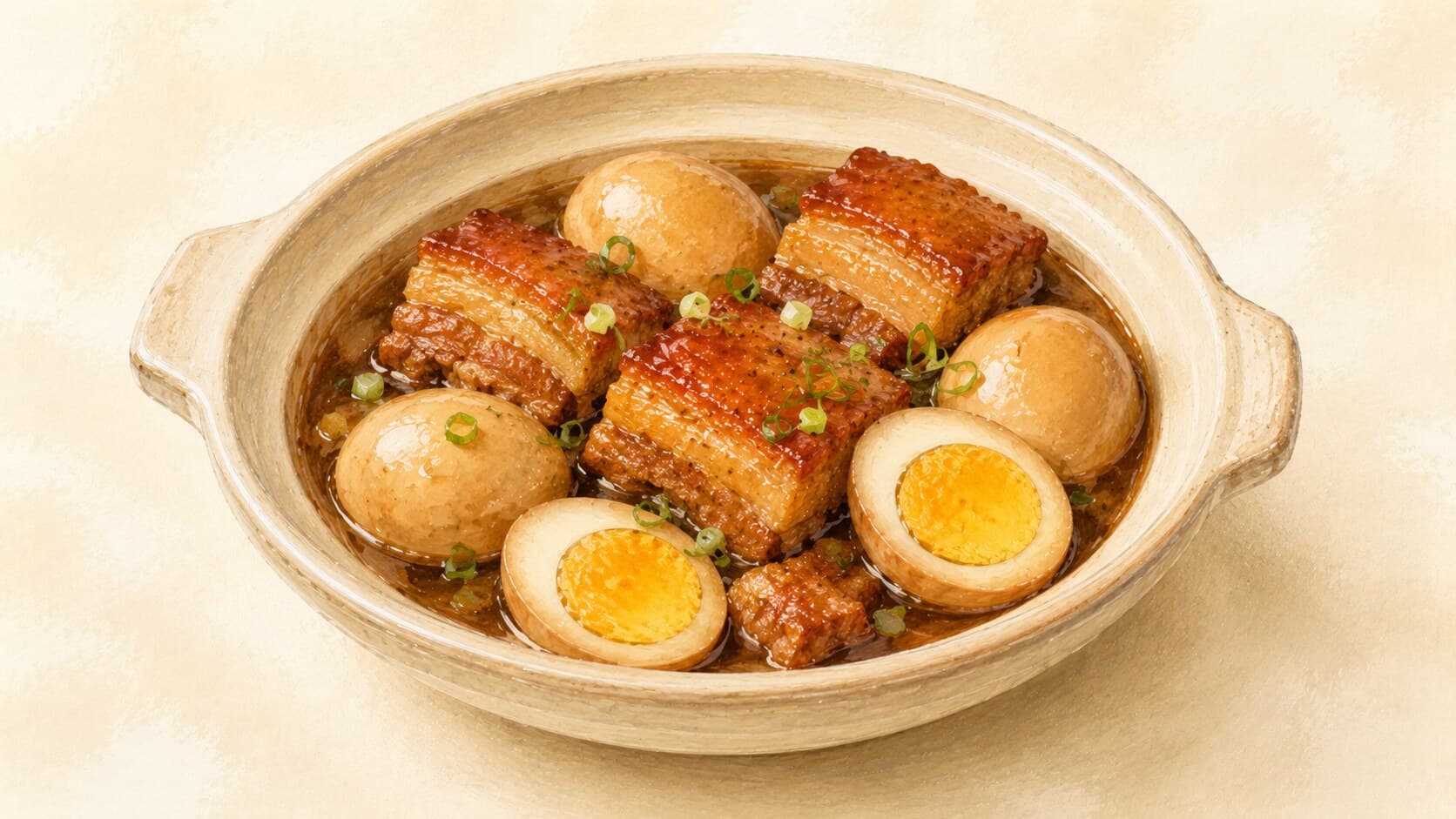
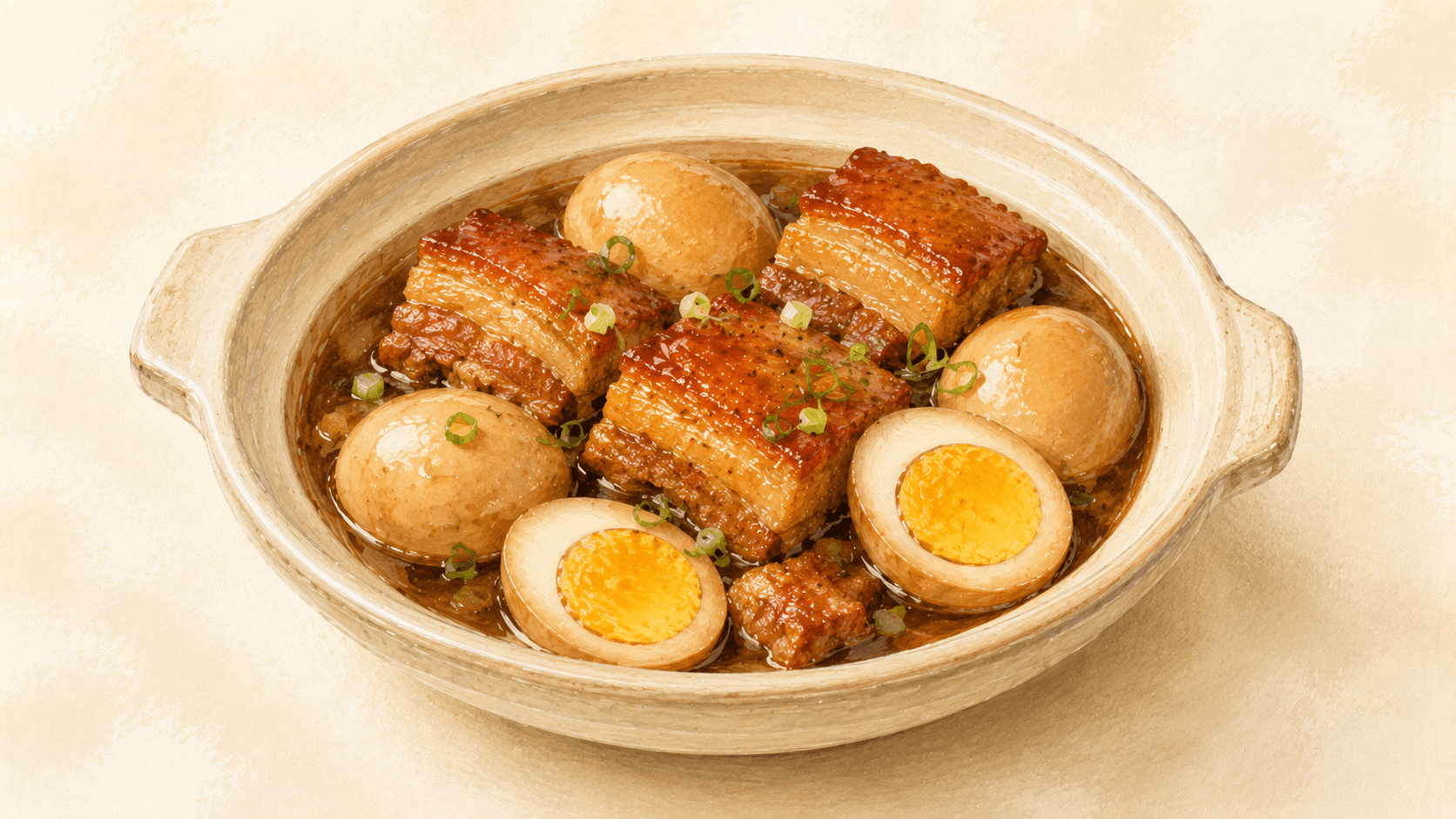
Thịt Kho Trứng (Vietnamese Braised Pork Belly and Eggs)
Coconut water — not coconut milk — is the braising liquid. Its sugars caramelize into the sauce gradually over an hour, producing a sweetness that no amount of added sugar can replicate. The process is subtle but the result is not.
Contents (8 sections)▾
Ingredients
- 500 g pork belly, cut into 4–5 cm cubes
- 6 hard-boiled eggs, peeled
- 500 ml young coconut water (from a young coconut or packaged, not sweetened)
- 3 tbsp fish sauce
- 2 tbsp sugar
- 3 shallots, halved
- 3 cloves garlic
- **For nước màu (caramel):**
- 2 tbsp white sugar
- 1 tbsp water
Steps
Make nước màu: combine sugar and water in a small pan over medium heat. Cook without stirring until the mixture reaches amber — rich, dark, and just short of bitter. Set aside.
In a large pot or clay pot over medium-high heat, place the pork belly cubes skin-side down. No oil is needed — the pork fat will render quickly and provide sufficient fat. Brown the pork on two sides to build a Maillard crust. This is the flavor foundation of the sauce.
Add shallots and garlic. Sauté for 1 minute until fragrant and slightly softened.
Add the nước màu, fish sauce, and sugar. Stir to coat the pork pieces evenly. Then add the coconut water — it should barely cover the pork. If it does not cover, add a small amount of water.
Bring to a boil. Skim any foam that rises in the first few minutes — there will be some from the pork proteins. Reduce to a steady, moderate simmer. The surface should show a consistent but not aggressive bubble.
After 30 minutes, add the peeled hard-boiled eggs. Nestle them into the braising liquid — they will absorb the color and flavor of the sauce over the remaining cooking time.
Continue simmering until the pork is very tender and the sauce has reduced to a glossy, lightly thickened consistency. Total braising time from start: 45–55 minutes. The sauce should be deep amber and coat a spoon. The eggs will have turned a warm tan-brown from the braising liquid.
Taste the sauce: it should be savory with a quiet sweetness and a roundness that comes specifically from the coconut water. If it tastes flat, add a few drops more fish sauce — not salt. Serve over rice.
Tools you'll want
Why this works
The choice of coconut water as the braising liquid is not traditional flavoring — it is a different kind of sweetening. Young coconut water contains natural sugars, primarily glucose and fructose, at concentrations of around 3–5%. When these sugars are heated and reduced over 45–55 minutes, they undergo partial caramelization and Maillard reactions with the amino acids in the pork stock that forms during braising. The result is a sweetness that is integrated into the sauce rather than layered on top — you cannot distinguish "the coconut water sweetness" from "the braising flavor" because they have merged. This is fundamentally different from adding a tablespoon of sugar at the end.
The nước màu gives the immediate flavor impact — the bitterness and depth of sugar pyrolysis products — while the coconut water provides the gradual sweetness that rounds out the sauce over the full cooking time. The two sources of sweetness are doing different work at different stages. The nước màu provides structure and color within the first few minutes. The coconut water builds body and rounds the flavor over the full 45-minute reduction.
The eggs absorb the braising liquid through two mechanisms: direct surface staining (the dark amber pigments from the nước màu and the Maillard products in the sauce deposit on the egg white surface), and actual flavor penetration through the egg white, which is porous enough to absorb small amounts of the salt and sugar in the braising liquid over 20–25 minutes of simmering. The day-two version, after a night in the refrigerator with the sauce, is measurably more flavorful inside the egg white than the day-one version — refrigeration slows the process but it continues.
Common mistakes
Using coconut milk.
Target: Young coconut water — clear, thin, slightly saline. NOT coconut milk.
Why it matters: Coconut milk = fat-water emulsion, pale opaque creamy sauce that ruins the dish. Coconut water = clean braising liquid with natural sugars that integrate into the sauce. Visual: water is clear, milk is white.
What to do: Read the label. Coconut water carton = correct. Coconut milk can = wrong.
Workarounds:
- No coconut water → plain water works but lacks the rounded sweetness — compensate with 1 tsp added sugar.
Insufficient browning of the pork.
Target: Two-face Maillard crust — visible caramelization on the cut surfaces, not just warm pork.
Why it matters: The browned crust contributes melanoidins (Maillard pigments) that give the sauce its depth. Un-browned pork → flat one-dimensional sauce regardless of braising time. Browning is non-optional.
What to do: Medium-high heat, pork belly cut-faces down, 3-4 minutes per side. Trust the visible color before adding aromatics.
Workarounds:
- Skin-on pork belly → render skin-down first to release fat; brown cut faces in that rendered fat.
Boiling instead of simmering.
Target: Moderate steady simmer — consistent small bubbles, no aggressive rolling boil.
Why it matters: Hard boil emulsifies pork fat into the liquid → pale cloudy greasy sauce. Steady simmer keeps fat floating as droplets (skimmable) or integrating gently. Cleaner concentrated flavor.
What to do: After initial boil, drop heat to maintain a steady visible bubble pattern without churning.
Workarounds:
- Stove runs hot → use a diffuser or partially cover with the lid offset.
Adding eggs too early.
Target: Eggs in at 30 minutes — halfway through braising. Out at 50-55 min total.
Why it matters: Eggs need 20-25 min for color + flavor. <15 min addition → whites overcook to rubber. >45 min addition → eggs barely color, no flavor penetration.
What to do: Set a timer for 30 minutes. Nestle peeled eggs into the liquid at that mark.
Workarounds:
- Want deeper egg flavor → refrigerate overnight in the sauce; continued absorption with no rubber risk.
Seasoning with salt.
Target: If flat, add fish sauce, not salt. Fish sauce = sodium + glutamate together.
Why it matters: The glutamate (an amino acid that the tongue reads as savory "umami" depth, naturally concentrated in fish sauce, soy sauce, parmesan, and cured tomatoes) depth is what's missing when sauce tastes flat — salt alone adds salinity without umami support. Fish sauce solves both at once.
What to do: Taste at 30 min and again at 45 min. If flat, a few drops of fish sauce at a time, re-taste.
Workarounds:
- Already very salty but flat → add a splash of coconut water + small amount of fish sauce to rebalance.
What to look for
- The pork browning at step 2: Visible caramelized color on two faces — not grey, not just warm. This color is not cosmetic.
- The nước màu color: Amber before adding to the pot — if it looks light golden, let it cook a little longer.
- The sauce color at 30 minutes: Should already be a warm deep amber. If still pale, the heat was too low for the reduction to be on track.
- The egg color at serving: The outside of the egg white should be a warm tan to amber — not white, not dark brown. Dark brown means the sauce was too concentrated too early.
- The sauce consistency at the end: Coats a spoon and does not run off immediately. Not watery, not syrupy thick. A clingy, glossy consistency.
Chef's view
Thịt kho trứng is one of those dishes that I had to make four or five times before I stopped second-guessing the process. The timing feels too long, the sauce looks too thin for too long, and then in the last 10 minutes everything converges. The sauce thickens, the pork takes on a lacquered surface, the eggs go from tan to a deeper amber, and suddenly the dish looks exactly right. That convergence is not accidental — it is the natural endpoint of what the reduction is doing — but it takes experience to trust it rather than intervening.
The Tết dimension (Tết is Vietnamese Lunar New Year, the most important holiday of the year) of this dish is worth noting: it is made in large batches for the New Year holiday because it improves with reheating. The pork absorbs more braising liquid after refrigeration, the eggs continue to take on flavor, and the sauce tightens further with each reheat. A pot of thịt kho trứng made on the 29th day of the lunar month will be better on the first day of the New Year than it was when freshly cooked. This is a dish designed for time.
Chef Test Notes
Test 1 — coconut water vs. plain water. Two batches, everything else identical. Coconut water version had a measurably rounder, more complex sweetness at the end of the 50-minute braise — the sauce tasted finished rather than assembled. Plain water version was adequate but more one-dimensional — the sweetness tasted added rather than integrated. The difference is not dramatic in a blind taste but it is consistent across multiple tests.
Test 2 — egg timing. Added eggs at 15 minutes vs. 30 minutes vs. 45 minutes (last 5 minutes). 15-minute addition: eggs were edible but the whites had become slightly rubbery by the end. 30-minute addition: ideal — amber-tinted whites with flavor penetration, firm but not rubbery. 45-minute addition: eggs barely stained, no internal flavor change, essentially just painted by the sauce. The 30-minute mark is the confirmed correct entry point.
Test 3 — browning vs. no browning. One batch browned the pork (3–4 minutes per face at medium-high), one batch went straight to braising without browning. The browned batch produced a noticeably more complex sauce — the Maillard compounds from the sear were clearly present in the final flavor. The un-browned batch was noticeably flatter, with the fish sauce and caramel reading as separate rather than integrated. Browning is not optional.
A note from HCMC
Thịt kho trứng is Tết food in most Southern Vietnamese families — made in large batches and eaten over the three days of the New Year holiday, because it improves with each reheating. The day-two version, after a night in the refrigerator with the sauce continuing to absorb into the eggs and pork, is better than day one. I have eaten it at friends' family tables in HCMC on New Year's morning over plain white rice, and the combination of the sweet-savory sauce and the simplicity of the occasion is one of the most specifically Vietnamese meals I know.
Related glossary terms
- Kho — the Vietnamese braising technique that reduces a seasoned liquid to a concentrated glaze around the protein.
- Nước màu — Vietnamese caramel sauce; the flavor and color foundation of kho dishes.
- Maillard reaction — the browning reaction that builds the flavor depth in both the seared pork and the reduced sauce.
Get the essays in your inbox — free
Weekly notes on flavor, fermentation, and food history — the writing behind the Atlas of Flavor. No spam; unsubscribe anytime.