
Som Tam (Green Papaya Salad)
This salad combines fresh ingredients with a balance of flavors for a refreshing dish.
Contents (5 sections)▾
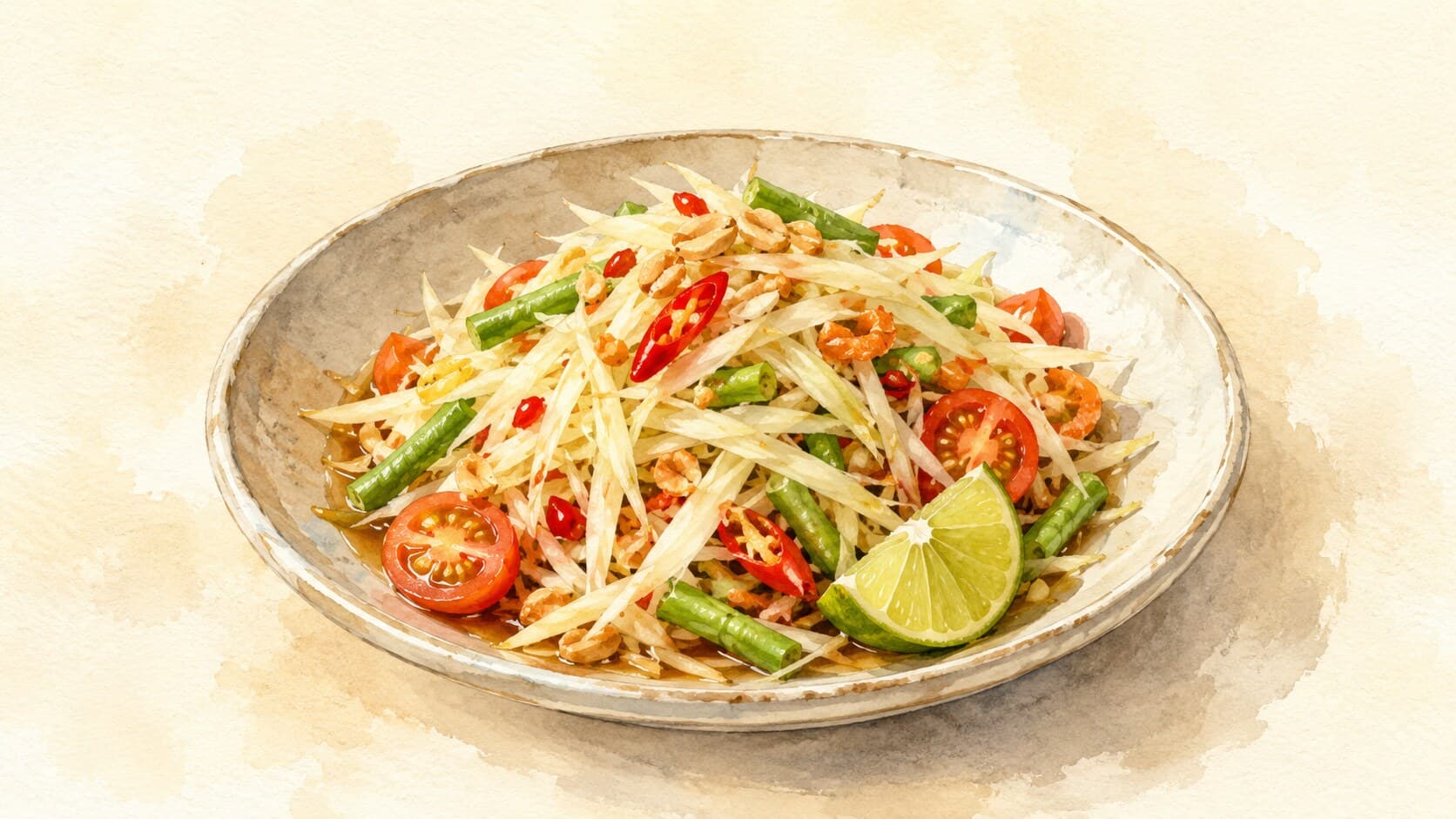
Ingredients
- 2 cups green papaya, shredded
- 1 cup cherry tomatoes, halved
- 1/4 cup green beans, cut into 1-inch pieces
- 1/4 cup roasted peanuts, crushed
- 2 tablespoons fish sauce
- 1 tablespoon lime juice
- 1 tablespoon palm sugar
- 2-3 Thai bird chilies, smashed
Steps
In a large bowl, combine shredded papaya, tomatoes, and green beans.
In a separate bowl, whisk together fish sauce, lime juice, palm sugar, and smashed chilies.
Pour the dressing over the salad and toss to combine.
Sprinkle crushed peanuts on top before serving.
Tools you'll want
- · Digital kitchen scale (gram precision)
Why this works
The balance of flavors in Som Tam arises from the interplay of salty, sour, and sweet components. The acidity of lime juice cuts through the richness of fish sauce, while palm sugar adds a subtle sweetness that rounds out the dish. The fresh crunch of green papaya is essential for texture, providing a refreshing contrast to the other ingredients.
Temperature plays a role in the preparation. The salad should be served chilled, enhancing the crispness of the papaya and the vibrancy of the other ingredients. The smashing of chilies releases essential oils, maximizing their flavor impact without overwhelming the dish.
Proper ingredient ratios are critical. Too much fish sauce can overpower the salad, while insufficient lime juice may result in a bland taste. Adjust these elements according to personal preference, but maintaining a balance is key to achieving the authentic flavor.
Common mistakes
Using ripe papaya.
Target: Unripe green papaya (papaya picked before it ripens — firm and crunchy, not sweet) — firm flesh, pale green-white interior, no orange tint.
Why it matters: Ripe papaya is soft, sweet, and falls apart in the salad — wrong texture entirely. Som tam's defining quality is the crunch of unripe fruit. Ripe papaya makes a different dish, not a worse som tam.
What to do: Press the fruit — should feel hard. Cut: pale green-white inside, no orange.
Workarounds:
- Can't find green papaya → green mango is the closest substitute, traditional in Lao-style.
- Last resort → firm cabbage + julienned carrot mix; texturally close, flavor-wise weaker.
Not pounding in a mortar.
Target: Wooden mortar and pestle (kruak) — pound ingredients to bruise, NOT pulverize.
Why it matters: Som tam means "pounded sour" — the bruising releases juices that mix with the dressing in a way knife-cutting can't replicate. The traditional name describes the technique.
What to do: Pound chilies + garlic first (paste), add palm sugar (dissolves), then papaya in batches with light bruising strokes — not crushing.
Workarounds:
- No mortar → shallow bowl + back of a wooden spoon; less authentic but works.
Adjusting balance wrong.
Target: Final balance: salty (fish sauce, a Southeast-Asian seasoning made from fermented anchovies) + sour (lime) + sweet (palm sugar, an amber unrefined sugar from palm-tree sap) + spicy (chili), all detectable, none dominant.
Why it matters: Som tam's signature is the 4-flavor harmony. Too much of any one element = unbalanced salad. Real cooks taste continuously and adjust to the diner's preference.
What to do: Start with smaller amounts of each. Taste, adjust toward whichever is missing. The dressing should make you blink — bright but balanced.
Workarounds:
- Less spicy preferred → still pound the chilies but use fewer (1 chili instead of 3).
- More sour preferred → add lime, NOT extra vinegar (changes character).
Skipping the peanuts.
Target: Roasted unsalted peanuts, crushed (not powdered), 2 tbsp per portion.
Why it matters: Peanuts add the textural counterpoint that completes the salad. Without them, you have crunchy + soft only — missing the nutty/oily/crispy layer. Traditional, not optional.
What to do: Lightly crush peanuts with the side of a knife or in the mortar; aim for halves and quarters, not dust.
Workarounds:
- Peanut allergy → toasted cashews or roasted soybeans are acceptable substitutes.
Not pounding the dried shrimp (small sun-dried shrimp used as a savory base in Southeast-Asian cooking).
Target: 1 tbsp dried shrimp pounded into the dressing — small but transformative.
Why it matters: Dried shrimp adds the umami depth that turns "papaya in dressing" into "som tam." Without it, the dish tastes thin. Most home recipes skip this and lose the dish's character.
What to do: Pound dried shrimp with the chilies and garlic at the start; integrates fully.
Workarounds:
- No dried shrimp → small amount of dried shiitake powder or extra fish sauce can partially substitute.
Serving too late.
Target: Toss and serve within 10 minutes. Papaya stays crisp.
Why it matters: Salt in the dressing draws water out of the papaya over time — what was crunchy turns limp and watery within 30 minutes. The dish is a "make-and-eat" preparation.
What to do: Prep all ingredients in advance, dress only at the moment of serving.
Workarounds:
- Make-ahead → keep papaya, dressing, peanuts, and tomatoes separate; combine at the table.
What to look for
- Bright green color of shredded papaya.
- Freshness of tomatoes and green beans.
- A balanced dressing that is not overly salty or sweet.
- Crunchiness when biting into the salad.
- A vibrant, inviting appearance overall.
Chef's view
Som Tam (the Thai green-papaya salad pounded in a mortar) reflects the vibrant flavors and textures of Thai cuisine. Originating from the northeastern region, the dish embodies the principle of balancing flavors and textures. The use of fresh, raw ingredients highlights the importance of seasonal produce in Thai cooking.
The technique of mixing and smashing ingredients is not just about flavor; it’s a ritual that brings the components together harmoniously. This salad is often enjoyed as a street food staple, showcasing the communal aspect of Thai eating culture. Each bite offers a taste of the rich culinary heritage of Thailand, making it a familiar dish both locally and globally.
<!-- beginner-glossed v1 -->Get the essays in your inbox — free
Weekly notes on flavor, fermentation, and food history — the writing behind the Atlas of Flavor. No spam; unsubscribe anytime.