
Sauce Mornay
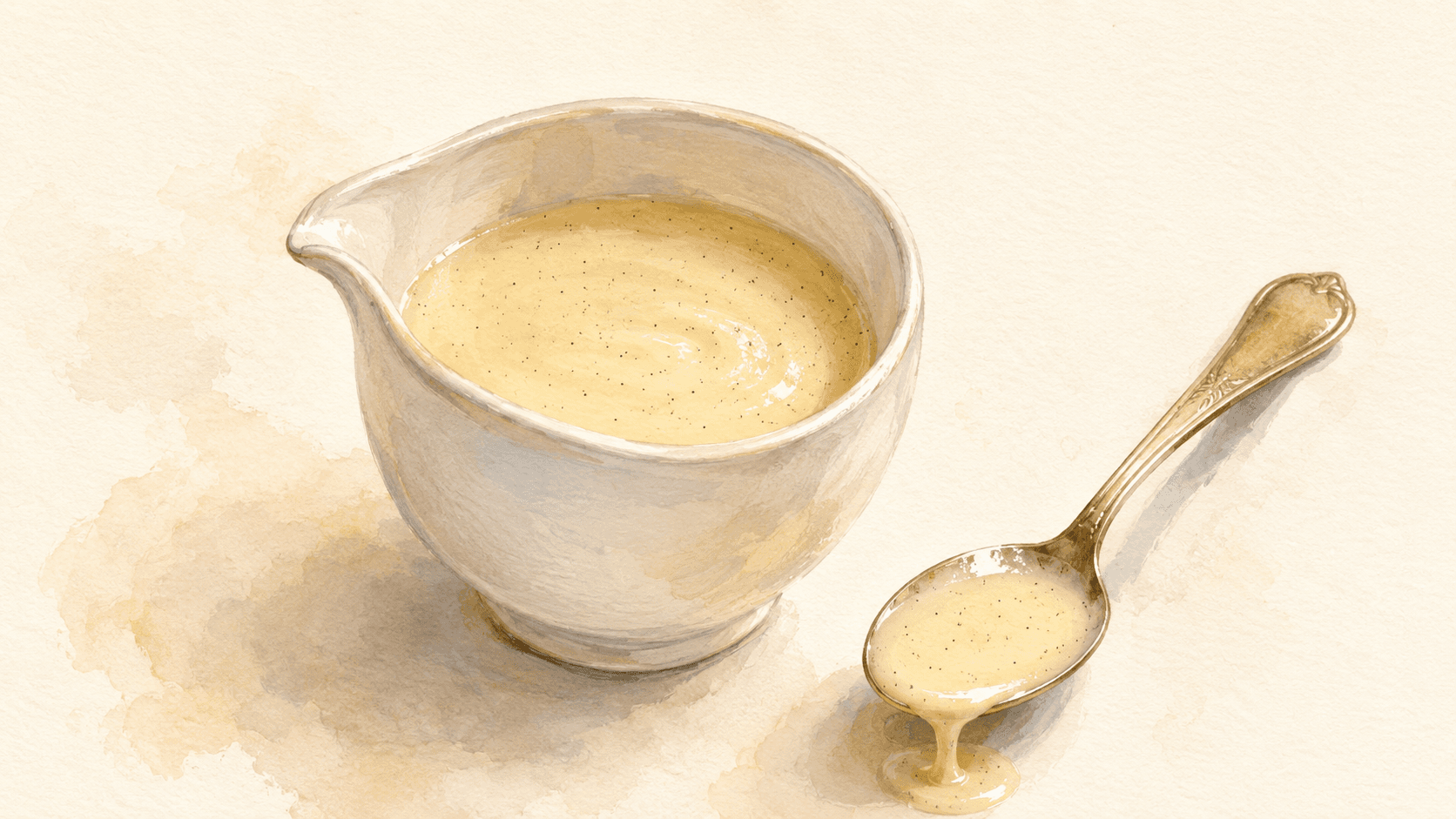
Béchamel enriched with Gruyère and an egg yolk liaison — the daughter sauce that teaches you how cheese and fat interact with a starch-thickened base.
Contents (7 sections)▾
Ingredients
- 500 ml finished béchamel sauce (hot)
- 80 g Gruyère, finely grated (or Comté, or half Gruyère/half Parmesan)
- 2 egg yolks
- 30 ml heavy cream (for the liaison)
- Fine sea salt and white pepper to taste
- Pinch of cayenne (optional)
Steps
Make or reheat your béchamel until it is hot but not boiling — just below 80°C. If it has a skin, whisk it smooth or strain through a fine-mesh strainer before proceeding.
In a small bowl, whisk together the egg yolks and heavy cream until uniform. This is your liaison — the enriching agent that gives Mornay its gloss and added body beyond the base béchamel.
Temper the liaison: ladle 2–3 spoonfuls of the hot béchamel into the egg yolk mixture while whisking constantly. This slowly raises the temperature of the eggs without scrambling them. A gradual approach here is non-negotiable — add the hot sauce to the eggs, never the eggs directly into the sauce.
Pour the tempered liaison back into the main pot of béchamel, whisking continuously over low heat. Cook for 1–2 minutes, still whisking, until the sauce is smooth and slightly thicker. Do not boil — above 85°C the egg proteins tighten and you risk curdling.
Remove from heat. Add the grated Gruyère in two or three additions, stirring after each until fully melted. Adding cheese in stages prevents the proteins from clumping and the fat from separating. Taste and adjust salt, white pepper, and optional cayenne. Use immediately — Mornay does not reheat well, and the cheese will tighten on standing.
Tools you'll want
- · Tri-ply stainless saucepan (1.5–2 qt / 18cm)
- · Balloon whisk (24cm / 11-inch)
- · Digital kitchen scale (gram precision)
- · Sauce strainer (chinois, perforated, or fine-mesh, 19–25cm)
Why this works
Sauce Mornay is not simply béchamel with cheese stirred in. It is a daughter sauce — a systematic enrichment that adds two functional elements: a cheese component and an egg yolk liaison. Each one changes the sauce in a specific, physical way.
The liaison (egg yolks whisked with cream) does two things. The lecithin in the yolks adds extra emulsifying power to the starch-stabilized fat-in-milk structure of the béchamel, making the finished sauce more stable and glossier. The proteins add a very gentle thickening — not enough to register as "thicker" by itself, but enough to give the sauce a satiny body that plain béchamel does not have. The critical rule is temperature: egg yolks begin to scramble around 70°C and set firmly above 85°C. The tempering step — adding hot sauce to the eggs gradually before returning the mixture to the pot — is how you raise the egg proteins gently enough that they contribute body without curdling.
The cheese layer follows the same logic as any fat-plus-protein emulsion. Gruyère melts cleanly because its proteins are relatively long and pliable at 60–70°C, and its fat content is high enough to flow smoothly into the béchamel's starchy matrix. The reason you add it off-heat or over very low heat, in stages, is that the proteins contract quickly above 80°C — if you push the temperature or add a large cold mass of cheese all at once, you get strings and grease, not a smooth sauce.
The result is a sauce with three layers of structure: the starch-gelatinized milk (béchamel), the egg-yolk emulsion (liaison), and the melted dairy protein network (cheese). Each layer reinforces the others. That structural depth is why Mornay coats a gratin so cleanly and holds under the broiler better than a plain béchamel would.
Common mistakes
Adding cheese to boiling sauce.
Target: Pan off heat before cheese goes in. Béchamel base should be warm, not bubbling.
Why it matters: Boiling breaks cheese's fat-protein bonds — fat leaks as grease, proteins tighten into strings. The signature glossy smoothness collapses into greasy strings.
What to do: Pull off heat, wait 30 seconds, then start adding cheese.
Workarounds:
- Sauce broke → off heat, whisk in 1 tbsp cold cream; sometimes restores emulsion.
Adding all cheese at once.
Target: 3 batches, stir each to melt fully before next.
Why it matters: Large cold mass shocks the sauce — temperature drops sharply, proteins seize into clumps. Gradual addition keeps everything in melt range.
What to do: Divide grated cheese into thirds visually. Handful at a time.
Workarounds:
- Don't have time → at least 2 batches; one is too crude.
Scrambling the liaison.
Target: Temper yolks — slowly drizzle hot sauce INTO yolks while whisking, never the reverse.
Why it matters: Hot sauce dumped into cold yolks cooks them on contact = scrambled bits in the sauce. Tempering raises yolk temperature gradually.
What to do: Ladle by ladle of hot sauce into yolks, whisking constantly. 3-4 ladles before returning the mixture to the pan.
Workarounds:
- Worried about safety → strain after tempering to catch any small cooked bits.
Using pre-grated cheese.
Target: Grate fresh from a block — fine grate, just before adding.
Why it matters: Pre-grated cheese has anti-caking cellulose coating that prevents clean melting — sauce becomes gritty and greasy.
What to do: Block + box grater. Grate fine for fast even melt.
Workarounds:
- Time-short → fresh grating only adds 60 seconds; just do it.
Trying to reheat.
Target: Make to order, or hold in bain-marie up to 20 minutes covered.
Why it matters: Reheating Mornay separates the emulsion — cheese congeals, sauce splits into grease and grainy curd. The structure is one-time use.
What to do: Time the sauce with the dish. Hold warm if needed; don't refrigerate and reheat.
Workarounds:
- Have leftovers → use cold as a spread on toast; don't try to re-emulsify.
Under-seasoning (or over-salting).
Target: Salt sparingly — Gruyère is already salty. Cayenne/white pepper to lift dairy heaviness.
Why it matters: Cheese contributes significant salt; adding more before tasting = oversalted sauce. Cayenne adds dimension without competing.
What to do: Taste before adjusting. Pinch of cayenne or white pepper is structural, not optional.
Workarounds:
- Want extra depth → nutmeg is classical here; small grating at the end.
What to look for
- Liaison before tempering: smooth, pale yellow, liquid. No strings, no lumps.
- After tempering: warm, slightly thicker, still pourable. The eggs have started to set without scrambling.
- After cheese addition: glossy, pale gold, coats a spoon cleanly. A small drip off the spoon should hold its shape for a second.
- Temperature check: below 80°C throughout the cheese stage. If you see it starting to bubble actively, pull the pan off the heat immediately.
Chef's view
The question I get most often about Mornay (a French cheese sauce built on béchamel with grated hard cheese and, classically, an egg-yolk liaison) is: which cheese? The classical answer is Gruyère, sometimes with a small proportion of Parmesan for sharpness. Comté (which is Gruyère's neighbor, aged slightly differently) works equally well. What you want is a hard alpine cheese with a fat content above 45% and a mild, nutty flavor that won't overwhelm the base sauce. Cheddar works technically but pulls the flavor register in an entirely different direction — British rather than French, and more aggressive. For a croque-monsieur (a hot French ham-and-cheese sandwich finished with Mornay) or a gratin dauphinois (a layered French potato dish baked in cream), Gruyère is not negotiable.
The liaison (a mixture of egg yolk and cream used to enrich and lightly thicken a sauce) is optional in practice — many modern French cooks skip it and just add cheese to béchamel (the classical white "mother" sauce made by cooking milk with a flour-and-butter roux). The version without liaison is called "béchamel au fromage" in some older texts and is quite acceptable for most gratins. But for a finished sauce served poured — over a fish, over eggs, over blanched vegetables — the liaison matters. It is what separates a cheese sauce from a cheese-flavored sauce.
Chef Test Notes
Tested with two approaches: cheese added directly to béchamel (no liaison), and the full Mornay with liaison. The liaison version was measurably glossier and held its texture under a broiler for 4 extra minutes before breaking. The no-liaison version is acceptable for everyday gratins; the full method is worth the extra step when the sauce is the centerpiece.
Related glossary terms
- Béchamel — the mother sauce this is derived from
- Liaison — the egg yolk and cream mixture that enriches and stabilizes
- Emulsion — the structural principle underlying both béchamel and Mornay
- Daughter sauce — the category Mornay belongs to within French sauce taxonomy
Get the essays in your inbox — free
Weekly notes on flavor, fermentation, and food history — the writing behind the Atlas of Flavor. No spam; unsubscribe anytime.