
Rouille
Saffron, garlic, bread, and olive oil — a Provençal emulsion where bread acts as emulsifier and saffron extraction determines the final color.
Contents (7 sections)▾
Ingredients
- 2 large garlic cloves (about 8 g), peeled
- 1 pinch saffron threads (about 0.3 g)
- 2 tablespoons (30 ml) boiling water or hot fish stock
- 50 g crustless white bread (about 2 thick slices, soaked in water and squeezed dry)
- 1 egg yolk — pasteurized, or from a shell egg treated to destroy Salmonella (optional; bread is the primary emulsifier — see the safety note)
- 1 teaspoon (5 ml) fresh lemon juice
- 150 ml extra-virgin olive oil
- 2 g fine sea salt
- Optional: 1 small pinch cayenne pepper
Steps
Bloom the saffron. Combine the saffron threads with 30 ml of boiling water or hot fish stock in a small bowl. Let steep for at least 10 minutes — the liquid will turn deep gold. This extraction step is not optional; saffron's color and flavor compounds (safranal, crocin) need hot liquid and time to release fully.
Pound the garlic. In a mortar and pestle, pound the garlic cloves with a pinch of salt until they form a smooth paste. This step produces the emulsification base and releases allicin. A garlic press is a shortcut; it works but the resulting flavor is slightly less integrated.
Add the bread. Soak the crustless bread in cold water for 30 seconds, then squeeze out nearly all the water — the bread should be moist but not dripping. Add the squeezed bread to the garlic paste and pound together until smooth. The bread starches are the primary emulsifier in rouille: they form a thick, stable matrix that holds the olive oil. This is the structural difference between rouille and aioli — bread, not egg yolk, is the main stabilizer.
Add the saffron liquid (and the optional egg yolk). Stir the saffron infusion (threads and all, or strained — both work) into the bread-garlic paste. Add the lemon juice — and, if you are using it, the pasteurized egg yolk. Pound and stir until uniform. The mixture should be bright golden-orange at this point.
Emulsify the oil. Begin adding the olive oil drop by drop, pounding and stirring constantly, as you would build a mayonnaise. After the first tablespoon has been absorbed, the addition rate can increase to a thin, steady drizzle. If the mixture gets too thick to work easily, add a teaspoon of warm water to loosen. Finished rouille is thick, spreadable, and deeply golden-orange. Adjust salt. Serve as a condiment for bouillabaisse, or spread on toasted baguette croutons floated in fish stew.
Tools you'll want
- · Sauce strainer (chinois, perforated, or fine-mesh, 19–25cm)
Why this works
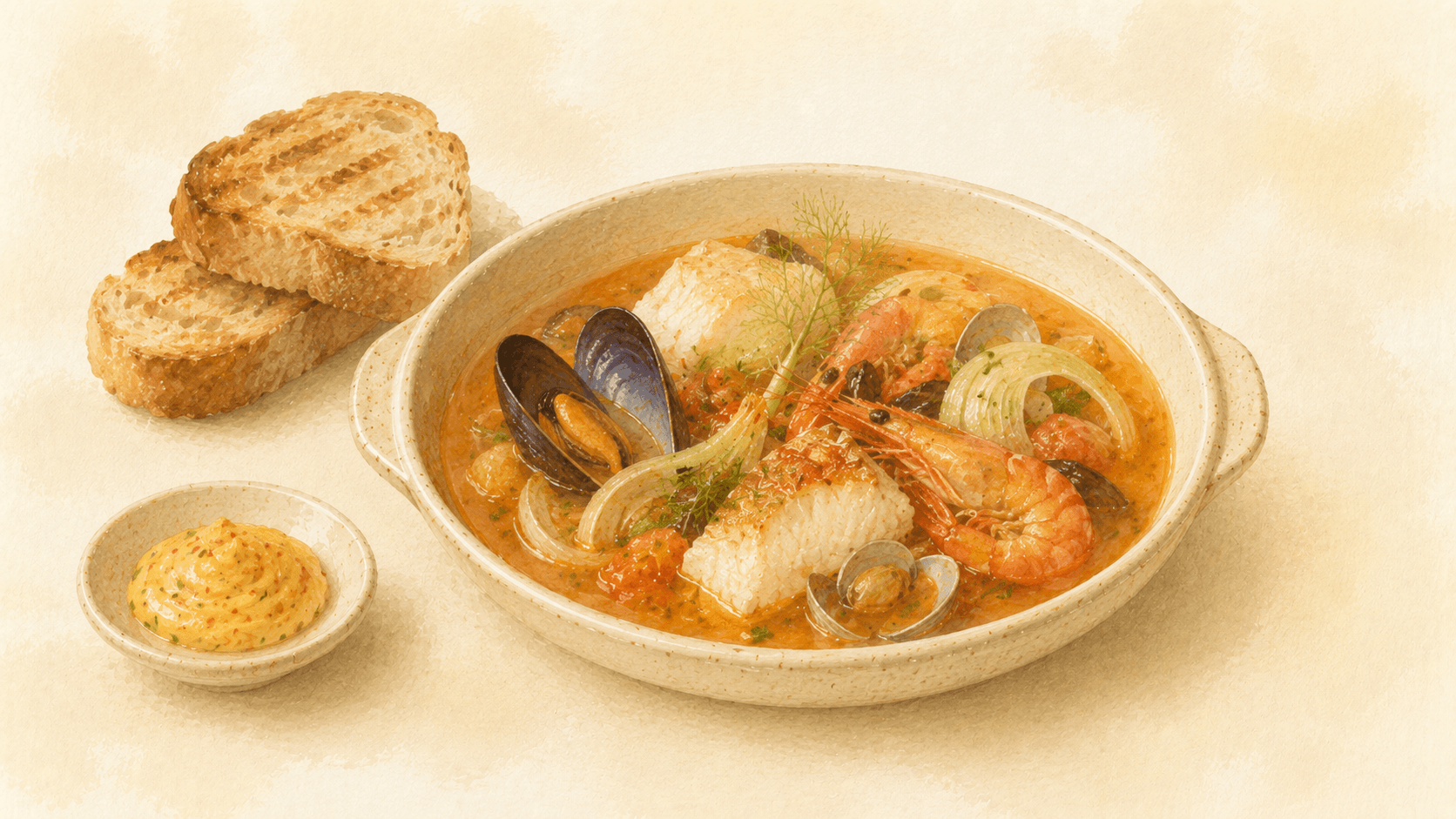
Rouille (a Provençal saffron-garlic emulsion sauce, cousin to aïoli) is Provençal — from Marseille and the coastal cooking of the south of France — and it is the condiment served with bouillabaisse, the classic Provençal fish stew. The name means "rust" in French, which is accurate: when properly made, the saffron turns the sauce a deep orange-gold that does look like polished rust.
The emulsion (a stable mixture of oil suspended in a water-based paste) mechanics of rouille are unusual because the primary emulsifier (the binding agent that holds oil and water together) is not egg yolk — it is bread. This separates rouille from aioli (garlic, egg yolk, oil) and from mayonnaise. Soaked and squeezed bread contains swollen starch granules that form a viscous, cohesive paste. That paste is thick enough to trap and suspend oil droplets without the lecithin that egg yolk provides. The texture is different from a yolk-based emulsion — rouille is a little denser, a little rougher — but it holds reliably and does not break the way a yolk emulsion can when overworked.
The saffron bloom (steeping saffron threads in hot liquid to release color and aroma) step is the flavor anchor. Saffron's color and aroma compounds — crocin for color, safranal for the distinctive hay-and-honey scent — are water-soluble and need time and heat to extract fully. Dropped into cold oil or cold paste, saffron contributes almost nothing. Steeped in hot liquid for ten minutes, it produces a deeply colored, aromatic infusion that carries through to the finished sauce. This is why the bloom step cannot be skipped or rushed.
Garlic provides the structural counterpart: pounded into paste before any liquid or oil, it releases its volatile compounds (allicin primarily, from the broken cell walls) and becomes the aromatic core of the sauce. The pounding matters — garlic minced or pressed retains more cell wall integrity and releases less of the compound structure that mortar work produces.
The olive oil emulsifies last, exactly as in a mayonnaise — added slowly into a thick base, stirred or pounded constantly until absorbed. The rate control is the same: too fast, and the oil pools above the emulsion; too slow is never a problem.
Safety — the egg yolk. The yolk here is raw and never cooked, so it carries a Salmonella risk. Bread — not egg — is rouille's primary emulsifier, so you can leave the yolk out for a fully egg-free sauce; if you include it for extra richness, use a pasteurized egg yolk, or a yolk from a shell egg treated to destroy Salmonella — an ordinary "fresh" egg is not the same. Pregnant people, infants and young children, older adults, and anyone immunocompromised should use pasteurized egg or omit it.
Common mistakes
Insufficient saffron blooming.
Target: 10 minutes minimum in hot (just-boiled) liquid. Color should be deep gold.
Why it matters: Saffron's color (crocin) and aroma (safranal) are water-soluble — they need heat + time to extract fully. Short bloom = pale, muted rouille without character.
What to do: Steep saffron in 50 ml hot fish stock or water for 10 min, covered. Use the liquid AND threads.
Workarounds:
- Time-short → 5 min minimum at higher temperature; not ideal but acceptable.
Wet bread.
Target: Bread soaked, then squeezed firmly until barely moist. No free water dripping.
Why it matters: Excess water from poorly-squeezed bread dilutes the emulsion before the oil starts — sauce becomes thin and broken.
What to do: Squeeze in your hands until no water drops. Bread should look damp, not wet.
Workarounds:
- Want extra-dry base → squeeze in a clean towel; more thorough than hands.
Adding oil too fast.
Target: First tablespoon drop-by-drop. Then thin stream once emulsion is visibly building.
Why it matters: Same mechanism as mayonnaise — too fast = oil pools, emulsion breaks. Patience at the start is essential.
What to do: Pound or whisk continuously while drizzling. Stop pouring if oil pools.
Workarounds:
- Broke → start over with fresh garlic+bread+saffron base, drizzle broken sauce in slowly as the "oil" stage.
Using stale or dense bread.
Target: Fresh white bread, crusts off — sourdough or country bread without dense crumb.
Why it matters: Stale or dense bread produces lumpy gritty texture that won't smooth out. Fresh soft white bread is the right substrate.
What to do: Buy fresh the day of making. Pain de mie or brioche works too (slightly richer).
Workarounds:
- Only stale bread → soak longer (5-8 min) and pulse in a food processor to smooth; better than gritty mortar work.
Over-seasoning with garlic.
Target: 2 large cloves for the standard batch — garlic present but saffron audible.
Why it matters: Rouille is a condiment, not a garlic paste. Excessive garlic overwhelms saffron and shifts the dish from "Mediterranean fish sauce" to "garlic sauce with color."
What to do: Start with 2 cloves, taste, add more only if needed.
Workarounds:
- Want gentler garlic → blanch cloves 1 minute in boiling water before pounding; reduces sharpness.
What to look for
- Saffron bloom: liquid is deep gold, saffron threads appear pale and exhausted. 10 minutes minimum.
- Garlic paste: smooth, no visible chunks, fragrant. A pinch of salt helps break down the fibers.
- Bread paste: moist and cohesive, holds its shape when pressed, no free water.
- Before oil: bright golden-orange mixture, uniform. This is the target color for the finished sauce too.
- Oil addition: first drops absorbed immediately; sauce thickens with each addition. If oil pools, slow down.
- Finished rouille: thick, spreadable, deeply golden — holds the shape of a spoon pressed into it.
Chef's view
The mortar and pestle version is the traditional form, and it is worth doing at least once because the texture differs from a food-processor rouille in a way that matters alongside a rich fish stew. The mortar version is slightly coarser, which gives the crouton it sits on something to grip. The processor version is smoother and faster; it is not wrong, just different.
Rouille's place in the teaching sequence is useful because it demonstrates emulsification without egg yolk as the only available tool — which challenges the assumption that lecithin is the only path to a stable emulsion. Bread starch is chemically different from lecithin but functionally similar in this application: both are amphiphilic structures that sit at the water-oil interface and prevent droplets from coalescing. Understanding this helps with a range of oil-in-water situations where egg is not an option.
Chef Test Notes
I tested rouille with three bread types: fresh crustless white bread (correct), day-old sourdough (too dense, lumpy paste), and good-quality brioche (too fatty, emulsion was unstable and greasy). Fresh crustless white bread is specified because its starch content and softness produce the right paste consistency. The bread choice is not interchangeable.
Related glossary terms
- Emulsion — the structure held by bread starch rather than egg yolk
- Bloom — the saffron extraction step that determines color and flavor
- Aioli — the garlic-oil cousin that uses egg yolk instead of bread
- Bouillabaisse — the traditional context rouille was made to accompany
Get the essays in your inbox — free
Weekly notes on flavor, fermentation, and food history — the writing behind the Atlas of Flavor. No spam; unsubscribe anytime.