
Roasted Carrots
Maillard reaction on the cut surface, caramelization on the exposed edges, glaze formation in the final minutes. A vegetable that rewards understanding all three stages.
Contents (7 sections)▾
Ingredients
- 600 g medium carrots (4–6 carrots, roughly uniform in size)
- 25 g unsalted butter, melted (or olive oil for a dairy-free version)
- 5 g fine sea salt
- 3 g granulated sugar (optional — enhances caramelization)
- 2 sprigs fresh thyme
- 1 g white pepper
- 10 ml water or dry white wine (for the glaze stage, see step 4)
Steps
Preheat the oven to 200°C (fan) or 210°C (conventional). Peel the carrots and cut them lengthwise in half. If the carrots are very large (over 2 cm diameter), cut into quarters. The goal is a flat cut surface that can make full contact with the hot baking sheet — this is where the Maillard reaction and caramelization will concentrate.
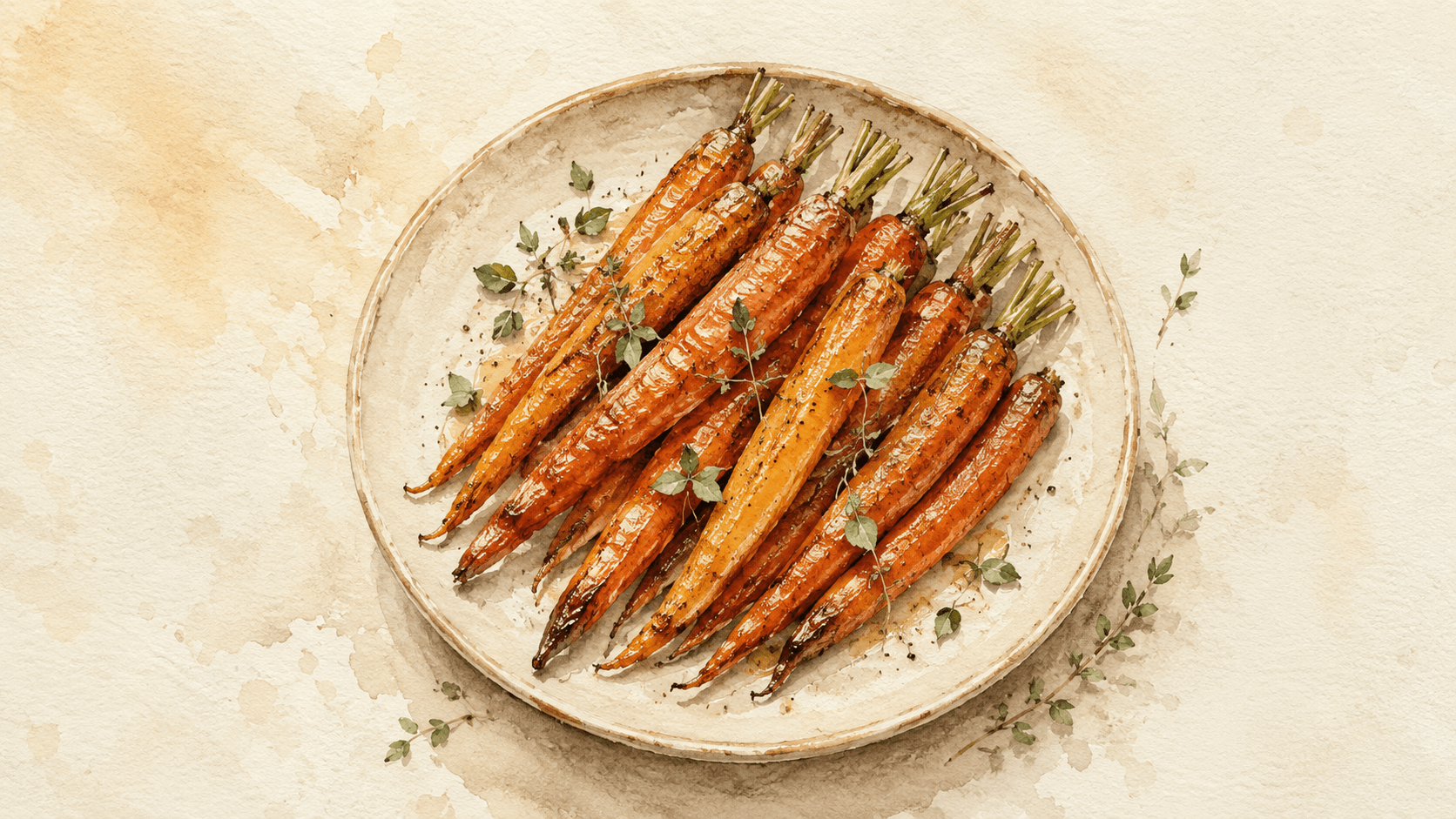
Toss the carrot halves with the melted butter, salt, and optional sugar. Arrange them cut-side down on a hot baking sheet — preheat the baking sheet in the oven for 5 minutes before adding the carrots. A preheated surface transfers heat immediately to the cut face, beginning the Maillard reaction before the oven's circulating air can dry the surface. Tuck the thyme sprigs between the carrots.
Roast for 20–25 minutes, without moving the carrots, until the cut faces are deeply amber and the surface is slightly charred at the thinnest edges. The Maillard reaction (browning of amino acids and reducing sugars above approximately 140°C) produces the complex, savory flavor. The caramelization (degradation of sucrose above 160°C) adds sweetness and bitterness. Both happen on the cut face; the rounded back face steams gently in contact with its own moisture.
When the cut faces are deeply colored, turn the carrots over. Add the water or white wine to the baking sheet — it will immediately sizzle and create steam. Return to the oven for 5–7 more minutes. The steam loosens the concentrated pan drippings and the liquid evaporates around the carrots, depositing the caramelized sugars and Maillard compounds back onto the carrot surface as a thin, shiny glaze. Watch the liquid level — when it's almost gone and the carrots look lacquered, pull them from the oven.
Serve immediately, or hold on the baking sheet for up to 15 minutes. The glaze continues to concentrate slightly as it cools. Remove the thyme before serving.
Tools you'll want
- · Digital kitchen scale (gram precision)
Why this works
Roasting a carrot is three simultaneous processes: Maillard reaction on the cut face, caramelization on the exposed sugars, and glaze formation in the final minutes. Each is driven by a different mechanism and each contributes a different register of flavor.
The Maillard reaction requires both amino acids and reducing sugars in the presence of heat above roughly 140°C. Carrots have both — natural free amino acids and glucose from the cell walls — which is why they respond so well to high-heat roasting. The reaction produces hundreds of new flavor compounds: the deep savory-sweet character of roasted vegetables that has no analogue in boiled or steamed carrots. This reaction happens specifically on the cut face, because that's where the cell contents are exposed and where direct contact with the hot metal surface drives the temperature high enough.
Caramelization is a parallel but different process: the thermal degradation of sucrose above 160°C, independent of amino acids. It produces the bitter-sweet compounds (caramel, furfural, furanones) concentrated at the edges of the carrot where moisture has fully evaporated and the sugar has nowhere to go but to brown. The bitter notes in caramelization are what prevent the finished carrots from tasting cloying, even though their sugar content is significant.
The glaze stage is a deliberate recovery step. The concentrated caramelized and Maillard compounds on the baking sheet are mobilized by the water or wine addition, which creates a brief steam phase that coats the entire surface of each carrot in a thin film of the concentrated cooking liquor. As that film dries in the oven's heat, it leaves behind a lacquered surface: shiny, intensely flavored, and visually distinct from an unglazed roasted carrot.
Common mistakes
Not preheating the baking sheet.
Target: Pan in oven during preheat — 220°C for 10+ minutes before carrots go on.
Why it matters: Cold pan delays Maillard reaction (the high-heat browning of amino acids and sugars that creates roast-flavor compounds); air dries the surface before the contact zone reaches 140°C. Hot pan = immediate Maillard from first contact.
What to do: Preheat pan + oven together. Carrots hit a hot surface, sear immediately.
Workarounds:
- No room for preheated pan → heavy cast-iron sheet retains heat better than thin tray.
Moving carrots during initial roasting.
Target: Don't disturb for 20 min — let cut faces develop amber crust undisturbed.
Why it matters: Maillard builds with sustained contact. Moving resets the contact zone temperature, interrupting crust development.
What to do: Set timer. Lift one carrot at the 20-min mark to check color; don't toss before that.
Workarounds:
- Worried about burning → check at 15 min, but don't toss; just visually confirm.
Under-roasting.
Target: Deep amber cut faces with slightly charred thin edges. NOT pale.
Why it matters: Pale carrots lack both the Maillard depth and the caramelized sweetness that justify the preparation. Color = flavor here.
What to do: Roast until visibly browned, not just softened. Total 30-40 min typically.
Workarounds:
- Carrots done but pale → finish 5 min under broiler; watch closely.
Too much liquid for the glaze.
Target: 10-15 ml liquid for the glaze — water, wine, or stock. Thin film, not pool.
Why it matters: More liquid turns glaze into steaming. The goal is a thin reducing film that lacquers the carrots, not a braise.
What to do: Measure. 2-3 tsp is right. Spreads across the hot pan, evaporates fast.
Workarounds:
- Used too much → continue roasting to reduce; takes longer to dry out.
Skipping the glaze.
Target: 5-minute glaze step at the end — adds the lacquered finish that defines the dish.
Why it matters: Without glaze, you have good roasted carrots but not "roasted with glaze." The visual lacquer and concentrated flavor are the dish's signature.
What to do: Add liquid to hot pan, return to oven 5 min.
Workarounds:
- Want richer finish → add 1 tsp honey or maple with the water; deeper glaze.
What to look for
- Before roasting: cut faces are flat and dry, coated in butter. If they look wet, the butter-to-salt ratio is off, or the carrots were not dried after peeling.
- At 20 minutes: cut faces should show deep amber coloring. Lift one carrot gently with tongs — the color should be concentrated in the contact zone.
- After turning and glazing: the liquid sizzles immediately and reduces rapidly. When the pan is nearly dry and the carrots look lacquered, they're done.
- Finished: deep amber cut face, slightly sticky glaze, edges with darker caramelized tips. Aroma: sweet, roasted, caramel and savory in equal measure.
Chef's view
The carrot is often underestimated as a vehicle for Maillard chemistry precisely because it is sweet. The assumption is that sweetness implies simple cooking. In fact, the combination of natural sugars and free amino acids in carrots makes them exceptionally responsive to high heat — the Maillard reaction and caramelization happen faster and at lower temperatures than in less sweet vegetables.
The sugar option in the ingredient list is not a recommendation for most situations. A carrot with 7–8% natural sugar content does not need help with caramelization. The sugar is only useful if the carrots are very young and mild-flavored — in early spring, when the sugars have not yet concentrated in the root.
For a more complex preparation, brown butter (beurre noisette, French for "hazelnut butter" — butter cooked until the milk solids turn golden and nutty) rather than melted butter changes the flavor entirely — the milk solids in the browned butter add another layer of Maillard products before the carrot even enters the oven.
Chef Test Notes
Tested at three oven temperatures: 180°C, 200°C, and 220°C (fan). At 180°C, the carrots cooked through before sufficient browning occurred — pale faces, low Maillard development. At 200°C, the timing aligned: the cut faces were deeply amber at the same moment the centers were fully tender. At 220°C, the edges charred too quickly before the centers cooked. Also tested the optional sugar: it made a noticeable difference with grocery store carrots (mild, high-water) and no difference with farm-market carrots (sweeter, lower water).
Related glossary terms
- Maillard reaction — the browning chemistry happening at the cut face
- Caramelization — the sugar-degradation chemistry happening at the edges
- Reduction — what the glaze stage is doing: concentrating the cooking liquor
Get the essays in your inbox — free
Weekly notes on flavor, fermentation, and food history — the writing behind the Atlas of Flavor. No spam; unsubscribe anytime.