
Pesto Genovese
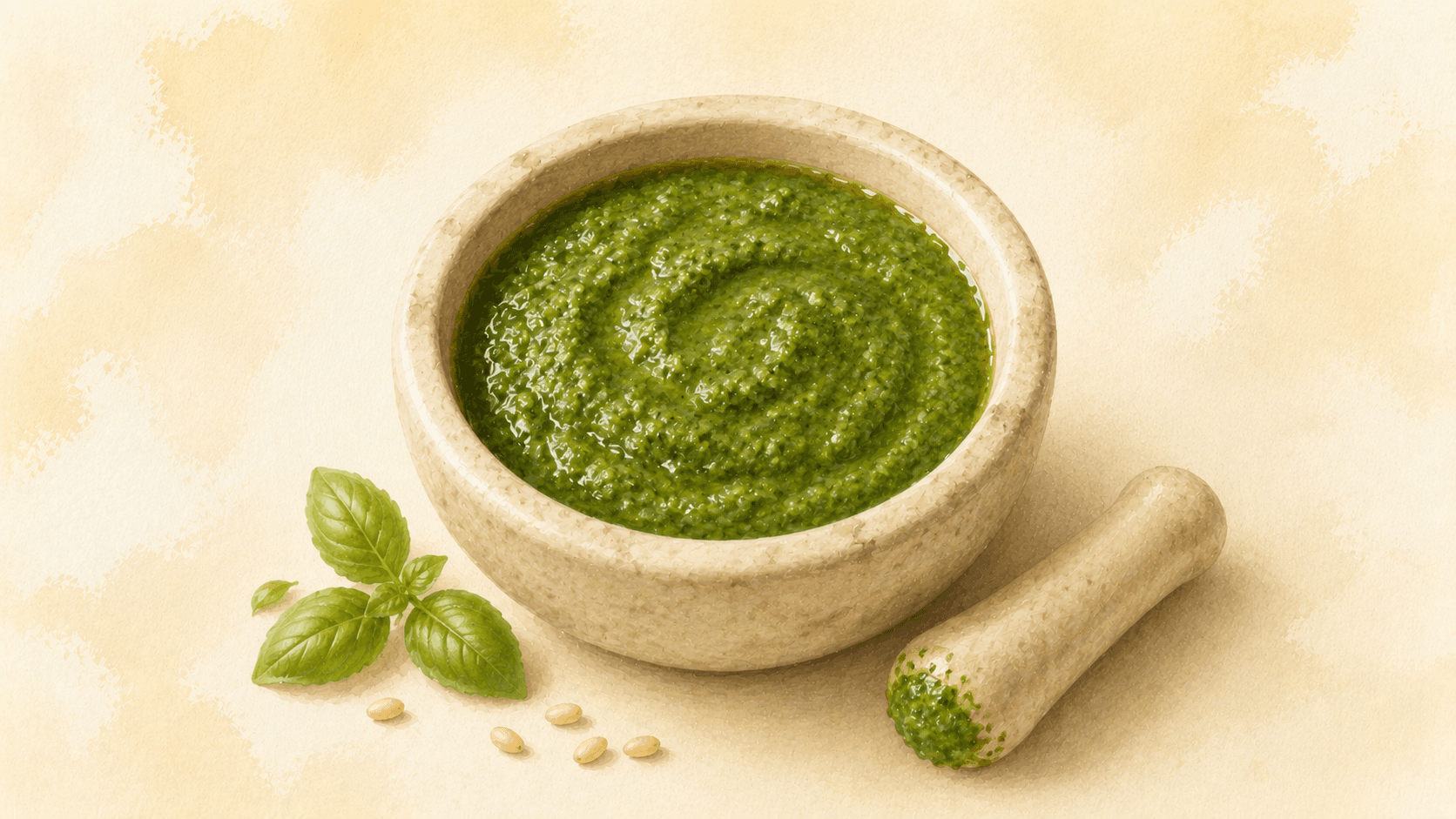
Basil, garlic, pine nuts, Parmigiano-Reggiano, and olive oil pounded or blended into a thick, intensely aromatic sauce. The original is made in a mortar — not for tradition, but because crushing (rather than cutting) releases the basil's volatile oils differently.
Contents (7 sections)▾
Ingredients
- 60 g fresh basil leaves (about 2 large bunches)
- 2 cloves garlic
- 30 g pine nuts — lightly toasted
- 50 g Parmigiano-Reggiano — finely grated
- 25 g Pecorino Romano — finely grated (optional; increases sharpness)
- 120–150 ml extra virgin olive oil
- Fine salt to taste
Steps
Mortar method: Begin with the garlic and a pinch of salt. Pound to a smooth paste — the salt acts as an abrasive, accelerating the breakdown of the cell walls. Add the pine nuts and pound until roughly broken but not completely smooth; some texture is desirable. Add the basil in 2–3 small handfuls, pounding and rotating the mortar between each addition. The leaves should be fully crushed into the paste before more are added. Work in the grated cheeses, then drizzle in the olive oil gradually while stirring with the pestle. Taste and adjust salt.
Blender method: Place the garlic, pine nuts, and basil in the blender with half the olive oil. Pulse in short bursts, scraping down the sides, until a rough paste forms. Do not run the blender continuously — the heat generated by a running blade will oxidize the basil more quickly and produce a darker, more bitter sauce. Add the grated cheeses and pulse again. Thin with the remaining oil to the desired consistency.
Store with a thin layer of olive oil poured over the surface to prevent oxidation. Pesto discolors rapidly once exposed to air — the chlorophyll in the basil is broken down by enzymes released when the cells are damaged. Use within 24 hours for best color, or freeze in portions for longer storage.
Why this works
Pesto is a collision of flavors held in suspension by fat. The basil's volatile aromatic compounds — primarily linalool, estragole, and eugenol — are released when the leaves' cell walls are broken. How those walls are broken matters more than most cooks realize.
A blender blade cuts the basil cells with a sharp edge at high speed. This cutting action severs the cell walls cleanly but also initiates an oxidation cascade almost immediately: the enzyme polyphenol oxidase (PPO), normally compartmentalized inside the cell, contacts oxygen and phenolic compounds from the cell wall as soon as the cell is disrupted. This is the same enzyme responsible for apple browning. The result is a sauce that darkens noticeably within minutes. Heat from the blade accelerates this further.
A mortar and pestle crushes the cells by blunt force. The crushing action releases the cell contents in a different physical form — the volatile oils are expressed as a fine mist rather than as an aqueous dispersion — and the rate of PPO contact with oxygen is slower. The mortar-made pesto stays brighter green for longer and has a more complex aromatic profile, because the volatile compounds are released intact rather than fragmented by the blade.
Pine nuts, rather than walnuts or cashews, are the classic choice because their fat is mild and sweet, with a resinous quality that echoes the Mediterranean character of basil and olive oil. Walnuts produce a more bitter, tannic result. The light toasting of pine nuts drives off moisture and amplifies the nutty volatiles — untoasted pine nuts produce a raw, faintly waxy note.
Parmigiano-Reggiano contributes both salt and glutamate — it is among the highest naturally occurring sources of free glutamate of any ingredient in the Italian pantry. This means that even a small addition shifts the umami level of the sauce noticeably. Pecorino Romano adds a sharper, more animal character from its sheep's milk origin.
Common mistakes
Running the blender continuously.
Target: Pulse in short bursts (2–3 seconds at a time) or use a mortar and pestle for the traditional method.
Why it matters: Continuous blending generates frictional heat and forces excessive air contact with the basil. The result is rapid oxidation — basil's bright green compounds (chlorophyll, monoterpenes) turn brown and metallic within minutes. Heat also kills the volatile aromatic compounds.
What to do: Chill the blender bowl in the freezer for 15 minutes before starting. Add ice cubes if the mixture warms up.
Workarounds:
- Mortar and pestle is the traditional method — slower but produces noticeably better color and flavor.
- A food processor with a pulse function works; an immersion blender does not (continuous, too much air).
Using dried or old basil.
Target: Fresh basil leaves, ideally less than 24 hours from harvest. Stems removed.
Why it matters: Dried basil is a fundamentally different ingredient — its volatile aromatics (linalool, eugenol, estragole) have evaporated or oxidized during drying. The peppery, slightly minty fresh-basil character cannot be reconstituted.
What to do: Use the freshest basil you can find. If your supermarket basil is wilted, skip pesto for that day.
Workarounds:
- Sub other tender herbs: parsley + mint for a "green sauce" pesto, or arugula for a peppery version. Different dish, but valid.
- No basil and craving pesto? Spinach-parsley-walnut "winter pesto" is a legitimate variant.
Over-salting before tasting.
Target: No added salt until the final taste; both cheeses (Parmigiano + Pecorino) and the garlic carry the dish's salt baseline.
Why it matters: Parmigiano-Reggiano is around 1.5 % salt by weight. Pecorino is even higher. Add these in standard pesto proportions and you've already hit a normal seasoning level.
What to do: Mix everything except added salt. Taste. Then decide.
Workarounds:
- For pasta application, remember the pasta water provides additional salt — adjust pesto saltiness toward "slightly under-seasoned."
Using pre-grated supermarket Parmesan.
Target: Parmigiano-Reggiano DOP, freshly grated from a wedge.
Why it matters: Pesto is one of the rare dishes where you eat the cheese raw — there's no heat to soften the flavor of inferior cheese. Pre-grated canister "parmesan" contains anti-caking agents (cellulose powder), and the flavor compounds have degraded from extended air exposure.
What to do: Buy a wedge, grate at the moment of use. The difference is dramatic.
Workarounds:
- Budget-conscious? Grana Padano gives 80 % of the flavor at 60 % of the cost.
- For sharpness, sub in Pecorino Romano for 25 % of the Parmigiano.
Storing without an oil layer.
Target: Top the pesto with a thin film of olive oil (5 mm or so) before refrigerating.
Why it matters: Pesto oxidizes brown-grey within hours of air contact. The oil layer creates an anaerobic seal — significantly extending color life.
What to do: Pack the pesto in a small jar, smooth the top, pour a layer of olive oil to fully cover. Refrigerate up to 5 days.
Workarounds:
- For freezing, freeze in ice cube trays first, then transfer to a bag. Skip the oil layer if freezing.
- For long-term color retention, blanch the basil leaves briefly (5 seconds in boiling water, ice bath) before processing — locks in chlorophyll. Trade-off: loses some aromatic intensity.
Cooking the pesto.
Target: Pesto is added off-heat, after the pasta is plated. NEVER heated.
Why it matters: Heating cooks the cheese into a sticky mass and destroys the basil's volatile aroma compounds. Pesto is a raw sauce.
What to do: Reserve some hot pasta water, drain the pasta, add the pesto to the pan off-heat with a splash of pasta water, toss.
Workarounds:
- For a smoother coating, blend 2 tbsp pasta water into the pesto before tossing — emulsifies the sauce.
- For warm potato applications (Ligurian classic), let the potatoes cool to "very warm" rather than "hot" before adding pesto.
What to look for
- Mortar method, after garlic pounding: smooth, glossy paste, no chunks.
- After basil addition: bright green paste, slightly chunky. Should smell intensely of fresh basil — if it smells faintly, more pounding is needed.
- After oil addition: the sauce should be thick and just pourable. Not runny, not a solid paste.
- Color: bright green when freshly made. Any browning at the surface is oxidation — stir in more oil.
Chef's view
Pesto is one of very few Italian preparations that genuinely degrades in a food processor compared to the mortar method (a heavy stone bowl used with a club-shaped pestle to crush ingredients by blunt force), and this is worth knowing because the mortar method is not difficult — it takes 15–20 minutes of occasional pounding and produces a noticeably more aromatic, brighter result. The effort is not the effort of skill; it is the effort of time. For cooks who make pesto frequently, a marble (a hard polished stone, prized in mortars because it stays cool and won't absorb basil oils) mortar is one of the best culinary investments in a kitchen.
The uses of pesto extend well beyond pasta. A spoonful stirred into minestrone (a hearty Italian vegetable soup) at the end of cooking is the Ligurian technique called pesto al minestrone. Pesto with fish — particularly pan-seared swordfish or sea bass — works because the fat-soluble aromatics from the basil penetrate the fish surface quickly. Bruschetta (grilled bread rubbed with garlic and olive oil) with pesto and a slice of tomato is less refined but honest.
Chef Test Notes
Tested mortar vs blender side by side with the same batch of basil. Mortar-made pesto was 2–3 shades brighter green immediately after making and remained brighter for 4 hours when both were stored uncovered at room temperature. After 24 hours in the refrigerator with oil covers, both had darkened to a similar degree.
Tested with and without Pecorino Romano. With Pecorino, the sauce had a sharper, more complex edge. Without, it was rounder and milder — appropriate for more delicate applications (lighter fish, eggs). Neither was wrong; the choice depends on what the pesto is accompanying.
Tested toasted vs untoasted pine nuts. Untoasted produced a faintly raw, waxy background note. 3 minutes in a dry pan at medium heat, watching carefully, was sufficient to resolve this.
Related glossary terms
<!-- beginner-glossed v1 -->Get the essays in your inbox — free
Weekly notes on flavor, fermentation, and food history — the writing behind the Atlas of Flavor. No spam; unsubscribe anytime.