
Pad Krapao
This dish balances the intense flavors of Thai basil with savory proteins in a quick stir-fry.
Contents (5 sections)▾
Ingredients
- 500g minced meat (chicken, pork, or beef)
- 4 cloves garlic, minced
- 2-3 Thai bird chilies, chopped
- 2 tablespoons vegetable oil
- 2 tablespoons soy sauce
- 1 tablespoon oyster sauce
- 1 tablespoon fish sauce
- 1 cup Thai basil leaves
- 1 teaspoon sugar
- 1 tablespoon lime juice
- Cooked jasmine rice for serving
Steps
Heat vegetable oil in a wide, heavy skillet over medium-high heat.
Add minced garlic and chilies; sauté until fragrant.
Add the minced meat and stir-fry, breaking it into small crumbles, until browned and cooked through. Because the meat is minced, its surface bacteria are worked all the way through, so cook it fully: check the thickest clump with an instant-read thermometer — 74 °C / 165 °F for chicken, 71 °C / 160 °F for pork or beef. Browning is a texture cue; the measured temperature is the safety check.
Stir in soy sauce, oyster sauce, fish sauce, and sugar; cook for 2 minutes.
Add Thai basil leaves and lime juice; stir until basil wilts.
Serve hot over jasmine rice.
Tools you'll want
- · Digital kitchen scale (gram precision)
Why this works
The high heat in a wide, heavy skillet allows for quick cooking, browning the meat and building flavor. The minced meat cooks rapidly, ensuring even browning, which enhances umami. Adding the sauces at the right moment infuses the meat with deep flavor while maintaining a slight glaze that clings to the ingredients.
Thai basil, added towards the end, retains its bright color and aromatic qualities. The sugar balances the savory notes, while lime juice adds acidity, brightening the dish. This balance of flavors is essential for an authentic Pad Krapao experience.
Common mistakes
Using sweet (Italian) basil instead of holy basil.
Target: Thai holy basil (krapao / กะเพรา) — slightly fuzzy, pointed leaves with purple stems.
Why it matters: The dish is literally named after the basil — "pad krapao" means "stir-fried with holy basil." Sweet basil has a fundamentally different aromatic profile (sweet anise/clove vs. peppery clove/mint). Using sweet basil produces a perfectly fine stir-fry, but NOT pad krapao.
What to do: Source Thai holy basil from an Asian market. Fresh keeps 3–4 days refrigerated; frozen works almost as well.
Workarounds:
- No holy basil? Thai sweet basil (horapha) is the next best — peppery and assertive, even if not authentic.
- Italian sweet basil: pleasant but the dish becomes a different category. Add 1/4 tsp ground clove to lean toward holy basil's character.
Mincing the meat too finely.
Target: Hand-chopped meat with visible texture — pieces about 5 mm, not paste.
Why it matters: The classic street version uses meat that's been hand-chopped with a cleaver, giving it irregular surfaces that absorb sauce and develop varied texture in each bite. Pre-ground supermarket meat is too uniform and tends to compact into a single mass during stir-fry.
What to do: Buy slices of pork or chicken thigh and chop them by hand with a heavy knife. Even 30 seconds of hand-chopping makes a noticeable difference.
Workarounds:
- Pulse pre-ground meat in a food processor for 3 seconds with a few thin slices of fresh meat added — creates texture variation.
- For chicken, use coarsely-cut chunks of thigh meat (skip the grinding entirely).
Cooking at low heat.
Target: Maximum heat, wok smoking, food in for 90 seconds total.
Why it matters: Pad krapao is a wok-hei dish — the characteristic char and aromatic intensity come from high-heat caramelization. Low heat produces meat that's stewed in its own juices rather than seared in oil — and the holy basil never gets the brief flash that releases its full aroma.
What to do: Preheat the pan/wok 2 minutes longer than seems necessary. Oil shimmering, almost smoking, before anything enters.
Workarounds:
- Weak home burner? Cook in single-portion batches — overloading the pan kills the heat instantly.
- A cast-iron skillet preheated for 5 minutes is the best wok-substitute most home kitchens have.
Adding the basil too early.
Target: Basil leaves added in the FINAL 10 seconds, off-heat ideally.
Why it matters: Holy basil's aroma compounds (eugenol, methyl chavicol) are volatile and heat-labile. Sustained cooking turns the leaves dark and bitter, releasing their compounds into the air instead of the dish.
What to do: Have the leaves prepped and at hand. The moment the meat is cooked, add the basil, give 1–2 tosses, and immediately plate.
Workarounds:
- For deeper aroma, divide the basil: half into the cook for 10 seconds, half added at the table.
- For maximum impact, "smoke" a few extra leaves: drop them onto an empty hot section of the wok for 5 seconds before adding to the dish.
Skipping the fried egg topping.
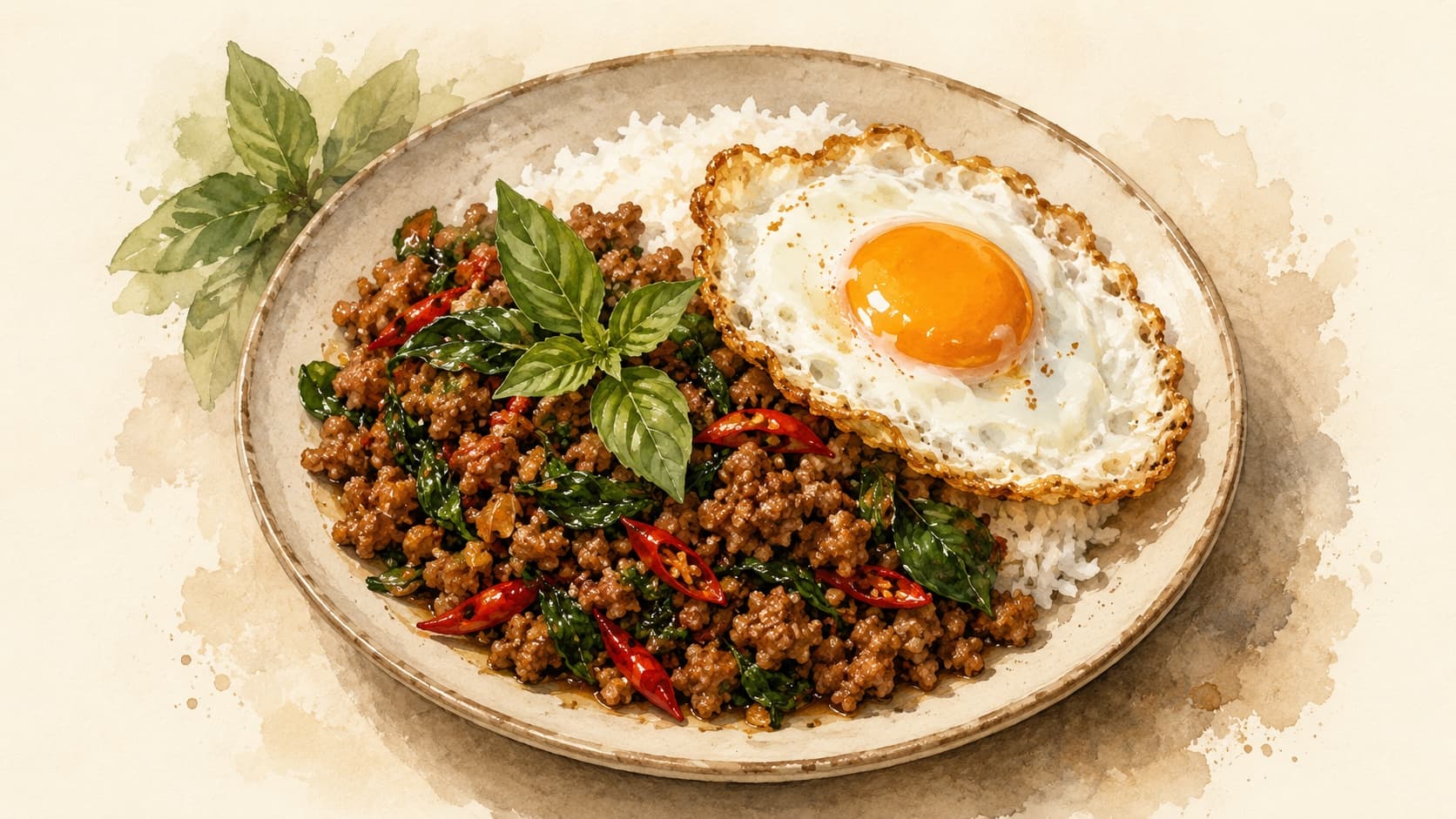
Target: A "kai dao" — Thai-style sunny-side-up fried egg with crispy lacy edges — served on top.
Why it matters: Pad krapao without the egg is incomplete. The runny yolk mixes into the rice and meat to round out the saltiness and intensity. This isn't garnish; it's a structural component.
What to do: Heat 1 tbsp oil in a separate pan until almost smoking. Crack the egg in (it will sizzle and bubble dramatically) and cook until edges are dark and crispy, yolk still runny — about 90 seconds.
Safety note (fried egg): The soft, runny yolk is an undercooked egg — softness, the glassy look, cooking time, and residual pan heat are not by themselves proof it is safe, and this method has no validated Salmonella kill step. To keep the runny yolk, use an egg pasteurized in the shell (treated through to the contents); ordinary freshness or a "raw-eating" (生食用) label is not the same as pasteurized. Otherwise cook the yolk fully through. High-risk diners (pregnancy, immunocompromised, very young or old) should use a pasteurized egg or a fully cooked yolk.
Workarounds:
- For dietary preferences, swap for soft tofu or skip — the dish is fine without, just less complete.
- For dinner parties, fry the eggs one at a time as portions are plated rather than holding warm.
Wrong sauce balance.
Target: 1 tbsp oyster sauce + 1 tsp dark soy + 1 tsp fish sauce + 1 tsp sugar + 1 tsp light soy per portion. Approximate; taste-adjust.
Why it matters: Pad krapao is a savory-sweet-spicy-aromatic balance. Bottled "Pad Krapao sauce" usually over-leans one direction (typically sweet). Building your own gives you control.
What to do: Mix the sauce ingredients in a small bowl BEFORE you start cooking. Add to the wok all at once after the meat is browned.
Workarounds:
- For a punchier version, add 1 tsp Thai chili paste or 1/2 tsp white pepper.
- For salt-conscious, halve the oyster + fish sauce, add 1 tsp Worcestershire to compensate for umami.
What to look for
- Bright green basil leaves.
- A rich, glossy sauce coating the meat.
- Minced meat evenly browned, not gray.
- A fragrant aroma of garlic and chilies wafting from the skillet.
Chef's view
Pad Krapao (literally "stir-fried with holy basil" — a Thai street-food classic with ground or chopped meat) is a staple in Thai cuisine, often enjoyed as a quick meal. The dish exemplifies the balance sought in Thai cooking—spicy, savory, and aromatic. Traditionally, it is made with either minced chicken or pork, but variations exist based on regional preferences.
This dish showcases the importance of fresh ingredients. The distinct flavor of Thai basil (Thai holy basil, Ocimum tenuiflorum — peppery and clove-scented, different from the sweet anise-leaning Italian basil) is irreplaceable, making it central to the dish’s identity. Understanding the balance of flavors and the significance of heat makes this simple meal authentic.
<!-- beginner-glossed v1 -->Get the essays in your inbox — free
Weekly notes on flavor, fermentation, and food history — the writing behind the Atlas of Flavor. No spam; unsubscribe anytime.