
Nikuman
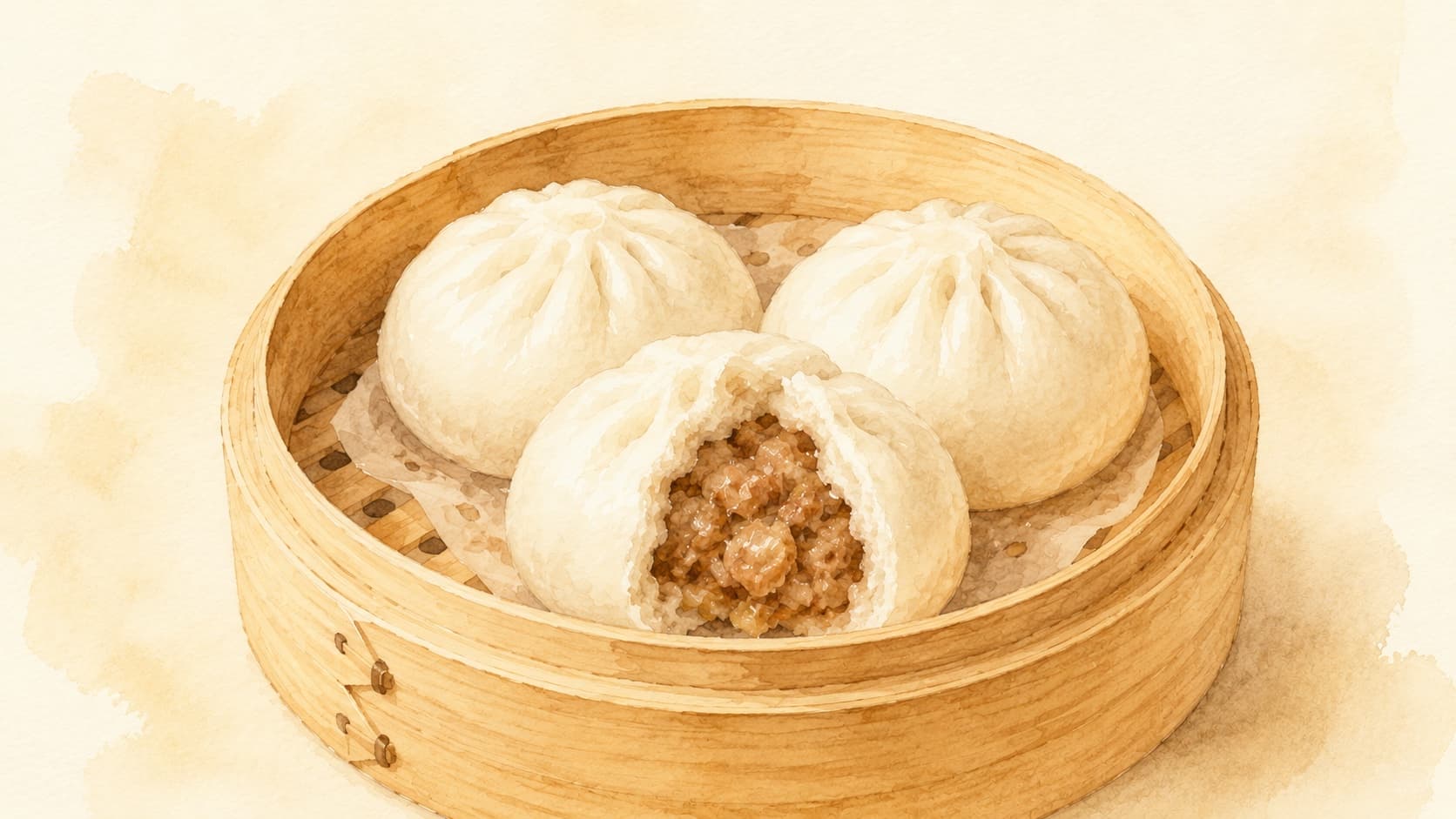
Nikuman combines a soft, steamed bun with a savory filling, showcasing the balance of texture and flavor in Japanese cuisine.
Contents (8 sections)▾
Ingredients
- 2 cups all-purpose flour
- 1 tablespoon sugar
- 1 teaspoon instant yeast
- 1/2 cup warm water
- 1 tablespoon vegetable oil
- 200g ground pork
- 1/4 cup chopped green onion
- 1 tablespoon soy sauce
- 1 tablespoon sesame oil
- 1 teaspoon grated ginger
- 1 teaspoon minced garlic
- salt to taste
Steps
In a bowl, mix flour, sugar, and yeast.
Add warm water and oil; knead until smooth.
Let dough rise for 30 minutes until doubled.
Combine pork, green onion, soy sauce, sesame oil, ginger, garlic, and salt.
Divide dough into portions, flatten, fill with meat mixture, and seal.
Steam for 15-20 minutes. The buns turning fluffy is a dough cue, not a meat cue — the filling is raw ground pork, so cut one bun open to confirm the filling is no longer pink and reaches 71 °C / 160 °F on an instant-read thermometer before serving.
Tools you'll want
Why this works
Nikuman relies on yeast for leavening (the rising action that makes dough light and airy), producing carbon dioxide that creates a light texture. The dough's hydration is crucial; too little results in dryness, while too much yields a sticky mass. A warm water temperature activates the yeast, promoting fermentation (the slow rising and flavor development as yeast feeds on the sugars in the dough). Allowing the dough to rise adequately develops flavor and elasticity.
The filling's balance is essential. A blend of pork, green onion, and seasoning creates an umami-dense core that complements the soft bun. The fat from the pork keeps the filling moist during steaming. Properly sealing the buns prevents leakage, ensuring the flavors meld during cooking.
Steaming produces a gentle heat that cooks the buns evenly. This method retains moisture, resulting in a tender, fluffy texture. Timing is critical; overcooking can lead to a rubbery consistency.
Common mistakes
Using cold water for yeast.
Target: Warm water at 35-40°C (body temperature) to activate dry yeast.
Why it matters: Cold water (<25°C) slows yeast activity dramatically; hot water (>50°C) kills yeast. The 35-40°C window is where yeast multiplies fast — bread rises in the expected 30-45 minutes.
What to do: Test with your finger — water should feel just warmer than skin. Thermometer for precision.
Workarounds:
- No thermometer → mix half cold + half just-boiled water in roughly 2:1 ratio for ~38°C.
Overfilling the buns.
Target: 40-50 g filling per bun, dough wrapper about 12 cm circle.
Why it matters: Overfilled buns can't seal tightly; filling pushes out during steaming. The dough also can't expand properly — result is dense, leaking buns.
What to do: Portion filling first (use a scale). Center on wrapper with clean borders for pleating.
Workarounds:
- Made filling too much → freeze excess for next batch; don't try to cram into wrappers.
Insufficient rising time.
Target: Dough doubles in size — 45-60 minutes in warm spot (25-28°C). Then second proof 15-20 min after shaping.
Why it matters: Under-risen dough = dense, gummy buns with no fluff. The second proof after shaping is non-optional — it lets the dough relax around the filling and pop during steaming.
What to do: Cover with damp cloth, warm spot (top of fridge, oven with light on). Visual check: doubled in volume.
Workarounds:
- Cold kitchen → slightly warm oven (off, just-warm interior) accelerates the rise.
Improper pleating/sealing.
Target: 12-18 pleats, pinched tightly at the top into a small twist.
Why it matters: Loose seals burst during steaming, releasing filling and broth into the steamer water. Traditional pleating creates strong structural integrity at the top.
What to do: Practice pleating: hold dough disc in non-dominant hand, pleat counter-clockwise with dominant hand. Pinch firmly at the top.
Workarounds:
- Pleating too hard → flat seam (closed dumpling style) is acceptable; less traditional but functional.
Steaming too long or too short.
Target: 15 minutes at high steam over rolling water boil. Check internal temp 80°C+ if uncertain.
Why it matters: Under-steamed = doughy bun with raw filling. Over-steamed = rubbery, dense bun (over-developed gluten under prolonged moist heat).
What to do: Set timer. Don't open steamer during cooking — release of steam drops temperature and causes collapse.
Workarounds:
- Multi-layer steamer → rotate layers halfway for even cooking.
Crowded steamer.
Target: Buns spaced 3 cm apart — they expand during steaming.
Why it matters: Touching buns merge into a single mass during steaming, ruining presentation and uneven cooking.
What to do: Parchment circles under each bun to prevent sticking. Steam in batches if needed.
Workarounds:
- Smaller buns → space can be closer (2 cm); still maintain gaps.
What to look for
- Buns should be fluffy and slightly glossy.
- The filling should be fully cooked and juicy.
- Buns should hold their shape without collapsing.
- A slight sheen on the surface indicates proper steaming.
- Avoid any burnt or darkened areas on the buns.
Substitutions
- Pork shoulder → 70/30 pork-and-shrimp. Adds a Cantonese register; texture stays plump if the shrimp is finely chopped, not pulverized.
- Shiitake → cremini or oyster mushroom + 1 tsp soy. Loses the deep umami of dried shiitake; the soy compensates for some of it.
- Sesame oil at finishing — non-negotiable. Toasted aroma rounds the filling. Plain neutral oil reads under-seasoned.
- All-purpose flour → cake flour at 50/50. Slightly softer steamed-dough texture, more like a Cantonese bao than a Japanese nikuman.
Make-ahead and storage
- Filling can be made a day ahead. Refrigerate covered; the flavor improves overnight as soy and shoyu penetrate the meat.
- Steamed nikuman freeze beautifully. Cool fully, freeze individually on a tray, then bag. They keep 1 month and are arguably better re-steamed than fresh.
- Re-steam — do not microwave to revive. From frozen: 8–10 minutes in a steamer. From refrigerated: 4–5 minutes. The dough rehydrates and pillows back to the original texture.
- Microwave from frozen is acceptable for emergencies (45 seconds wrapped in a damp paper towel), but the texture is noticeably tougher than steamed.
- Raw filling refrigerated keeps 2 days. Discard if liquid pools dramatically, smell turns sour, or color shifts — the filling is a high-moisture protein mix and degrades faster than a roast.
Chef's view
Nikuman has deep roots in Japanese street food culture, often enjoyed during colder months. It embodies the principle of harmony—soft, warm buns enveloping a savory filling. The dish reflects the Japanese ethos of simplicity and balance, making it a comfort food staple.
The technique of steaming is integral to preserving moisture and flavor, distinguishing Nikuman from other dumplings. The variety of fillings showcases regional diversity, allowing for creative adaptations while honoring tradition.
Related glossary terms
<!-- beginner-glossed v1 -->Get the essays in your inbox — free
Weekly notes on flavor, fermentation, and food history — the writing behind the Atlas of Flavor. No spam; unsubscribe anytime.