
New York Cheesecake
A classic dessert characterized by its dense and creamy texture, achieved through precise ingredient ratios and baking techniques.
Contents (5 sections)▾
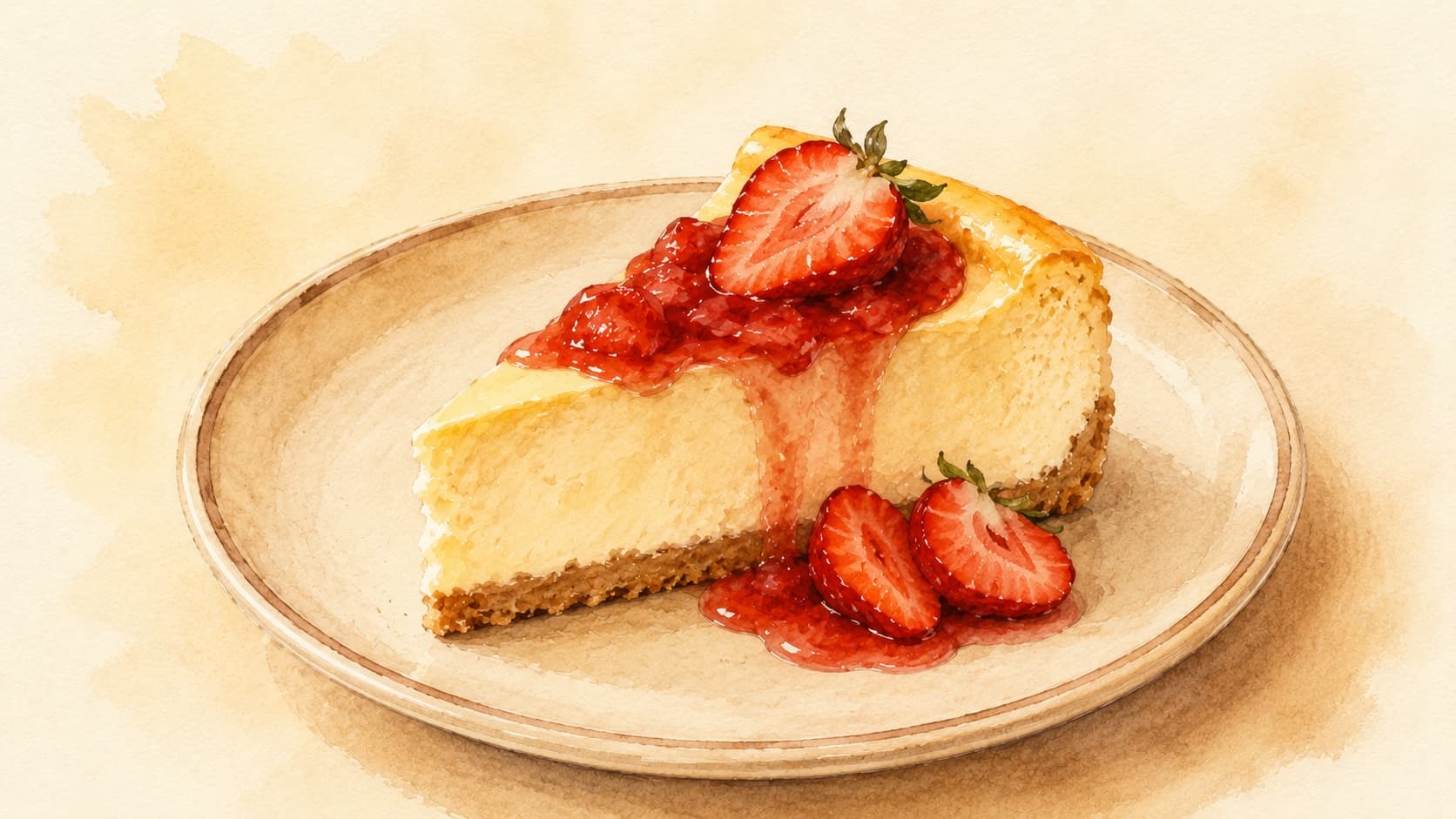
Ingredients
- 1 1/2 cups graham cracker crumbs
- 1/4 cup granulated sugar
- 1/2 cup unsalted butter, melted
- 4 (8 oz) packages cream cheese, softened
- 1 1/4 cups granulated sugar
- 1 teaspoon vanilla extract
- 4 large eggs
- 1 cup sour cream
Steps
Preheat oven to 325°F (160°C).
Combine graham cracker crumbs, 1/4 cup sugar, and melted butter in a bowl; press into the bottom of a springform pan.
In a large bowl, beat softened cream cheese until smooth; gradually add 1 1/4 cups sugar and vanilla.
Add eggs one at a time, mixing on low speed until just combined; fold in sour cream.
Pour filling over the crust and bake for 20 minutes until set but still slightly wobbly in the center.
Cool at room temperature, then refrigerate for at least 4 hours before serving.
Tools you'll want
Why this works
The New York cheesecake's density stems from the high cream cheese content and the minimal incorporation of air during mixing. This results in a rich and smooth texture. The eggs provide structure, while the sour cream adds tang and creaminess, balancing flavors.
The crust, made from graham cracker crumbs, contributes a slight crunch and sweetness, complementing the creamy interior. Baking at a consistent low temperature in a springform pan (a round pan with removable sides that release the cake without flipping) ensures even cooking, preventing cracks and maintaining a silky texture. Cooling gradually allows the cheesecake to set properly without sudden temperature changes that can lead to cracking.
Achieving the perfect consistency involves careful mixing. Overbeating can introduce too much air, leading to a lighter texture, which is not typical of New York cheesecake. The key is to mix until just blended.
Common mistakes
Cold ingredients.
Target: Cream cheese, eggs, sour cream — all at ROOM TEMPERATURE before mixing. About 20 °C.
Why it matters: Cold cream cheese stays in lumps that won't smooth out no matter how long you beat. Beating harder to compensate incorporates air, which causes the cake to puff and crack in the oven.
What to do: Pull cream cheese from fridge 2+ hours before baking. Eggs and sour cream, 1 hour minimum.
Workarounds:
- Forgot to soften? Microwave cream cheese for 30 seconds (unwrapped, on a plate). Stir, microwave another 15 seconds. Should be soft but not melted.
Overmixing the batter.
Target: Mix on LOW speed only. Just enough to combine ingredients into a smooth, glossy batter.
Why it matters: High-speed beating incorporates air bubbles. These expand in the oven, then collapse as the cake cools, producing cracks and a less-dense texture. NY cheesecake should be DENSE.
What to do: Use the paddle attachment (not whisk) on the lowest speed. Scrape sides often. Stop the moment ingredients are uniform.
Workarounds:
- Bubbles formed? Let the batter rest 10 minutes before pouring — bubbles rise and pop.
Baking too hot or without water bath (a tray of hot water that surrounds the pan to provide gentle, even heat).
Target: 160 °C, in a water bath (bain-marie) — pan wrapped in foil, surrounded by hot water reaching halfway up the sides.
Why it matters: High direct heat sets the outside long before the center, producing cracks and uneven texture. The water bath insulates and the lower temperature lets the custard set evenly.
What to do: Wrap springform in 2 layers of heavy foil (prevents water seepage). Place in a roasting pan. Add boiling water around it AFTER both are in the oven (safer than carrying water).
Workarounds:
- No water bath? Place a separate pan of water on the rack below — adds humidity without the wrap. Less effective but better than nothing.
Pulling too early or too late.
Target: Edges set, center has a wobble zone about the size of a coin when nudged. Internal temperature 70 °C.
Why it matters: Cheesecake continues setting as it cools. "Looks done" usually means "will be overbaked at service." Conversely, "definitely jiggly" means "raw center."
What to do: Check at 60 minutes. Nudge the pan — should wobble like Jell-O in the center.
Workarounds:
- For ultimate reliability, use a thermometer — 70 °C in the dead center is done.
Sudden temperature changes.
Target: Turn oven OFF, crack the door, let cheesecake sit for 1 hour in the cooling oven. Then room temperature 1 hour. Then refrigerate.
Why it matters: Hot cheesecake hitting cold air contracts suddenly, which causes cracks. The three-stage cool (oven-off → counter → fridge) eases the cake down gradually.
What to do: Plan ahead. The cool process alone takes 2 hours before refrigeration.
Workarounds:
- For dinner parties, bake the day before — cheesecake is BETTER after overnight chilling.
Skipping the chill.
Target: Minimum 8 hours refrigeration, ideally 24 hours.
Why it matters: Cheesecake's structure sets during the cold rest — the proteins and fats firm up into the dense, sliceable texture. Cut too soon and it's slumpy.
What to do: Make the day before serving. The wait is not optional.
Workarounds:
- Emergency 4-hour chill works but slices will be softer.
Wrong cream cheese.
Target: Full-fat block cream cheese (Philadelphia or equivalent). NOT spreadable, NOT whipped.
Why it matters: Spreadable cream cheese contains gums and gelatin to stay soft — these prevent the cake from setting properly. Whipped cream cheese has air already incorporated.
What to do: Block cream cheese only. Check the label for "cream cheese, salt, stabilizers" — minimum ingredients.
Workarounds:
- Low-fat versions exist but produce notably less rich cheesecake. Skip for special occasions.
What to look for
- A slightly wobbly center when baking is complete.
- A golden-brown crust that is firm but not overly hard.
- A smooth and even surface with no cracks.
- A rich, creamy texture when slicing.
- A slight sheen on the top from the sour cream layer.
Chef's view
The New York cheesecake has roots in early American cuisine but is heavily influenced by European traditions, particularly from Germany and Italy. Its evolution reflects the adaptability and creativity of American baking.
This cheesecake is often enjoyed during celebrations and gatherings. The technique emphasizes precision, requiring attention to detail for the ideal texture and flavor balance. Each bite should deliver a harmonious blend of creamy, tangy, and sweet elements, making it a timeless dessert choice.
<!-- beginner-glossed v1 -->Get the essays in your inbox — free
Weekly notes on flavor, fermentation, and food history — the writing behind the Atlas of Flavor. No spam; unsubscribe anytime.