
Lemon Tart
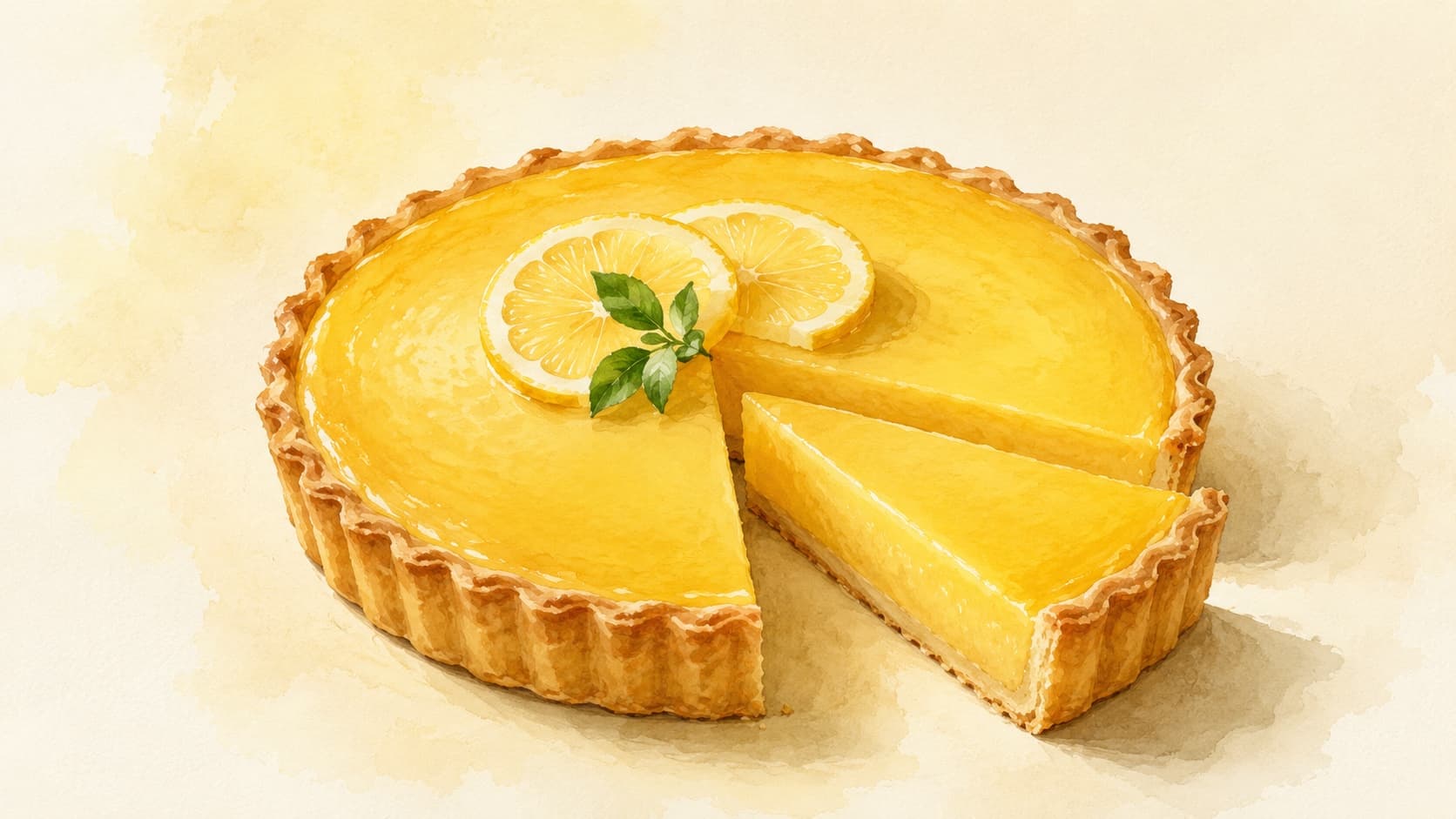
A balanced combination of crust and citrus filling creates a classic French dessert.
Contents (5 sections)▾
Ingredients
- 1 1/4 cups all-purpose flour
- 1/2 cup unsalted butter, chilled and diced
- 1/4 cup granulated sugar
- 1/4 teaspoon salt
- 1 large egg yolk
- 1/4 cup fresh lemon juice
- 1 tablespoon lemon zest
- 3/4 cup granulated sugar
- 2 large eggs
- 1 large egg white
- 1/4 cup heavy cream
- Powdered sugar for dusting
Steps
Preheat oven to 350°F (175°C).
In a bowl, combine flour, butter, sugar, and salt until crumbly.
Add egg yolk and mix until dough forms; press into a tart pan.
Blind bake the crust for 15 minutes; remove and cool.
In another bowl, whisk together lemon juice, zest, sugar, eggs, and cream.
Pour filling into the crust and bake for 20 minutes; cool before serving.
Tools you'll want
Why this works
The balance of acidity in the lemon juice and the sweetness from sugar creates a harmonious flavor. The crust, made with butter and flour, provides a firm base that contrasts the smooth filling. Baking at 350°F ensures a gentle setting of the filling without curdling the eggs. The addition of cream yields a rich texture that complements the tartness of the lemons.
The dough needs to be chilled before baking to maintain its structure. Blind baking prevents the crust from becoming soggy, allowing it to hold its shape during the filling process. The use of egg yolks enriches the filling, while the egg white can be discarded to streamline the recipe.
Common mistakes
Overbaking the curd filling.
Target: Pull from the oven when the center wobbles slightly (a 4–5 cm zone), edges fully set. Internal temperature 75 °C.
Why it matters: Lemon curd continues to set as it cools — pulling at "perfectly firm" produces a rubbery, weeping result. The window between "underbaked" (won't slice cleanly) and "overbaked" (rubbery, syneresis) is narrow.
What to do: Start checking at 18 minutes for a 23 cm tart. Nudge the pan — the wobble should be like Jell-O, not liquid.
Workarounds:
- Overbaked tart: still edible, just less luxurious. Mask with extra whipped cream on serving.
- For absolute reliability, use a digital probe thermometer — 75 °C is the magic number.
Using bottled lemon juice.
Target: Freshly squeezed lemon juice from heavy, fragrant lemons (Meyer or Eureka). Plus zest from 2 lemons per tart for aromatic depth.
Why it matters: Bottled lemon juice has been pasteurized, losing the volatile aromatic compounds (citral, linalool) that give the curd its fresh character. The acidity will be there, but the personality won't.
What to do: Buy lemons heavy for their size — heavier = more juice. Zest before juicing.
Workarounds:
- For more complexity, blend in 1 tbsp lime juice or 1 tsp yuzu juice for a brighter top-note.
- Out of season? Frozen lemon juice cubes (frozen at peak season) are far better than bottled.
Skipping the blind bake.
Target: Blind bake at 180 °C for 20 minutes covered with parchment + pie weights, then 8–10 minutes uncovered until pale gold and dry to the touch.
Why it matters: The lemon curd is wet. Without a pre-baked crust, you get soggy bottom — the most universally disappointing pastry texture.
What to do: Use pie weights, dried beans, or even rice (label and reuse). Brush the par-baked crust with egg white and return to the oven for 2 minutes to create a moisture barrier.
Workarounds:
- No pie weights? Wad up parchment tightly into a ball and use that — works surprisingly well.
- "Cheat" moisture barrier: dust the cooled blind-baked crust with a tablespoon of powdered sugar or fine breadcrumbs before adding the curd.
Pastry dough warm or under-rested.
Target: Rest dough chilled for 1 hour minimum before rolling, AND another 30 minutes after rolling into the pan before baking.
Why it matters: Warm pastry doesn't hold shape and shrinks in the oven (creating a tart with shorter, deformed sides). The double-rest allows gluten to relax and butter to firm — both essential for clean, sharp tart sides.
What to do: Make dough the day before. Pre-rest. Roll. Pan. Rest again. Bake.
Workarounds:
- Tight schedule? Freeze the rolled, panned crust for 20 minutes instead of refrigerating for 30. Same effect.
- For maximum sharpness on the sides, freeze the crust before blind baking — minimizes shrinkage.
Adding the filling to a warm crust.
Target: Fill the crust while it's still WARM (just out of the blind bake), with WARM curd. Both around 60 °C.
Why it matters: The "warm into warm" technique creates a chemical bond between the curd and crust surface — no separation, no weeping. Cold curd into a cold crust often delaminates.
What to do: Time the curd to be ready as the blind bake finishes. Pour, level, return to oven for the final set.
Workarounds:
- If your timing is off, reheat the crust briefly (5 minutes at 100 °C) before adding warm curd.
- For a cold-assembly tart (Italian style), use a higher-pectin curd (add 1/2 tsp gelatin) and chill the whole assembly overnight.
Using bottled "lemon extract."
Target: Real lemon zest, fresh, microplaned directly into the curd base.
Why it matters: Lemon extract is a synthetic flavor compound that captures the citral but none of the complex peel oils. The result is one-dimensional — "lemon flavored" rather than "tasting of lemon."
What to do: Zest only the yellow part, avoiding the bitter white pith. Use 2 lemons' worth of zest per tart.
Workarounds:
- Stale zest? Toast it briefly in dry butter for 30 seconds to revive volatile oils before adding.
- For an aromatic boost, infuse the zest in warm cream or milk for 30 minutes before making the curd — even more flavor extraction.
What to look for
- A golden-brown crust.
- A slightly set filling with a slight jiggle.
- Even color across the tart surface.
- Glossy finish on the filling.
Chef's view
Lemon tart is a quintessential French dessert, often featured in patisseries. Its origins date back to the Middle Ages, evolving through various cultural influences. The tart captures the essence of French cuisine—simple ingredients enhanced through technique.
The textural contrast between the crisp crust and the creamy filling is vital. The tart is versatile, serving as a refreshing end to a meal or a delightful afternoon treat. Techniques refined over generations ensure that each bite is a balance of tart and sweet, showcasing the beauty of lemon.
<!-- beginner-glossed v1 -->Get the essays in your inbox — free
Weekly notes on flavor, fermentation, and food history — the writing behind the Atlas of Flavor. No spam; unsubscribe anytime.