
Gougères
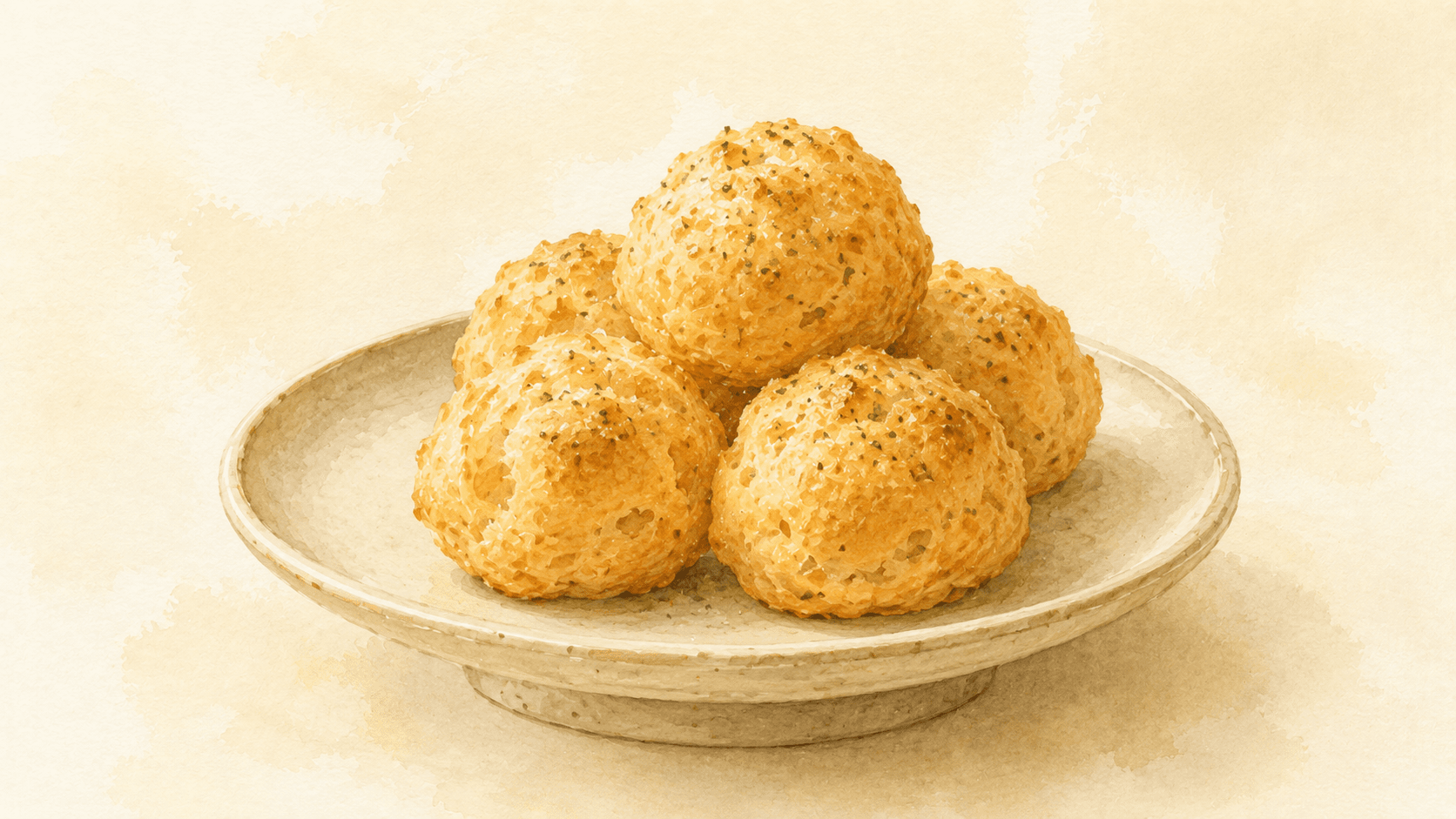
Savory choux pastry puffs made with Gruyère folded into the paste before baking. Gougères are light because the choux dough relies on steam — not chemical leavening — for its rise.
Contents (7 sections)▾
Ingredients
- 120 ml water
- 120 ml whole milk
- 85 g unsalted butter
- ½ tsp fine salt
- pinch of white pepper
- pinch of freshly grated nutmeg
- 130 g all-purpose flour — sifted
- 4 large eggs
- 100 g Gruyère — finely grated (or Comté)
Steps
Bring water, milk, butter, salt, white pepper, and nutmeg to a full boil in a medium saucepan. The butter must be fully melted before boiling begins — if the liquid boils before the butter is incorporated, water evaporates and the ratio of liquid to flour shifts. Once at a full boil, remove from heat.
Add the sifted flour all at once and stir vigorously with a wooden spoon until a smooth paste forms and pulls away from the sides of the pan. Return to medium heat and continue stirring for 2–3 minutes until a thin film forms on the bottom of the pan. This drying step is critical — excess moisture in the paste will limit how many eggs the dough can absorb and will produce flat, dense puffs.
Transfer the paste to a bowl and allow it to cool for 5 minutes until it no longer steams aggressively (around 60°C). Add the eggs one at a time, beating vigorously after each addition until fully incorporated before adding the next. The paste will look as though it has broken after the first egg — continue beating. The finished paste should fall from the spoon in a slow ribbon and hold a V-shape when the spoon is lifted. If it falls in a single mass, it needs more egg. If it pours freely, too much egg has been added.
Fold in the grated Gruyère until evenly distributed. Pipe or spoon the paste onto a parchment-lined baking sheet in mounds about 3 cm wide and 2 cm high, spacing them 4 cm apart. Wet your finger and press any peaks down lightly — this prevents them from burning.
Bake at 220°C for 10 minutes until puffed, then reduce to 180°C without opening the oven door and bake for a further 15 minutes until golden and firm. Do not open the oven during the first 20 minutes. The internal steam that causes the puff will escape if the oven is opened early, and the gougères will deflate. They are done when they sound hollow when tapped on the bottom.
Why this works
Gougères (small savory French puffs of cheese-laced choux dough) rise because of steam, not baking powder. Understanding this mechanism explains every step in the preparation and most of the common failures.
The choux paste (a cooked flour-and-egg dough that puffs up with steam in the oven) is made from a cooked starch paste — the panade — in which the flour's starch granules have been gelatinized by the hot liquid. This gelatinized network is what makes the paste cohesive and elastic. When eggs are added and beaten in, they contribute additional protein networks (primarily from the egg white) and water. The fat from the butter and the egg yolk coats the flour particles and creates the characteristic richness of choux.
When choux enters a hot oven, the water in the dough — from both the egg whites and the milk and water in the panade — converts to steam. The gelatinized starch and egg protein structure is strong enough and elastic enough to stretch and hold around the expanding steam pocket rather than bursting. This is the puff. The structure sets as the proteins denature and the exterior crust dries, holding the expanded form permanently.
The drying step — cooking the paste over heat after adding the flour until a film forms on the pan — is not a stylistic formality. It removes moisture from the gelatinized paste before the eggs go in. If the paste is too wet, it will not be able to absorb the correct number of eggs; the final paste will be too liquid, the steam will escape through a thin crust rather than building pressure, and the gougère will not puff effectively.
The cheese serves structural and flavor roles simultaneously. Folded into the paste after the eggs are incorporated, the Gruyère's fat contributes to a more tender crumb and a browned, fragrant crust. Its salt adjusts the overall seasoning. Gruyère is preferred over milder cheeses because its sharpness and slightly nutty character are audible against the neutral richness of choux. Comté, an adjacent Swiss-style cheese from France's Jura region, is a close substitute.
Common mistakes
Too much liquid in the panade.
Target: Butter fully melted before the liquid hits a rolling boil. Use a wide saucepan (20+ cm).
Why it matters: If the liquid boils before butter incorporates, water evaporates and the liquid-to-flour ratio shifts. Result: under-hydrated paste that can't absorb enough egg, leading to dense flat puffs.
What to do: Cut butter into small cubes for fast melting. Bring up to boil gently — watch for full butter integration before the surface bubbles vigorously.
Workarounds:
- Already evaporated some? Add 1 tbsp more milk at the boil to compensate.
Under-drying the paste over heat.
Target: Thin film forms on the pan bottom — about 2 minutes of continuous stirring after flour addition.
Why it matters: The film is the visual indicator that excess moisture has been driven off. Wet paste = can't absorb the right number of eggs = liquid final paste = no puff. This step is non-skippable.
What to do: Stir continuously over medium heat. Watch for the film — when the bottom shows a thin pale-yellow layer that follows the spoon, you're done.
Workarounds:
- Stove too weak to get a film? Stir 30 seconds longer at the highest heat you can manage.
Adding eggs too quickly.
Target: Each egg fully absorbed before adding the next. Paste must cool to ~60°C before the first egg.
Why it matters: Hot paste (>70°C) cooks the egg protein on contact — scrambled bits in the dough. Too-fast egg addition leaves visible separation; the paste won't recover its smooth structure even with extended beating.
What to do: Wait 5 minutes after pulling paste off heat. Add eggs one at a time, beating fully smooth between each.
Workarounds:
- Stand mixer with paddle attachment → faster and more uniform than hand mixing; still add one egg at a time.
Opening the oven door early.
Target: Do not open for the first 20 minutes.
Why it matters: The steam inside the gougère is the rising agent. Opening the door = pressure drops, steam escapes, crust hasn't set, gougères deflate. They will not recover.
What to do: Set a timer. Check through the oven window only. Open only when the timer says 20 minutes minimum AND gougères are visibly puffed and golden.
Workarounds:
- Need to rotate the pan for uneven heat? Wait until 15 minutes minimum and rotate quickly (under 3 seconds) — risky but sometimes necessary.
Undercooked gougères.
Target: Hollow sound when tapped on the bottom. Firm to touch, deep golden color.
Why it matters: A gougère with a wet interior collapses within minutes of leaving the oven — the steam structure couldn't fully set, and gravity wins. The exterior may look perfect, but the inside is still raw choux paste.
What to do: Take one out at 25 minutes, tap test. If dull thud or feels heavy, return all for 3-5 more minutes.
Workarounds:
- Edges browning before centers cook → drop oven to 170°C for the last 5 minutes — slow internal drying without over-browning.
What to look for
- After flour addition: paste is smooth, pulls from sides and bottom of pan, no lumps.
- After drying over heat: thin film on bottom of pan. Paste should not be glossy.
- Correct consistency before piping: paste falls in a slow, thick ribbon; holds a definite V-shape.
- Mid-bake (10 minutes): gougères visibly puffed and beginning to color. Do not open.
- Done: deep golden, firm to the touch, hollow sound when tapped on the bottom.
Chef's view
Gougères are among the most versatile items in the French baking repertoire because their savory richness and lightness make them equally appropriate as an aperitif accompaniment, an amuse-bouche, or a component of a cheese course. They are one of the few preparations where knowing the underlying mechanism — steam leavening — gives a practical advantage: once the physics are understood, the method becomes logical rather than prescriptive.
The classic pairing is with Burgundian wine, both white and red, because the fat and salt of the cheese amplify the aromatic compounds in the wine while the lightness of the choux does not overwhelm a glass-side bite. But they are also excellent with sparkling wine, with aged cider, or simply warm from the oven by themselves.
Chef Test Notes
Tested with Gruyère, Comté, and a mild cheddar. Gruyère produced the best result — the sharpness was clearly audible in the finished gougère and the browning was deeper. Comté was nearly identical. Mild cheddar was acceptable but produced a less complex flavor.
Tested drying time: 1 minute, 2 minutes, and 3 minutes over heat after flour addition. At 1 minute, the paste was slightly wetter and the finished gougère was a bit less pronounced in its hollow. At 3 minutes, no noticeable difference from 2 minutes. Two minutes until film forms is the reliable benchmark.
Tested the oven-open failure deliberately: opening the door at 8 minutes caused visible deflation in half the batch within 2 minutes of re-closing the oven.
Related glossary terms
- Choux pastry — the base preparation this recipe is built on
- Maillard reaction — responsible for the golden crust color and flavor
- Gelatinization — the starch transformation when flour is cooked in liquid to form the panade
Get the essays in your inbox — free
Weekly notes on flavor, fermentation, and food history — the writing behind the Atlas of Flavor. No spam; unsubscribe anytime.