
Gastrique
Equal parts sugar and vinegar caramelized together — the sweet-acid base that anchors fruit sauces and teaches caramelization physics in a single ingredient.
Contents (7 sections)▾
Ingredients
- 100 g white sugar
- 100 ml white wine vinegar (or red wine vinegar, or fruit-appropriate vinegar)
- Optional: 1 tablespoon water, to help the initial dissolve
Steps
Combine sugar and optional water in a small heavy saucepan. Cook over medium-high heat without stirring — swirl the pan gently if needed to distribute heat. The sugar will melt and begin to color. Watch the color progression: pale gold → amber → dark amber. The target is dark amber (165–175°C), the color of a copper coin or dark honey. At this stage, the sugar has caramelized fully and developed its characteristic bitter-sweet depth.
Add the vinegar off heat. Remove the pan from the heat and — standing back from the pan — pour in the vinegar carefully. The hot caramel will react violently: it will spit, steam explosively, and may partially solidify as the cold liquid meets the hot sugar. This is normal. Return the pan to medium heat.
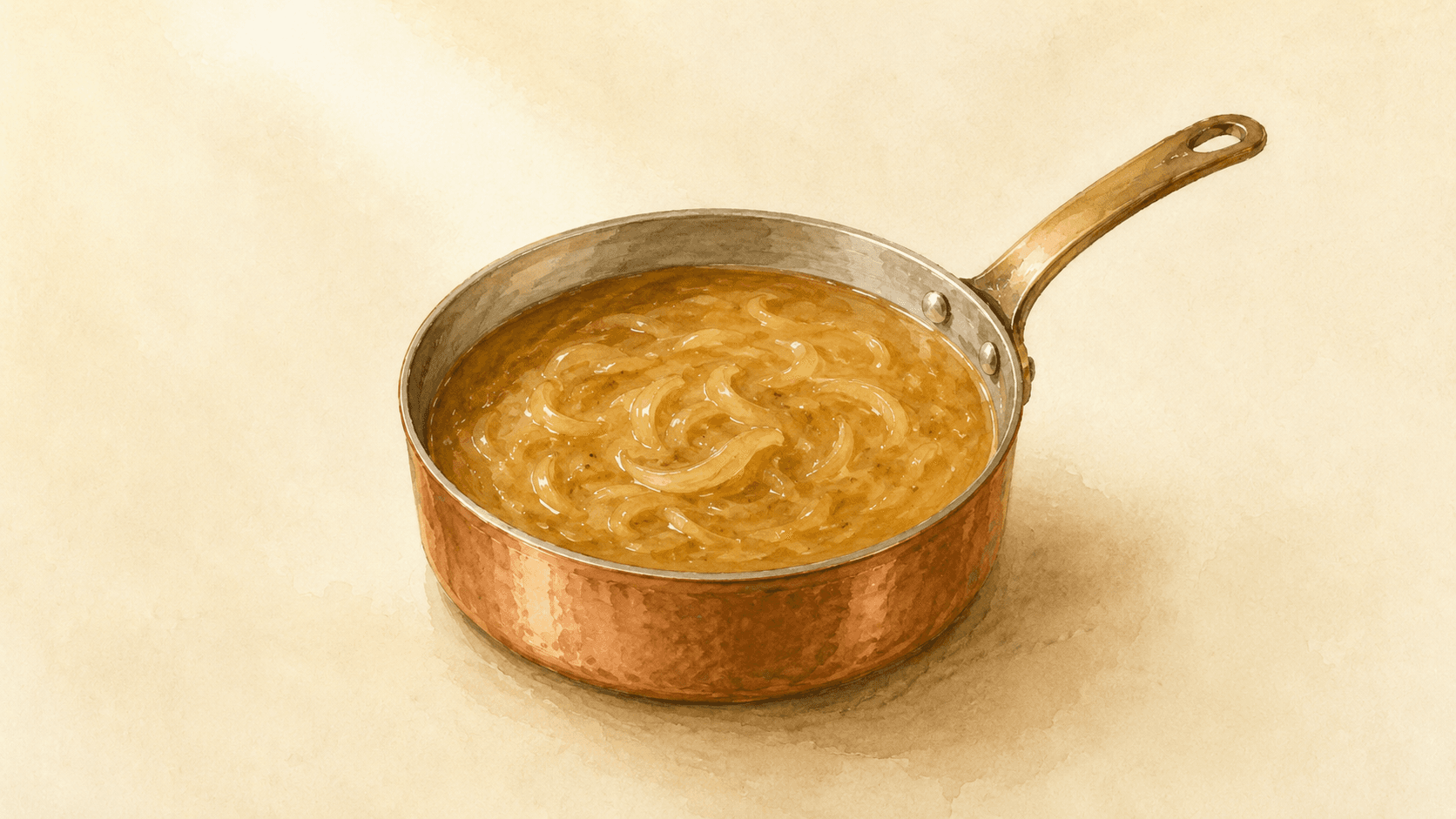
Stir and dissolve. Over medium heat, stir constantly until all the solidified caramel has dissolved back into the vinegar and the liquid is smooth and uniform. This takes 2–3 minutes. The gastrique will be dark amber, fluid, and strongly aromatic — both sweet and sharply sour, with a slight bitter edge from the caramel. Taste carefully (it is very hot). The acidity should be forward but not raw.
Use immediately or store. Gastrique can be used right away as the base for a sauce (add to fond, add fruit juice, finish with butter — see Sauce Bigarade). Or cool completely and store in a sealed jar in the refrigerator for up to 2 weeks. It will thicken significantly when cold; rewarm gently to use.
Tools you'll want
- · Tri-ply stainless saucepan (1.5–2 qt / 18cm)
Why this works
A gastrique (a vinegar-and-sugar reduction that lifts savory sauces) is one of the most information-dense recipes in the French repertoire: a single compound made from two ingredients that teaches caramelization physics, acid-base balance, and sauce construction simultaneously.
The caramelization sequence is the first lesson. White sugar, applied to heat, goes through several phase transitions. First it melts (140–150°C); then it begins to caramelize — a term that covers a complex set of thermal decomposition and recombination reactions that produce hundreds of aromatic compounds, brown color (from glucose polymers called caramelans, caramelens, and caramelins), and a characteristic bitter-sweet flavor. The progression from pale amber (approximately 160°C) to dark amber (approximately 175°C) to black (185°C+) is fast — often faster than it looks — and the window for a correct gastrique is about 10–15°C wide. Understanding where the target is (dark amber, not black, not pale) and developing the eye to stop the cooking at the right moment is the skill the gastrique teaches.
The vinegar addition is the second lesson. Pouring cold liquid into hot caramel is an exothermic shock: the caramel contracts, spits, partially solidifies, and produces a violent cloud of steam. This is chemistry in real time — the caramel's temperature drops from ~175°C to the boiling point of vinegar (~118°C for acetic acid solution), and the physical contraction of the caramel creates the solidification. Returning the pan to heat and stirring dissolves the solidified bits back into solution. The result is a single liquid that contains caramel's aromatic compounds in an acidic medium — chemically stable, stored as a stable sauce base.
The gastrique's role in fruit sauces is to balance what would otherwise be overly sweet or overly acidic flavor profiles. A bigarade sauce made with just bitter orange juice and fond would be sour and flat; the caramel adds depth, color, and the sweet-bitter note that makes bitter orange readable rather than harsh. A cherry sauce made with just cherry juice and stock would taste simple; gastrique makes it taste structured. The same logic applies to any fat-rich savory context — game, duck, pork liver — where an acidic-sweet counterpoint is needed.
Common mistakes
Stirring the caramel.
Target: Swirl the pan, never stir. Even heat from gentle pan movement.
Why it matters: Stirring introduces air and uneven heat — sugar can crystallize back into granular form (seizes into a mass). Swirling distributes heat without disturbing the crystal structure.
What to do: Lift and tilt the pan. Don't insert a spoon or whisk into the syrup.
Workarounds:
- Crystallized → start over; cannot recover crystallized sugar in a small batch.
Under-cooking the caramel.
Target: Dark amber, 165-175°C — color of dark honey or copper coin.
Why it matters: Pale gold lacks the bitterness that gives gastrique its complex character. The flavor compounds form specifically at the dark amber stage.
What to do: Watch color carefully. Pale → gold → wheat → dark honey → COPPER (stop). Past copper = burnt.
Workarounds:
- Burned past dark amber → start over; bitterness is irreversible.
Pouring vinegar too fast.
Target: Slow steady pour from the side, pan off heat, step back. Vinegar will boil violently on contact.
Why it matters: Fast pour = violent reaction, spatter, possible burns, increased risk of burning the caramel. The thermal shock and steam need to be controlled.
What to do: Take pan off heat, pour vinegar slowly down the side of the pan, stand back as it sputters.
Workarounds:
- Warm vinegar before pouring (briefly microwaved) for less thermal shock.
Not dissolving solidified caramel chunks.
Target: Return to heat after vinegar, stir over heat 2-3 min until completely smooth — no chunks remaining.
Why it matters: Chunks left in finished gastrique will burn in the next cooking step (when added to a sauce). All caramel must be re-dissolved into the vinegar.
What to do: Return to medium heat, stir gently, let chunks melt back into the liquid.
Workarounds:
- Stubborn chunks → strain through fine mesh to remove; small loss but salvageable.
Storing while hot.
Target: Cool to room temperature before sealing in a jar.
Why it matters: Hot gastrique sealed creates pressure (could pop the lid), and condensation traps moisture that affects shelf life.
What to do: Cool open in the pan, then transfer to a clean glass jar.
Workarounds:
- Need to use immediately → leave open until used; no storage needed.
What to look for
- Before the caramel: sugar granules in pan, no color.
- Melting: edges melt first, then center; swirl occasionally to distribute.
- Pale gold: color of wheat — this is not done yet.
- Dark amber: color of dark honey, copper coin — stop here. Target.
- After vinegar: violent steam, partial solidification — normal.
- Finished gastrique: smooth, fluid, dark amber, strong sweet-acid aroma.
Chef's view
Gastrique is one of the recipes I use as a teaching tool for caramelization for the same reason a pastry chef might use it: there are no other ingredients to distract from the caramel itself. When students learn Maillard browning with meat, the meat's protein and fat provide many variables. When they learn caramelization with a gastrique, it is sugar, heat, and time — the simplest possible system for observing the color progression and developing an eye for the target.
The sweet-acid pairing logic in gastrique is also more broadly useful than its duck sauce context implies. Anywhere a dish needs simultaneous sweetness and acidity in concentrated form — vinaigrettes that need more than vinegar alone, dessert sauces, reduced fruit glazes — the gastrique principle of pre-caramelizing the sugar before adding acid produces a more complex, layered result than adding sweet and sour elements separately.
Chef Test Notes
I tested gastriques at three color depths: pale amber (160°C), dark amber (175°C), and nearly burnt (182°C). The pale amber gastrique was essentially just reduced sweetened vinegar — usable but flat. The dark amber version was significantly more complex: bitter-sweet, fragrant, with the characteristic depth that makes bigarade and similar sauces work. The 182°C version had a detectable acrid note that persisted even after adding fond and orange juice. The 175°C target is not approximate — an extra 5 degrees makes a real flavor difference.
Related glossary terms
- Caramelization — the thermal decomposition chemistry the gastrique is built on
- Reduction — the water-evaporation step that concentrates both the caramel and the acid
- Maillard reaction — the related but distinct browning chemistry that occurs in proteins, not sugar
- Sauce bigarade — the most common sauce application of gastrique
Get the essays in your inbox — free
Weekly notes on flavor, fermentation, and food history — the writing behind the Atlas of Flavor. No spam; unsubscribe anytime.