
Crème Caramel
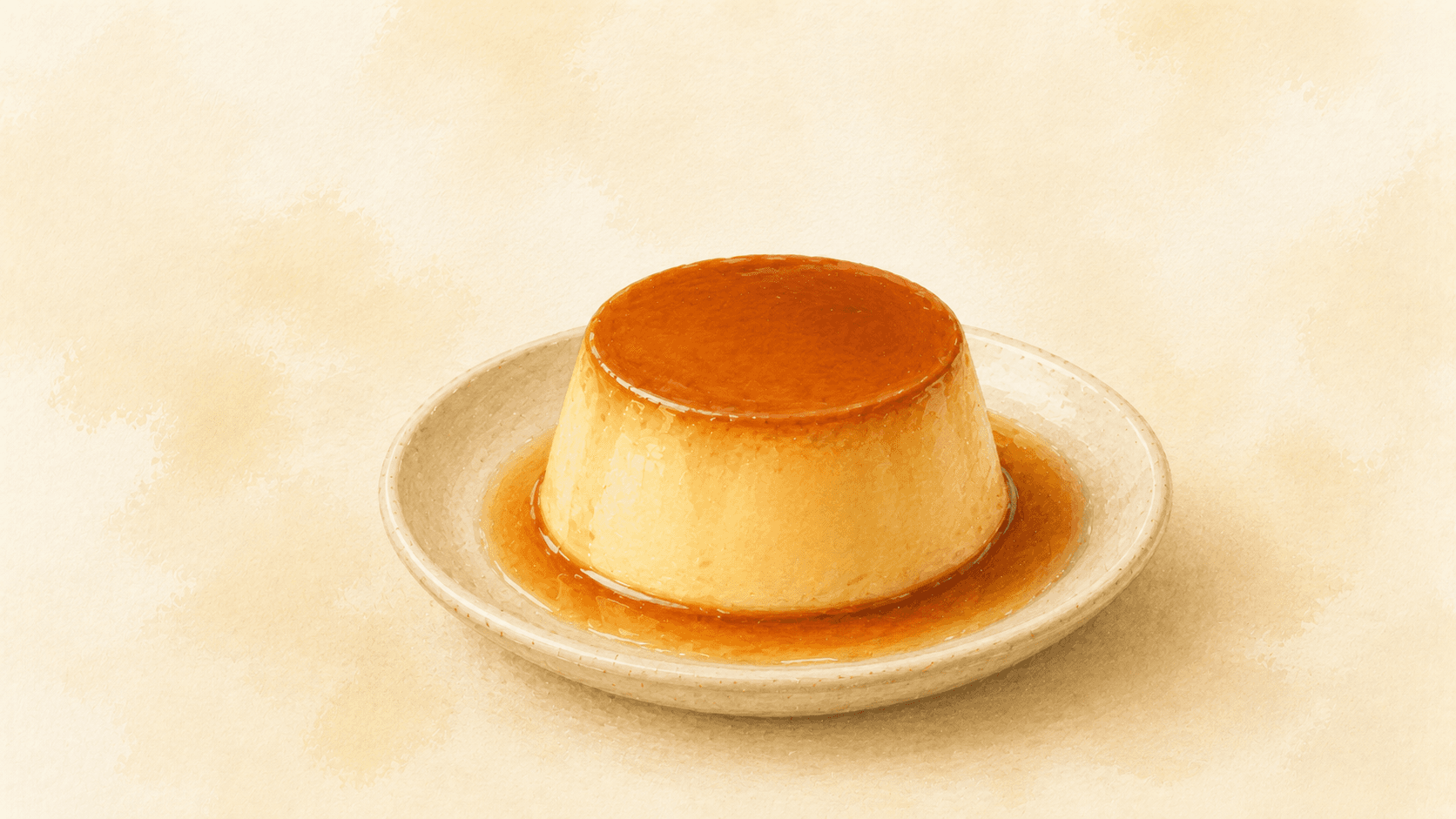
Dry caramel lines the mold; an egg custard bakes in a water bath. Custard set temperature is 75–82°C. The water bath is not a luxury — it insulates the eggs from the oven's direct 160°C heat.
Contents (8 sections)▾
Ingredients
- For the caramel:
- 150 g caster sugar
- 2 tbsp water (30 ml)
- For the custard:
- 500 ml whole milk
- 100 ml heavy cream (35% fat)
- 4 large eggs
- 2 large egg yolks
- 100 g caster sugar
- 1 vanilla bean, split and scraped (or 1 tsp vanilla extract)
- 1 small pinch fine sea salt
Steps
Make the caramel: Combine the 150 g sugar and water in a small heavy saucepan. Cook over medium-high heat without stirring. The mixture will bubble vigorously, then calm. Watch carefully from this point — the edges will begin to color first. Gently swirl the pan (do not stir) to equalize the color. When the caramel reaches a deep amber color (like dark honey — about 175–180°C), remove from heat immediately. Carefully pour about 2–3 tbsp of caramel into the bottom of each ramekin and swirl to coat the base evenly. Work quickly — the caramel sets fast. Set ramekins aside.
Preheat the oven to 160°C (325°F). Place the ramekins in a deep roasting pan. Heat the milk, cream, and vanilla bean (seeds and pod) in a small saucepan until just steaming — do not boil. Remove the vanilla pod.
In a large bowl, whisk together the whole eggs, yolks, sugar, and salt until the sugar is dissolved and the mixture is uniform — about 30 seconds. Avoid creating foam; this is a blend, not a whip.
Temper the eggs: pour the hot milk mixture into the egg mixture in a steady, slow stream while whisking constantly. This gradually raises the egg temperature without scrambling them. Strain through a fine-mesh sieve into a pouring jug to remove any foam or partially cooked egg strands.
Pour the custard into the prepared ramekins. Fill the roasting pan with boiling water to come halfway up the sides of the ramekins. The water bath holds the temperature around the ramekins at 100°C, preventing the custard from overheating. Carefully transfer to the oven and bake for 35–45 minutes, until the edges are set but the center still has a gentle wobble when the pan is nudged. Remove from the water bath and cool to room temperature, then refrigerate at least 3 hours or overnight.
To unmold: run a thin knife around the edge of the ramekin. Place a serving plate face-down on top, then invert together in one firm motion. Lift the ramekin slowly — the caramel should flow down around the sides of the custard. Serve cold.
Tools you'll want
- · Sauce strainer (chinois, perforated, or fine-mesh, 19–25cm)
- · Instant-read digital thermometer
- · Balloon whisk (24cm / 11-inch)
Why this works
Crème caramel is a study in two distinct chemistry processes: dry caramel formation and egg-protein coagulation. Each follows its own rules, and the recipe is structured around managing both.
The caramel is made by the thermal decomposition of sucrose. At around 160°C, sucrose molecules begin to break apart and recombine into hundreds of new compounds — the characteristic flavor of caramel, with its bittersweet, complex notes. This is the same chemistry as caramelized onion, but at a much faster pace because the caramel is a concentrated liquid with nothing to slow the reaction. The window between amber (correct) and burnt (ruined) is narrow, which is why watchfulness is the primary skill. The dark color is not browning in the Maillard sense — it is purely thermal decomposition of sugar.
The custard is set by egg-protein coagulation. Egg proteins, which are coiled and soluble in water at room temperature, begin to unfold (denature) when heated. As they unfold, they form bonds with neighboring proteins, creating a network that traps water molecules and sets the liquid into a soft solid. The temperature range for this in a whole-egg custard is roughly 75–82°C. Below 75°C, the proteins have not fully networked and the custard will be liquid or very loose. Above 85°C, the proteins contract violently — syneresis — squeezing water out of the network, and the custard becomes grainy and weeping.
The water bath keeps the environment around the ramekins at a maximum of 100°C (water's boiling point), not the oven's 160°C. Without the bath, the outer layers of custard would reach 160°C while the center is still cold — you would have a rubbery exterior and a raw center. The bath is not optional; it is the mechanism.
Tempering the eggs — adding hot milk slowly to cold yolks — raises the yolk temperature gradually, preventing the rapid local temperature spike that would scramble the eggs on contact with hot milk.
Common mistakes
Letting the caramel burn.
Target: Deep amber color (like dark honey), pulled from heat 5–10 seconds before "perfect" — residual heat carries it the rest of the way.
Why it matters: The window between deep amber and burnt is under 30 seconds at full heat. Burnt caramel is bitter and cannot be hidden in the finished dish — bitterness migrates into the custard. There's no rescue.
What to do: Watch the pan, don't walk away. The color changes faster than you expect at the end. Have a wet towel ready to set the pan on to stop the cook.
Workarounds:
- For more control, switch to wet caramel (sugar + 2 tbsp water): slower color change, wider window. Trade-off: slightly less intense flavor.
- If you're nervous, pull at "medium amber" — the result will be sweeter and milder. Still good, just a different style.
Foaming the custard.
Target: Whisk gently in slow, deliberate strokes. Strain through a fine sieve before pouring.
Why it matters: Vigorous whisking incorporates air bubbles. These bubbles bake into the custard as small craters on the surface and small holes throughout — destroying the silken, dense texture that defines a great crème caramel.
What to do: Use a fork or wire whisk gently. After mixing, rest the mixture 5 minutes for bubbles to surface, then strain.
Workarounds:
- If the mixture is still foamy, skim the surface with a paper towel just before pouring.
- For maximum smoothness, use an immersion blender at the lowest speed for 5 seconds only — distributes ingredients without aeration.
Skipping the water bath (bain-marie).
Target: Surround the ramekins with hot water reaching halfway up their sides. Oven at 150–160 °C.
Why it matters: The water bath insulates the custard from direct oven heat, ensuring the eggs cook gently and evenly. Without it, the bottom and edges set into rubber while the center is still raw — there is no oven temperature that makes this work.
What to do: Place ramekins in a deep roasting pan, pour boiling water around them after they're in the oven (safer than carrying a tray of water).
Workarounds:
- For a steam version, cover the roasting pan with foil to trap moisture — gives an even silkier result.
- An Instant Pot on "egg" setting at low pressure also works — produces nearly identical results in less time.
Overbaking.
Target: Edges set, center has a 2–3 cm zone of gentle wobble when you nudge the ramekin. Internal temperature 75–80 °C.
Why it matters: Custard continues to set as it cools — pulling at "perfect" produces "overcooked." Overbaked crème caramel weeps water (syneresis) around the edges and has a curdled texture.
What to do: Start checking at 30 minutes. Nudge the ramekin — the center should wobble like Jell-O.
Workarounds:
- A digital thermometer probe inserted into the center is the most reliable method. Pull at 75 °C.
- If overbaked, the dish is still edible — just less silky. No salvage for syneresis, unfortunately.
Unmolding too soon.
Target: Refrigerate 3+ hours, ideally overnight. Custard must be cold throughout.
Why it matters: Warm custard hasn't fully gelled — unmolding produces collapse, not the dramatic dome that defines crème caramel.
What to do: Make the day before. Run a thin knife around the edge, place a plate over the ramekin, invert in one quick motion.
Workarounds:
- If pressed for time, freeze for 30 minutes before unmolding — faster firming.
- For service, you can re-warm the unmolded custard gently in a 80 °C water bath for 5 minutes if you prefer it slightly warm (matches the caramel sauce temperature).
Using cold ramekins for the caramel.
Target: Pour the hot caramel into cold, dry ramekins, swirling to coat the bottom evenly.
Why it matters: The caramel needs to set into a thin layer on the ramekin bottom. Wet or warm ramekins prevent proper setting and cause the caramel to crystallize.
What to do: Have ramekins ready and dry. Pour quickly while the caramel is still fluid; swirl to coat.
Workarounds:
- If the caramel hardens before pouring, warm it gently with a splash of water and a low flame.
- For an even thicker caramel coating, return ramekins to the freezer for 2 minutes after pouring to set the layer quickly.
What to look for
- Caramel color: deep amber, like dark honey — not pale gold (undercooked) and not black (burnt). Smell it: a slight bitter edge is correct; acrid means burnt.
- Custard pre-bake: smooth, uniform, no visible foam. Run a spoon gently across the top to break any surface foam before going in the oven.
- At 35 minutes: edges fully set, center wobbles as a single mass (not sloshing). This is the target. If it sloshes still, continue in 5-minute increments.
- After refrigeration: fully firm, surface smooth, edges pulled slightly from the ramekin wall.
Chef's view
Crème caramel is among the oldest preparations in European custard history. The Roman patina — a baked mixture of eggs, fish sauce, and honey — is recognizably an ancestor of the custard form. The medieval European crustade was an egg-and-milk tart baked with a thin pastry. By the 18th century, the caramel-lined custard mold we now recognize had been codified in French pâtisserie, and Carême gave it the structure that remains today.
The word flan causes confusion because it refers to different things in different languages. In French, flan is an open-faced pastry custard tart; what the rest of the world calls flan (the caramel-custard that unmolds) is crème renversée or crème caramel in French. In Spanish and Latin American cooking, flan is precisely the unmolded caramel custard. The same preparation travels under three names.
Chef Test Notes
Tested baking temperatures at 150°C, 160°C, and 170°C with water bath. At 150°C, the custard took 55–60 minutes but the texture was the silkiest and showed no syneresis. At 160°C, 40–45 minutes with excellent texture. At 170°C, the edges set significantly before the center and small bubbles appeared in the custard — a sign of local over-coagulation. The 160°C / 40–45 minute combination is the practical optimum; 150°C works for those who have the time.
A note on history
The caramel-lined custard mold has traceable ancestry going back to Roman patina dishes — baked egg preparations sweetened with honey and sometimes flavored with pepper or garum. Medieval Arab cooking developed sweetened milk custards; the Kitab al-Tabikh (10th century Baghdad) contains milk-and-egg preparations similar in structure to modern flans. The specific combination of dry caramel as lining plus baked custard as content was codified in 18th-century French pâtisserie, and the technique spread globally through colonial and restaurant culture. The Japanese purin (プリン) descends directly from the French crème caramel via the Meiji-era introduction of Western pastry techniques.
Related glossary terms
- Caramelization — the thermal decomposition of sugar at the core of the caramel layer
- Coagulation — the egg-protein network formation that sets the custard
- Bain-marie — the water bath that insulates the custard from direct oven heat
- Tempering — the gradual temperature equalization of yolks before the hot milk is combined
- Syneresis — the water expulsion from over-coagulated protein networks that overbaking produces
Get the essays in your inbox — free
Weekly notes on flavor, fermentation, and food history — the writing behind the Atlas of Flavor. No spam; unsubscribe anytime.