
Churros
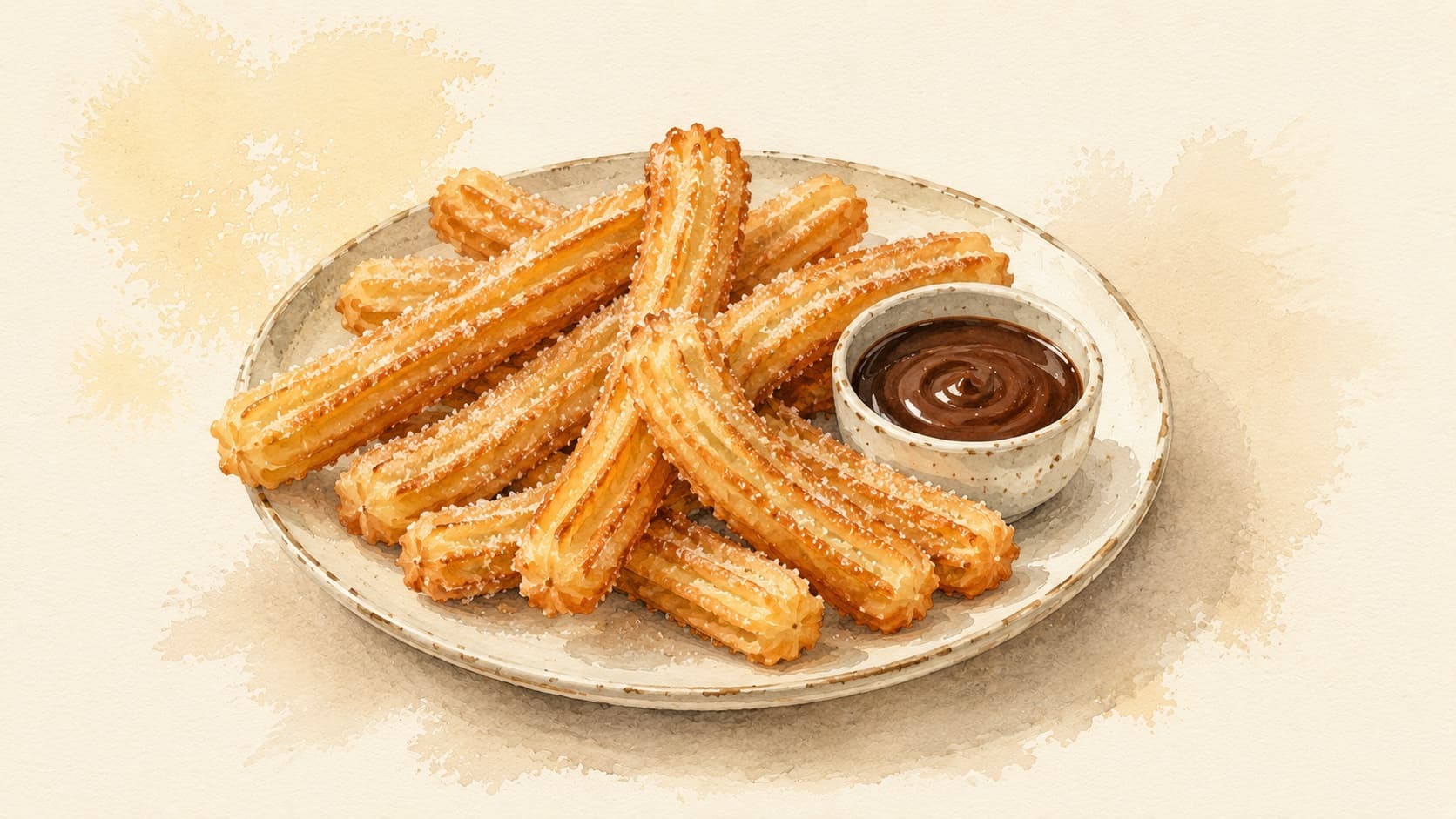
Churros consist of a dough fried to a crisp exterior, yielding a soft interior, often dusted with sugar.
Contents (5 sections)▾
Ingredients
- 1 cup water
- 2 tablespoons sugar
- 1/2 teaspoon salt
- 1 cup all-purpose flour
- 2 large eggs
- 1 teaspoon vanilla extract
- 1/4 teaspoon ground cinnamon
- Vegetable oil for frying
Steps
In a saucepan, combine water, sugar, and salt. Bring to a boil.
Remove from heat, stir in flour until the mixture forms a ball.
Let cool slightly, then mix in eggs and vanilla until smooth.
Heat oil in a skillet to 350°F (175°C). Pipe dough into hot oil.
Fry until golden brown, about 2-3 minutes per side.
Drain on paper towels, then coat with cinnamon sugar.
Tools you'll want
Why this works
Churros rely on a choux pastry method (a simple cooked dough of water, flour, and eggs that puffs with steam), which allows steam to create a light and airy texture. The water in the dough turns to steam during frying, expanding and forming hollow centers. The oil temperature is crucial; too low results in greasy churros, while too high can burn them. A consistent 350°F (175°C) ensures a crispy exterior without compromising the interior.
The flour-to-water ratio is vital. Too much flour creates a dense product, while too little results in a fragile structure. Eggs add richness and moisture, binding the dough while providing elasticity. The addition of vanilla and cinnamon enhances flavor, making churros not just a treat but an experience.
The star-shaped tip is not decoration — it is a physical safety requirement. A perfectly round dough cross-section traps steam and air pockets at the core during frying; the trapped vapor expands under heat and can rupture the churro explosively in hot oil, spitting at the cook. The longitudinal ridges from a star tip provide channels for steam to escape along the surface as the dough cooks. The same ridges also increase surface area, multiplying the crisp-outer-shell footprint and giving the cinnamon sugar more to grip. Star is engineering, not aesthetics.
Common mistakes
Wrong oil temperature.
Target: 175°C maintained throughout — too cool = greasy, too hot = burned exterior + raw center.
Why it matters: Churros are a precision-temperature item. 165°C absorbs oil and becomes soggy; 195°C+ burns before the interior cooks through. The 175°C window is narrow.
What to do: Deep-fry thermometer. Adjust heat between batches.
Workarounds:
- No thermometer → wooden chopstick test: steady stream of small bubbles.
Round (non-star) piping tip.
Target: Star tip mandatory — provides surface ridges for steam escape.
Why it matters: Round cross-section traps steam and air inside the dough — at frying temperature, this can rupture explosively. Star ridges = safety + better crisp + more surface for cinnamon sugar.
What to do: Large star tip (open star pattern). The grooves are non-negotiable for safety.
Workarounds:
- No star tip → pipe thinner churros (1.5 cm); reduces but doesn't eliminate explosion risk.
Adding eggs to too-hot dough.
Target: Cool the cooked paste until just barely warm to touch (~60°C) before adding eggs.
Why it matters: Hot paste scrambles eggs on contact — you get cooked egg bits in the batter, ruining texture. Cooling lets eggs incorporate smoothly.
What to do: 5 minutes cooling after cooking the paste. Then add eggs one at a time.
Workarounds:
- Spread paste in a thin layer on a tray for faster cooling.
Inconsistent churro lengths.
Target: Uniform 10-12 cm pieces, piped to same diameter.
Why it matters: Uneven sizes = different cooking times in same oil batch. Some burn, others raw.
What to do: Pipe in long strips onto parchment, cut with scissors to uniform length before adding to oil.
Workarounds:
- Piping directly into oil → use kitchen scissors to cut as you pipe; takes practice.
Coating cold churros with sugar.
Target: Roll in cinnamon sugar while still hot — within 30 seconds of frying.
Why it matters: Hot oil-coated surface holds sugar; cooled and dried surface doesn't. Late coating = sugar slides off.
What to do: Sugar mix ready in bowl before frying. Drain on rack briefly, roll in sugar while hot.
Workarounds:
- Want extra coating → toss in sugar twice, with brief pause between to set first layer.
Frying too many at once.
Target: 3-4 churros per batch in a 25cm pan with 7-8cm oil depth.
Why it matters: Crowded oil drops temperature, churros stick together and absorb oil.
What to do: Batches. Wait for oil to return to 175°C between.
Workarounds:
- Larger pot of oil → maintains temperature better; allows more per batch.
What to look for
- Golden-brown color indicates proper frying.
- Crisp texture when bitten into.
- Hollow interior when broken apart.
- A light, airy feel indicates well-prepared dough.
- Sweet aroma with a hint of cinnamon.
Chef's view
Churros have deep roots in Mexican and Spanish cultures, often enjoyed at fairs and street markets. Their simplicity allows for endless variations, from classic cinnamon sugar to chocolate-dipped versions. Mastering churros requires practice, particularly in piping technique, which influences their final shape and texture.
In Mexico, churros are more than a snack; they are a cultural symbol, often served alongside hot chocolate for dipping. This tradition highlights the communal aspect of food, making churros a treat across generations.
<!-- beginner-glossed v1 -->Get the essays in your inbox — free
Weekly notes on flavor, fermentation, and food history — the writing behind the Atlas of Flavor. No spam; unsubscribe anytime.