
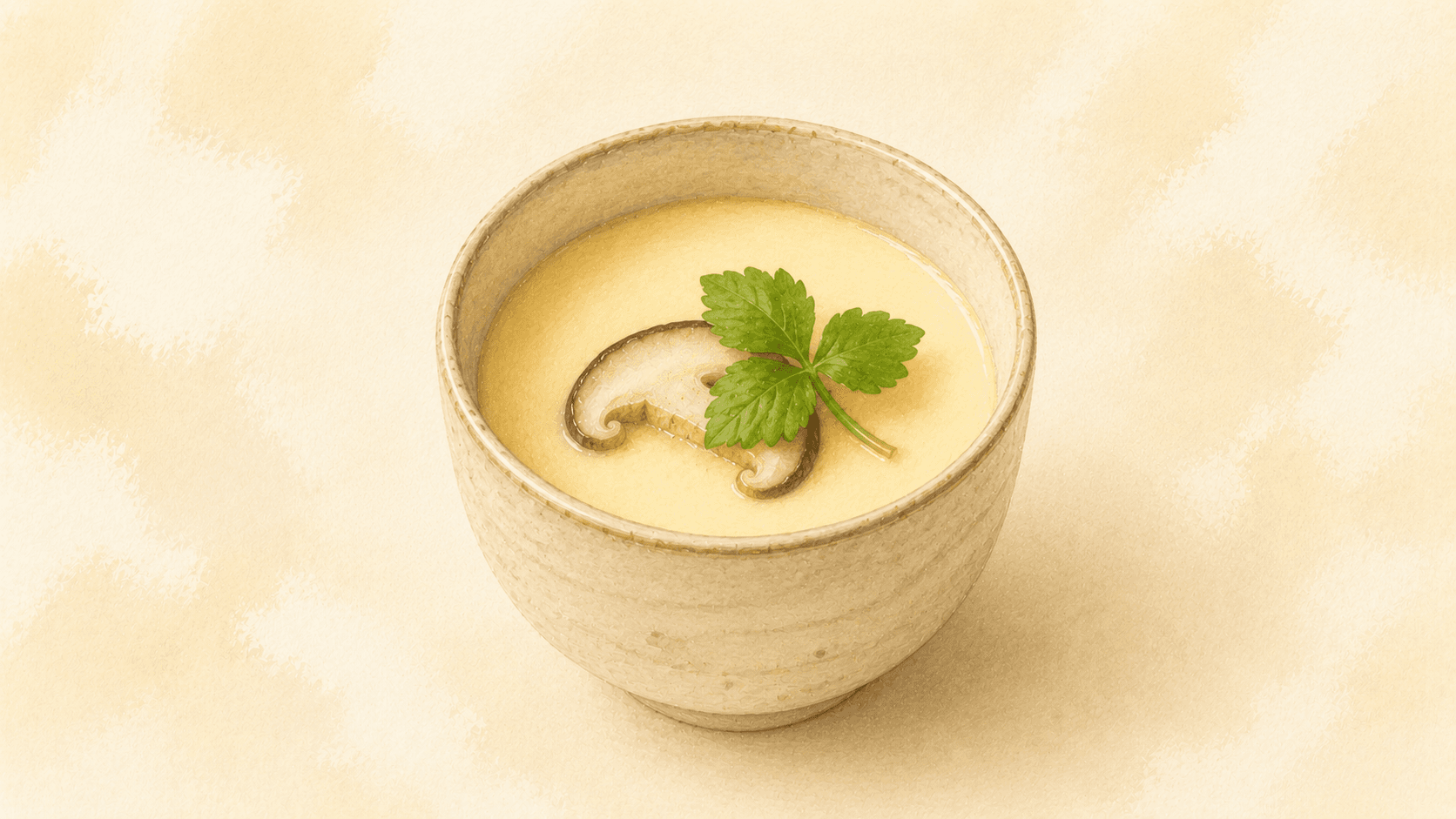
Chawanmushi
Dashi and egg in a 3:1 ratio by weight, steamed at 80–85°C until just set: the science is identical to quiche custard but the method is steaming rather than baking, and the ratio of liquid to egg is what produces the impossibly delicate, barely-there texture.
Contents (7 sections)▾
Ingredients
- 3 large eggs (about 180 g cracked weight)
- 540 ml dashi (ichiban-dashi, cooled to room temperature) — the 3:1 dashi:egg ratio by weight
- 1 tbsp soy sauce (usukuchi/light soy preferred)
- 1 tbsp mirin (heated briefly to burn off alcohol)
- 1/2 tsp fine sea salt
- Toppings (per cup): 2 pieces raw shrimp (tails removed), 2 pieces kamaboko, 1 ginkgo nut, 1 mitsuba sprig
Steps
Crack eggs into a bowl and beat gently with chopsticks until the white and yolk are fully combined — do not whip, just break and stir. Strain the beaten eggs through a fine-mesh strainer; this removes the chalazae and any undissolved protein, producing a cleaner, smoother custard.
Add the cooled dashi gradually to the strained eggs, stirring gently. Add soy sauce, mirin, and salt. Stir to combine, then strain the entire mixture through the fine-mesh strainer again into a pouring jug. The second strain removes any undissolved egg particles. Skim off any foam from the surface — foam produces holes in the finished custard.
Divide the toppings between the four cups: arrange shrimp, kamaboko, and ginkgo nut in each. Pour the egg-dashi mixture over the toppings gently, filling each cup to about 80% full. Cover each cup with its lid, or seal tightly with plastic wrap.
Set up a steamer with water already at a boil. Reduce heat to low-medium — the steam should be gentle, not fierce. Place the cups in the steamer. Critical: maintain the steam temperature at 80–85°C; a fierce boil produces bubbles in the finished custard (called 'su' in Japanese — an undesirable pockmarked texture). If using a bamboo steamer, place a folded tea towel under the lid to catch condensation drops. Steam for 12–15 minutes for a 150 ml cup.
Test for doneness: insert a thin skewer or cake tester into the centre. It should come out clean, and the surface should barely jiggle when the cup is moved. The internal temperature at centre should read 75–78°C. If not set, replace the lid and steam 2–3 minutes more. Serve immediately in the steaming cups, or cool to room temperature for a summer version.
Tools you'll want
- · Sauce strainer (chinois, perforated, or fine-mesh, 19–25cm)
- · Instant-read digital thermometer
Why this works
Chawanmushi is the most delicate egg preparation in Japanese cuisine, and its delicacy is built into the ratio. At 3 parts dashi (Japanese savory stock, usually from kelp and dried fish) to 1 part egg by weight, the custard (a soft set of egg and liquid cooked gently) contains far more liquid than egg: approximately 75% of the total weight is dashi. In a French baked custard like quiche, the ratio runs closer to 1:1 (liquid to egg); in crème caramel, approximately 2:1. The chawanmushi ratio produces a barely-set texture that quivers on the spoon — so soft it barely holds its own weight, so uniform it could pass for smooth tofu.
The protein chemistry is identical to any other egg custard. Egg proteins (ovalbumin, ovomucin, lipovitellin) denature and crosslink between 62–82°C, forming a continuous gel network. The difference from a quiche is that the dilution ratio is so high that the protein network is correspondingly sparse — fewer protein molecules per unit volume means a more open, more delicate gel structure. The gel barely sets before it would liquefy again.
The steaming method matters for a different reason than most people realize. Steaming produces a gentler, more controllable heat environment than baking: the steam temperature at atmospheric pressure is fixed at 100°C, but by modulating the steam intensity (flame height under the pot), you can hold the food at a temperature significantly below the steam temperature because the heat transfer rate is controlled by the steam density. At low-medium heat, the food surface never exceeds 80–85°C regardless of the boiling water temperature. This is not possible in a dry oven, where radiant and convective heat can drive the food surface to the oven's full temperature.
The Japanese term for ruined chawanmushi is su ga haitta — literally "air has entered," referring to the pockmarked, porous texture that results from over-temperature steaming. When the water in the custard boils locally (above 100°C at the interior, or driven by fierce steam), steam bubbles form and escape, leaving behind a honeycomb of holes. This is the signature failure mode of chawanmushi and the reason the recipe specifies gentle steam. Su renders the texture grainy and the appearance unpleasant, but the flavour is often unaffected — so it is an aesthetic failure rather than a safety one.
Common mistakes
Vigorous whisking of the eggs.
Target: Mix gently with chopsticks or a fork — slow, deliberate strokes. NEVER use a wire whisk.
Why it matters: Air bubbles incorporated by whisking expand during steaming, creating pinhole-sized cavities (called su, す) throughout the custard. This destroys the silken texture that defines chawanmushi.
What to do: Hold the chopsticks at a slight angle and drag through the egg in long strokes. Lift, drag — minimum bubble incorporation.
Workarounds:
- If bubbles formed anyway, let the mixture rest 10 minutes for bubbles to rise, then skim with a paper towel before straining.
Not straining twice.
Target: Strain the beaten egg through a fine sieve once, then strain the combined egg-dashi mixture again.
Why it matters: Chalazae (the white fibrous cords anchoring the yolk) and any incidental bits of shell don't dissolve in the custard — they appear as white threads or specks in the finished product. Double straining catches everything.
What to do: Pour through the finest mesh sieve you have. If you see solid bits in the sieve, you needed this step.
Workarounds:
- No fine sieve? Coffee filter in a regular sieve produces the cleanest results.
Too much steam heat.
Target: Low-medium steam after the initial boil. Water at a gentle simmer below the cups, not a rolling boil.
Why it matters: This is the SINGLE most common failure. Fierce steam (full boil) overheats the custard rapidly, producing the dreaded su texture (full of cavities). Eggs set best around 85 °C — sustained higher heat ruins the texture.
What to do: Bring water to a boil → place cups in steamer → reduce heat to low-medium → cover. Maintain a quiet, steady steam.
Workarounds:
- No way to control steamer heat precisely? Crack the steamer lid slightly to let some steam escape — lowers effective temperature.
- Oven steam method: bake at 150 °C in a water bath, covered with foil — most stable temperature control.
Not covering the cups.
Target: Each cup covered with its own lid OR plastic wrap.
Why it matters: Condensation drips from the steamer lid land on the custard surface as it cooks, creating pits and water marks on the otherwise smooth top. The cover prevents this.
What to do: Authentic chawanmushi cups come with matching lids. Lacking that, stretch plastic wrap over each cup.
Workarounds:
- For pretty presentation, lay a kitchen towel between the cup lid and the steamer lid — catches condensation without disrupting steam.
Using hot dashi.
Target: Cool the dashi to room temperature before combining with the beaten egg.
Why it matters: Hot dashi starts cooking the eggs on contact, creating partially-set lumps. The mixture needs to enter the cups uniformly liquid.
What to do: Make dashi ahead, cool completely. Combine: dashi 4 parts + egg 1 part + light soy 1 tsp + mirin 1 tsp per cup.
Workarounds:
- Short on time? Cool dashi in an ice bath for 10 minutes.
Overfilling the cups.
Target: Fill to 80 % of cup volume.
Why it matters: The custard expands slightly during steaming. Filling to the top causes overflow and uneven cooking around the rim.
What to do: Leave a 1 cm gap at the top. Pour through the second-strain stage directly into the cups.
Workarounds:
- For overflowing portions, scoop excess back into a measuring cup — chawanmushi can be portion-controlled.
Skipping the resting step after steaming.
Target: Rest 2–3 minutes in the steamer after turning off the heat, lid still closed.
Why it matters: Removing immediately exposes the custard to a sudden temperature drop, which can cause it to weep (syneresis) and develop water pooling on top.
What to do: Turn off heat → wait 3 minutes → carefully remove cups.
Workarounds:
- For cold service, refrigerate the rested chawanmushi for 2 hours minimum — develops different but legitimate textural profile.
What to look for
- The raw mixture: pale golden, fluid, no foam on the surface, no visible streaks of white. Strained clean.
- Steaming at 10 minutes: the edges are beginning to set; the centre still moves freely. Normal at this stage.
- At 12–15 minutes: gentle wobble at centre when moved, surface smooth and barely glossy. A thin skewer comes out clean.
- Internal temperature: 75–78°C at the geometric centre of the cup. Most reliable check.
- Texture in the cup: quivers on the spoon, barely holds its shape. If it holds rigidly like hard tofu, it is overdone.
Chef's view
The ratio argument — 3:1 versus other proportions — has a strong basis in both tradition and science. Home Japanese recipe books often specify the ratio as volume rather than weight (e.g. 3 parts dashi to 1 part egg by volume), which produces a slightly different result because the density of beaten egg is less than dashi. The weight-based 3:1 ratio in this recipe is more precise and produces the more delicate result. I find the weight method more reliable.
Toppings in chawanmushi are part of its charm and represent what is seasonally available in the Japanese kitchen: ginnan (ginkgo nuts) in autumn, shrimp throughout the year, mitsuba (Japanese parsley), kamaboko (fish cake), chicken, or shiitake mushroom. What the toppings share is that they are all already cooked or safe to eat at the temperature the custard reaches — because the internal temperature, 75–78°C, is sufficient for food safety but not high enough to cook raw proteins properly. If using chicken, ensure it is pre-cooked or cut small enough that it reaches safe temperature.
The summer version — served at room temperature or chilled — is eaten as a cold dish and requires more careful salinity calibration: cold dulls salt perception, so the cold chawanmushi should be seasoned slightly more assertively than a hot version.
Chef Test Notes
I tested the ratio at 2.5:1, 3:1, and 3.5:1 (dashi:egg by weight). The 2.5:1 version was noticeably firmer — closer to a quiche texture, which many people find more acceptable but which lacks the characteristic chawanmushi fragility. The 3.5:1 version barely set and collapsed on the spoon — interesting, but impractical. The 3:1 version is the correct balance for the traditional texture: set but trembling. The double-straining step was the single most impactful detail — unchained versions with unstrained eggs had visible white threads throughout.
Related glossary terms
- Dashi — the umami base that provides approximately 75% of the custard's liquid weight
- Coagulation — the protein science that determines the custard's set temperature and texture
- Steaming — the controlled heat-transfer method that makes gentle, even custard possible
Get the essays in your inbox — free
Weekly notes on flavor, fermentation, and food history — the writing behind the Atlas of Flavor. No spam; unsubscribe anytime.