
Agedashi Tofu
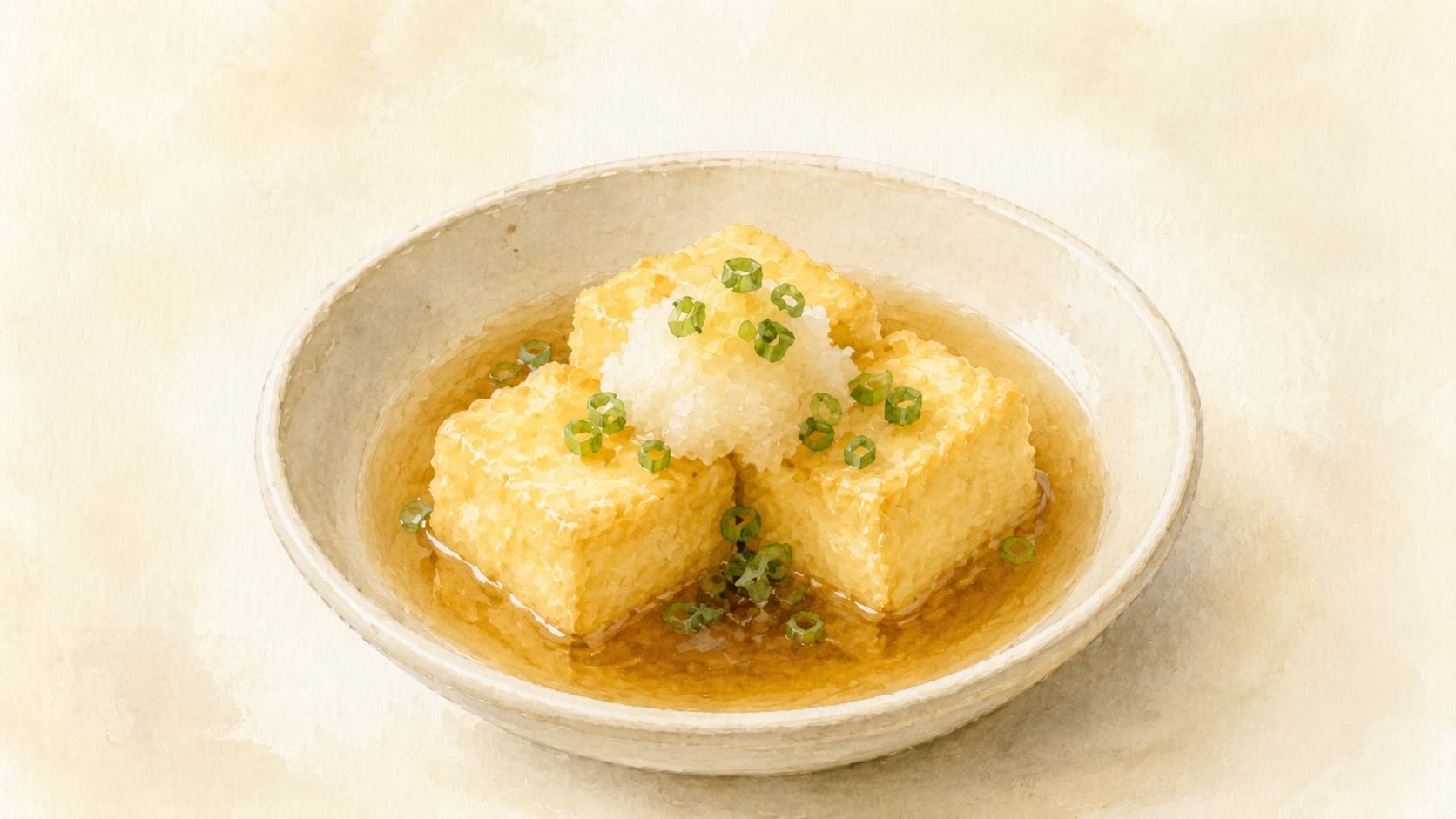
Silken tofu in a light starch crust, served in warm dashi broth — tofu moisture management and the starch-broth interaction are the two technical points.
Contents (7 sections)▾
Ingredients
- 1 block silken tofu (300–350 g), extra-firm silken preferred
- Potato starch (katakuriko), enough to coat — about 3–4 tablespoons (30 g)
- Neutral oil for frying, at least 5 cm deep
- —
- For the dashi broth (ankake):
- 200 ml dashi (ichiban-dashi or standard kombu-katsuobushi dashi)
- 40 ml soy sauce (light soy sauce / usukuchi for a cleaner color)
- 40 ml mirin
- 1 teaspoon (5 g) potato starch dissolved in 1 tablespoon cold water
- —
- Toppings:
- 30 g daikon, finely grated (save the moisture)
- 2 stalks green onion (negi), thinly sliced
- 1 g katsuobushi (dried bonito flakes, optional)
- 5 g fresh ginger, grated (optional)
Steps
Drain the tofu thoroughly. Cut the block into 6 even cubes (or 4, if large). Line a tray or cutting board with paper towels, place the tofu on top, and cover with more paper towels. Place a light weight (a plate) on top and let sit for at least 15 minutes. Silken tofu contains an enormous amount of water; any free surface moisture will cause violent oil splatter and prevent the starch from adhering. This step is not optional.
Make the dashi broth. Combine dashi, soy sauce, and mirin in a small saucepan. Bring to a simmer over medium heat. Taste — it should be savory, slightly sweet, and clean. Stir in the dissolved potato starch and cook for 30 seconds, stirring constantly, until the broth thickens to a light veil that clings lightly to a spoon (ankake consistency). Keep warm.
Coat the tofu. Working gently to avoid breaking the fragile blocks, dust each cube thoroughly with potato starch. Shake off the excess — a thick, uneven coat will produce gummy patches. A thin, even coat is the goal: enough to form a crust, not so much that the exterior becomes pasty.
Fry the tofu. Heat oil to 170–175°C. Lower the starch-coated tofu cubes in carefully — they will spit if surface moisture remains, which is why the drainage step matters. Fry for 3–4 minutes, turning gently once, until the exterior is light golden and just set. Do not overcrowd the pot; oil temperature drops with each piece added. Remove and drain briefly on paper towels.
Assemble and serve immediately. Place the fried tofu in warm serving bowls. Pour the hot dashi broth over and around — the contrast of crisp exterior and hot broth is the defining texture experience of agedashi. Add grated daikon (and its juice), sliced green onion, and any optional toppings. Serve within 2 minutes; the crust softens quickly in the broth.
Tools you'll want
- · Fine-mesh dashi strainer
Why this works
Agedashi tofu is built on two technical decisions: how to manage the water in silken tofu before frying, and how to make a starch coating that becomes a crust in oil but then softens gracefully in broth. Neither is obvious, and together they explain why this dish is technically more demanding than it appears.
Silken tofu is roughly 85–90% water by weight. That water is a problem for frying: surface moisture causes violent steam expansion when it contacts hot oil, creating splatter, and also prevents the potato starch from adhering. The drainage step — paper towels, gentle weight, fifteen minutes — removes surface moisture without compressing the fragile interior. What you want is a block that is surface-dry but still tremblingly soft inside.
Potato starch (katakuriko) is the preferred coating rather than wheat flour or cornstarch. Potato starch gelatinizes (its starch swells with heat and moisture and sets into a coating) at a slightly lower temperature than cornstarch and forms a crisper, more transparent crust at frying temperature. In boiling water or hot broth, that same crust gradually re-hydrates and becomes soft — not mushy, not dissolved, but silky. This transition from crisp (in oil) to silky (in broth) is the defining quality of a good agedashi. Cornstarch works but produces a slightly starchier, more resistant texture. Flour produces a heavy crust that becomes gummy in broth.
The dashi broth (dashi is the clear Japanese stock, usually made from kelp and dried bonito, that gives the dish its savory backbone) is finished as an ankake — a lightly thickened sauce using dissolved potato starch. The slight thickness (thin veil, not gravy) keeps the hot broth clinging to the tofu cubes rather than running off them, prolonging the transition period between crisp and soft. The seasoning ratio of dashi:soy sauce:mirin at roughly 5:1:1 is the classic Japanese proportion for a clean, savory, slightly sweet liquid — the same framework as mentsuyu (a ready-made Japanese noodle-soup base of dashi, soy sauce, and mirin), just diluted further.
The temperature of the oil matters for a different reason in agedashi than in most frying. At 160°C, the crust takes too long to set and the tofu absorbs oil. At 185°C, the exterior sets too hard before the interior is warm. 170–175°C is the window where the crust forms quickly and the interior warms to serving temperature without hardening.
Common mistakes
Skipping or rushing the drainage.
Target: Drain tofu with a gentle weight (a small plate works) for 15 minutes minimum, 30 minutes for best results.
Why it matters: This is THE single most common failure. Inadequately drained tofu carries surface water that causes oil splatter, prevents starch from adhering, and produces soggy, oily agedashi.
What to do: Place tofu on a plate lined with paper towels, top with another plate, weight gently. Wait. Pat surface dry just before flouring.
Workarounds:
- Fast version: microwave drained tofu for 90 seconds on a paper-towel-lined plate — accelerates water release.
- For ultra-dry tofu, press for 1 hour with more weight.
Too much potato starch.
Target: Light, even dust — coat barely visible. Shake aggressively after dredging (rolling each piece in the starch to coat it).
Why it matters: Excess starch produces thick gummy patches that collapse into the broth. The signature of good agedashi is the thin, glassy starch coat that crisps in oil and softens just at the surface when the broth hits.
What to do: Dust each cube, then shake hard in a sieve to remove all excess. Some bare spots are OK.
Workarounds:
- For variety, use cornstarch (slightly crisper) or a 50/50 mix of potato + cornstarch.
Oil too cold.
Target: 175 °C, measured with a thermometer.
Why it matters: Below 165 °C, starch hydrates in oil rather than crisping — the tofu absorbs oil, the crust stays soft, and the result tastes greasy. Above 190 °C, starch burns before the tofu warms through.
What to do: Use a thermometer. Drop a pinch of starch — it should sink, then immediately rise to the surface with rapid bubbles.
Workarounds:
- No thermometer? Test with a chopstick — small steady bubbles around it means ready.
Letting fried tofu sit before plating.
Target: Assemble and pour broth within 2 minutes of pulling tofu from oil.
Why it matters: The crust starts losing crispness immediately after frying as moisture from inside migrates outward. Sitting on a wire rack for 5+ minutes ruins the texture you just created.
What to do: Have the broth simmering, garnishes ready. Fry → drain briefly → plate → pour broth → serve.
Workarounds:
- For dinner-party staging, fry to par-crisp (partly crisped, stopped before fully done) 30 seconds short, hold in a warm oven, finish-fry for 30 seconds at service time.
Over-thickening the broth.
Target: Ankake (the broth) consistency — a drop on the back of a spoon barely holds its shape.
Why it matters: Over-thickened broth becomes gloopy and coats the mouth unpleasantly. Agedashi's broth is supposed to be a delicate veil, not gravy.
What to do: Add cornstarch slurry (cornstarch stirred into a little cold water so it won't clump) in small additions, wait 30 seconds, assess. Stop the moment it lightly thickens.
Workarounds:
- Already too thick? Whisk in 1–2 tbsp dashi or hot water to thin.
Wrong tofu.
Target: Soft tofu (kinugoshi) — silky, almost custard-like inside.
Why it matters: The contrast between crisp exterior and silken interior is the entire point of agedashi. Firm tofu produces a "fried tofu cube" that misses the textural drama.
What to do: Buy soft/silken tofu. Handle gently during draining (very fragile).
Workarounds:
- For more structural reliability, use "soft momen" (firm-side of soft) — easier to handle while preserving the silken quality.
What to look for
- Drained tofu: surface looks dry, no water pooling beneath the block, tofu still holds its shape.
- Starch coat: even and light — tofu looks dusted, not crusted.
- Oil temperature: a pinch of starch dropped in sizzles immediately and rises to the surface.
- Frying: light golden color, not brown; crust is set when gently prodded with a chopstick.
- Dashi broth: barely thickened, coats the back of a spoon with a thin veil, clear amber color.
- Assembled: broth poured over, crust still holds for 1–2 minutes before softening.
Chef's view
The silkiness of agedashi is the goal — not the crunch, which is transient, but the moment just after the broth hits the crust and you get both textures at once. Eating it quickly is not a recommendation, it is the instruction. The dish changes its character every 30 seconds in the bowl.
Agedashi is also the recipe that most clearly exposes the function of dashi as a base. You can taste the dashi clearly because there is almost nothing covering it — no cream, no fat, no reduction. The seasoning is transparent. This makes it an excellent teaching moment for dashi quality: a mediocre dashi produces a flat, salty broth; a good ichiban-dashi (the first, most delicate batch of dashi drawn from fresh kelp and bonito) makes the same dish taste alive.
Chef Test Notes
I tested three coating starches side by side: potato starch (correct), cornstarch, and a 50/50 mix. The potato starch crust was the lightest and most transparent after frying, and transitioned most gracefully in broth. The cornstarch version was slightly thicker and held its crunch 30 seconds longer — which sounds positive but felt wrong in the context of the dish. The mix was intermediate. For agedashi specifically, potato starch (katakuriko) is not interchangeable.
Related glossary terms
- Dashi — the broth base whose quality drives the dish
- Katakuriko — the potato starch that creates the characteristic crust and silky transition
- Ankake — the lightly thickened sauce technique used for the broth
- Silken tofu — the tofu variety whose high water content is both the challenge and the texture goal
Get the essays in your inbox — free
Weekly notes on flavor, fermentation, and food history — the writing behind the Atlas of Flavor. No spam; unsubscribe anytime.